.svg)
.svg)
Ultraviolet (UV) "light" is a type of electromagnetic radiation. UV light has a shorter wavelength than visible light. Purple and violet light has shorter wavelengths than other colors of light, and ultraviolet light has even shorter waves than violet does, so ultraviolet light is sort of "purpler-than-purple" light or "beyond violet" light. With wavelengths ranging from 10 to 400 nanometers (nm), UV radiation is divided into three main categories based on wavelength: UVA (315–400 nm), UVB (280–320 nm), and UVC (100–280 nm). Each type has distinct properties and applications, with varying levels of interaction with the Earth's atmosphere.
UV radiation carries more energy than visible light and can initiate photochemical reactions. Shorter-wavelength UV, particularly UVC and part of UVB, has sufficient energy to damage DNA and break certain chemical bonds, making it useful in sterilization and other industrial applications. Meanwhile, UVA and UVB contribute to natural processes like vitamin D synthesis but also pose risks, such as skin damage and increased cancer susceptibility, due to prolonged exposure. For environmental professionals, understanding UV radiation is key to tackling environmental challenges. Monitoring UV levels helps assess its effects on ecosystems, human health, and mitigation efforts. This article explores UV radiation, its sources, impacts, protective measures, and the methods used to detect and measure it.
1. What is UV Radiation (UV)?
Ultraviolet (UV) radiation has wavelengths between 100 and 400 nm, making it higher in frequency and shorter in wavelength than visible light. It naturally comes from the sun but can also be produced by artificial sources used in industries, businesses, and recreational activities.
UV radiation ranges from 100 to 400 nm and is divided into three types:
- UVA: Ultraviolet A Rays (315-400 nm)
- UVB: Ultraviolet B Rays (280-315 nm)
- UVC: Ultraviolet C Rays (100-280 nm)
As sunlight passes through the atmosphere, UVC and most UVB radiation (about 90%) are absorbed by ozone, water vapor, oxygen, and carbon dioxide. UVA, however, is less affected and makes up most of the UV radiation that reaches the Earth’s surface, with a small amount of UVB.
The amount of UV radiation hitting the Earth depends on factors like the sun’s position, latitude, cloud cover, altitude, ozone layer thickness, and ground reflection. Depletion of the stratospheric ozone layer primarily increases the amount of UVB reaching Earth's surface, while UVA transmission is only minimally affected. This increase can harm humans, animals, plants, and marine life. In humans, it can lead to skin cancer, cataracts, and weakened immune systems.
UV Radiation in Atmosphere
The Earth’s atmosphere acts as a natural shield, blocking most UV radiation from reaching the surface and keeping it from reaching the ground. UVC is almost completely absorbed by molecular oxygen and ozone in the upper atmosphere before reaching Earth's surface. UVA reaches the Earth's surface and primarily causes indirect DNA damage through oxidative stress, contributing to skin aging and skin cancer. UV-B, however, is the main cause of sunburn and skin cancer, but most of it is also absorbed by ozone before reaching us. The amount of UV-B at the surface depends heavily on how much ozone is in the atmosphere.
The amount of UV radiation that reaches the Earth depends on factors like the thickness of the ozone layer, altitude, and cloud cover. Human activities that damage the ozone layer, like pollution, allow more UV-B to reach the surface, increasing health risks for humans, animals, and plants.
2. Sources
Ultraviolet (UV) radiation is a type of non-ionizing radiation present in the environment, coming from both natural and man-made sources. While it helps in processes like Vitamin D production, excessive exposure can pose health risks.
Natural source: The primary natural source of UV radiation is the sun. It emits all types of UV rays (UVA, UVB, and UVC), but the Earth’s atmosphere filters out most harmful UVC and a portion of UVB, leaving mainly UVA to reach the surface.
Man-made sources in ambient air:
Artificial sources of UV radiation that contribute to ambient levels include:
- Mercury vapor lamps, UV disinfection systems, and other artificial UV sources used in industrial and commercial applications.
- Tanning beds that release UV rays into indoor spaces.
- Certain mercury vapor and specialized UV lamps used for industrial or commercial purposes.
- Ultraviolet lasers used in industrial processing, semiconductor manufacturing, and scientific research.
Understanding these sources is crucial for monitoring and managing UV exposure in the air we breathe.
3. What is the UV Index (UVI)?
The Ultraviolet Index (UVI) is a scale from 1 to 11+ that shows how strong UV rays are during the day and their potential to harm your skin.
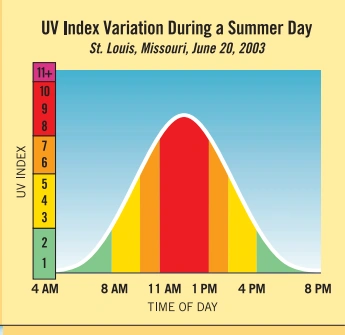
The UV Index represents the expected intensity of erythemally weighted UV radiation, typically forecast for solar noon when UV levels are highest. The higher the number, the stronger the UV rays and the greater the risk of skin damage. The World Health Organization (WHO) has developed an internationally recognized system of colors corresponding to levels of the UVI.
| Category | UVI Range | Color |
| Low | 0-2 | Green |
| Moderate | 3-5 | Yellow |
| High | 6-7 | Orange |
| Very High | 8-10 | Red |
| Extreme | 11+ | Purple |
Source: https://www.who.int/news-room/questions-and-answers/item/radiation-the-ultraviolet-(uv)-index#:~:text=What%20is%20the%20UV%20index,takes%20for%20harm%20to%20occur. 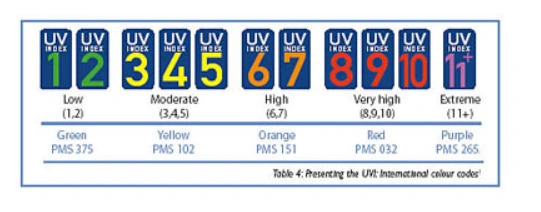 Source https://www.who.int/news-room/questions-and-answers/item/radiation-the-ultraviolet-(uv)-index#:~:text=What%20is%20the%20UV%20index,takes%20for%20harm%20to%20occur
  Source: https://www.epa.gov/sites/default/files/documents/uviguide.pdf
4. Health & Environmental Impact of UV Radiation
The sun is the main source of UV radiation, and it can reach you in three ways: directly from the sun, scattered through the sky, or reflected off surfaces around you. When the ozone layer gets thinner, it reduces the atmosphere’s natural protection against harmful UV rays. By understanding these risks and taking simple precautions, you can enjoy the sun while keeping yourself safe from UV-related health issues.
Health Effects:
- Sunburn is a sign of short-term overexposure, while premature aging and skin cancer are side effects of prolonged UV exposure.
- UV exposure increases the risk of potentially blinding eye diseases if eye protection is not used.
- Chronic overexposure to UV radiation increases the risk of skin cancers, including basal cell carcinoma, squamous cell carcinoma, and melanoma.
- There are numerous forms of artificial UV radiation sources, some of which produce significant levels of UV radiation. Arc welders used in industry emit a high level of UV radiation, and workers exposed to welding radiation may experience comparable health impacts as workers exposed to excessive solar UV radiation.
Did you know this? Each year, more new cases of skin cancer are diagnosed in the U.S. than new cases of breast, prostate, lung, and colon cancer combined. One in five Americans will develop skin cancer in their lifetime. One American dies from skin cancer every hour. Unprotected exposure to UV radiation is the most preventable risk factor for skin cancer.
Environmental Impacts: Ultraviolet (UV) radiation doesn’t just impact humans; it affects wildlife too. Elevated UV-B exposure can reduce growth and photosynthetic activity in many plant species, although sensitivity varies among species. This raises concerns that ozone depletion could lead to the loss of plant species and a decrease in the global food supply. Since all life is connected, changes in plant diversity can have serious ripple effects. Plants are the foundation of the food chain, help prevent soil erosion and water loss, produce oxygen, and store carbon dioxide, making them essential for life on Earth.
In aquatic ecosystems, UV exposure harms phytoplankton, the foundation of the marine food chain, disrupting life under the water.
Solar UV radiation drives photochemical reactions between nitrogen oxides (NOₓ) and volatile organic compounds (VOCs), leading to the formation of ground-level ozone.
5. Possible Corrective Measures
- First, protecting the ozone layer is crucial. Reducing the use of ozone-depleting substances like certain aerosols and refrigerants can help restore this natural shield against harmful UV rays.
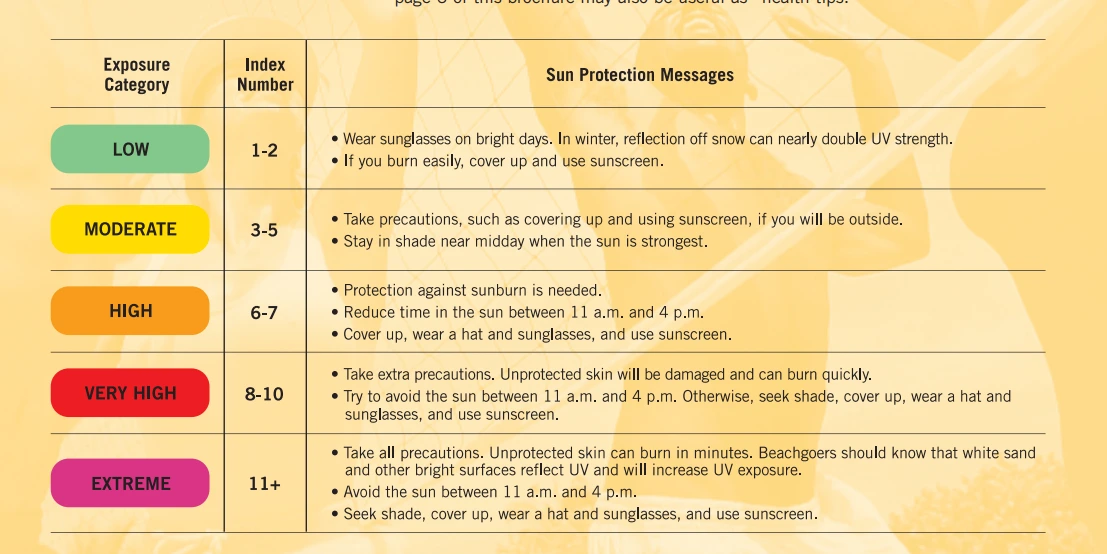
- For individuals, simple steps like wearing sunscreen, UV-protective clothing, and sunglasses can reduce the risk of UV exposure.
- Limiting time outdoors during peak sunlight hours and seeking shade are also effective ways to stay safe.
- On a larger scale, promoting awareness about the effects of UV radiation and supporting policies for sustainable practices can make a significant difference.
- Watch the UV Index. The UV Index provides important sun safety information to help people plan outdoor activities.
- Be extra careful around water, snow, and sand. These surfaces reflect the sun’s harmful rays, making sunburn more likely.
 Source: https://www.epa.gov/sites/default/files/documents/uviguide.pdf
 6. Measurement methods of UV Radiation
Accurately measuring UV radiation is important to understand its effects on health, the environment, and industries. UV sensors are the main tools used to measure. They work by turning UV radiation into electrical signals, making it easy to monitor its intensity.
Photodiode Sensors: A photodiode-type UV sensor measures ultraviolet irradiance. When light strikes the photodiode, it energizes the electrons, which causes an electric current. The electric current will be stronger in response to brighter light. The electrical current can then be measured and transformed into a digital or analog output.
Photodetector: UV photodetectors, including photodiodes and photomultiplier tubes (PMTs), convert incident ultraviolet radiation into electrical signals proportional to UV intensity. These detectors are commonly used in scientific, industrial, and environmental monitoring applications due to their high sensitivity and wavelength-specific response.
The cell is a large exposed diode that is constructed using a pn junction between appropriately doped semiconductors. Photons hitting the cell pass through the thin p-doped upper and are absorbed by electrons in the n-doped layer. This causes conduction electrons and holes to be created.
Pyranometer: A pyranometer measures total solar irradiance across a broad spectral range (typically 285–3000 nm), including UV, visible, and near-infrared radiation. It is primarily used to measure total solar energy rather than UV radiation alone.
The core component of the Pyranometer is a spherical glass enclosure equipped with a thermopile or photoelectric element, which is capable of converting the received solar radiation into an electrical signal. When the sun's rays hit the Pyranometer's receiver directly, the receiver absorbs the solar radiation and converts it into heat. This thermal energy creates a temperature difference across a thermopile, generating a voltage proportional to the incoming solar irradiance. By measuring this change in resistance value, the intensity of solar radiation can be calculated.
This pyranometer is highly accurate and supports inspections. It is widely used in fields like solar energy, weather monitoring, agriculture, building material testing, and air pollution studies to measure solar radiation.
Spectrometers or Spectroradiometers: Spectral radiation refers to the intensity of radiation from a source (like the sun, lamps, or reflected surfaces) across different wavelengths. Each radiation source has a unique spectrum, which helps characterize it under varying conditions.
Spectrometers measure the relative spectral radiation over a specific wavelength range. On the other hand, spectroradiometers are calibrated spectrometers that provide absolute measurements, such as energy flux (W/m²/nm) or photon flux (µmol/m²/s/nm).
7. Oizom’s Sensor Working Principle for UV Radiation
Oizom’s UV Radiation Sensor Module is designed to accurately measure solar radiation in the surrounding environment. This real-time sensor helps monitor the intensity of solar rays, providing valuable insights into UV radiation levels. A high UV Index, detected by the sensor, indicates potential harm to human health. Additionally, the data can support studies of photochemical atmospheric processes, including correlations between UV irradiance, ozone formation, and secondary pollutant dynamics.
The sensor operates on the principle of photoconductivity, where its conductivity changes in response to light intensity. Developed in-house by Oizom, this innovative sensor technology ensures precise and reliable measurements.
The module is commonly used in climatological research, meteorological networks, greenhouses, building automation, reflectance studies, weathering, and monitoring the performance of weather stations. With its robust design and advanced technology, Oizom’s UV Radiation Sensor plays a key role in supporting accurate and actionable environmental data analysis.
8. Why Choose Oizom UV Radiation Sensor?
- Oizom’s UV Radiation Sensor provides accurate and consistent measurements, making it ideal for real-time monitoring and research applications.
- Built with advanced photoconductivity technology, the sensor delivers reliable and high-performance results for various environmental applications.
- The UV radiation sensor is designed for long-term operation with minimal maintenance under recommended operating conditions.
- Engineered for durability, the sensor performs effectively in extreme weather conditions, ensuring long-term reliability and minimal maintenance.
- Offers accurate real-time data on UV radiation and light intensity, supporting timely decision-making.
- Our sensors comply with the RoHS criteria for restricting hazardous substances in electrical and electronic devices.
9. Reasons Why UV Radiation Measuring is Important:
- Monitoring UV radiation helps protect against its harmful effects, such as skin cancer, sunburn, and eye damage like cataracts. Understanding UV levels allows individuals and communities to take preventive measures and reduce health risks.
- UV radiation plays a critical role in ecosystems. Excessive UV exposure can harm plant growth, damage phytoplankton in aquatic ecosystems, and disrupt the food chain. Monitoring UV levels helps assess its impact on the environment and biodiversity.
- Measuring UV radiation provides insights into the health of the ozone layer. Long-term UV-B measurements, when interpreted alongside atmospheric and meteorological data, can help assess the effects of stratospheric ozone depletion.
- UV radiation influences air quality by driving photochemical reactions that produce ground-level ozone and smog. Measuring UV levels helps us understand these reactions and their impact on pollution and public health.
- UV radiation is a component of solar energy that affects climate systems. Measuring it supports climate studies and optimizes solar energy systems by providing data on sunlight intensity and its variations.