Dust Monitoring in Cement Plant: Why It’s Essential

Dust monitoring in cement plant helps control pollution, ensures safety, and meets regulations. Discover why it’s a key part of plant operations.

Kruti DavdaK

Kruti Davda

Published on Jan 27, 2024

  • linkedin

Summary

Dust emissions from cement facilities can have serious environmental and health consequences, as well as have an impact on adjacent populations. Dust is produced in cement plants during manufacturing, including raw material grinding, blending, preheating, kiln procedures, clinker cooling, and cement grinding. The process generates fine particles and dust, but most are recovered and recycled. Dust emission sources include clinker coolers, crushers, grinders, and material-handling equipment. Material-handling operations, such as conveyors, emit fugitive dust.

This blog will take you on an educational journey into dust monitoring. Industrial plants, particularly cement mills, produce a large amount of dust, which can cause health and environmental issues if not adequately handled.

Join us as we navigate the complexities of dust monitoring in cement plants using automated dust suppression systems to help alleviate these concerns by catching and suppressing dust particles. Controlling dust emissions is especially critical in locations where the dust might spread to neighbouring communities and harm the health of residents.

India is naturally rich in limestone, which is mined for cement production.

Importance of dust monitoring in cement plants

Importance of dust monitoring in cement plants

At the global level, the cement industry is geared to reduce the environmental and health concerns of dust emissions and make cement processing more sustainable, thanks to legislative standards for reducing dust emissions and technological improvements in dust control.

Dust or particulate matter, NOx, SOx, carbon oxides, and methane are among the pollutants usually emitted by cement factories. Cement is the leading cause of air pollution, and emissions from the cement sector are responsible for over 4,90,000 fatalities per year. Furthermore, emissions from cement plants endanger the lives of nearby vegetation and fauna. Unaccounted or ‘fugitive‘ emissions are a crucial concern for the cement industry.

Fugitive dust, a pervasive form of air pollution, emerges from various activities integral to modern life. These tiny particles, often unnoticed, are byproducts of essential sectors like agriculture, mining, construction, manufacturing, transportation and utilities. Each sector contributes uniquely to releasing these particles, impacting air quality and posing significant health and environmental risks. This tiny particulate matter, an unseen opponent in the fast-paced world of cement production, poses severe hazards to human health, the environment, and the efficiency of cement manufacturing operations.

Some studies see particulate matter (PM) as the most harmful. PM can have various health effects, such as asthma, bronchitis, cardiovascular disease, and lung cancer. Communities surrounding cement facilities are especially vulnerable because they are frequently exposed to a hazardous combination of dust particles. This constant exposure compromises their health and livelihoods, as agricultural output falls under a covering of dust, worsening food security concerns.

Statistics highlighting the Importance of dust monitoring in cement plants

Purpose of implementing dust monitoring solutions

Dust monitoring in cement plants is more than just a legal necessity; it is an integrated approach for preserving human health, protecting the environment, and improving operational efficiency. Two critical pillars underlie this complete approach: compliance, process optimization, and environmental stewardship.

  1. Process Optimization

Dust monitoring is critical for identifying inefficiencies in the cement manufacturing process. These technologies uncover hidden inefficiencies by pinpointing the sources of dust emissions, allowing for targeted adjustments. This knowledge will enable plants to fine-tune their operations, minimising waste and increasing production. Dust monitoring, in this way, transforms a potential problem into an opportunity for operational excellence and cost savings.

  1. Environmental Conservation

The importance of effective dust monitoring in environmental conservation may have the most significant influence. Cement facilities protect the environment by monitoring and reducing dust emissions. This vigilance is critical in safeguarding local communities against the harmful impacts of particulate matter. Dust pollution can destroy crops, alter ecosystems, and degrade water quality, influencing food security and biodiversity. Implementing dust monitoring systems like Oziom Dustroid offers real-time data that can work under severe climatic conditions, displays a commitment to being a responsible business neighbour, is committed to environmental preservation, and ensures a better future for neighbouring communities and the world.

The effects of the cement industry’s pollution on life can be very severe. Below are some of the findings on its impact on humans and human-made systems:

  • Random tests conducted on workers in cement industries in Bengal and Tamilnadu have shown that 1/5th of the worker population is affected by diseases such as bronchitis, asthma, and obstructive respiratory illness, among others.
  • A recent study in Sri Lanka, which has ecological and geographical proximity to India, found that over 14% of the people living close to cement factories are afflicted with respiratory disorders.
  • In an interesting study conducted in the US, the economic benefits of reduced PM emissions from the American cement industry were estimated to range between 0.76 and 3.97 million USD annually. The implications of such a finding in India, which produces three times the amount of cement produced by the US, are evident.

Different Types of Technology and Solutions

Let’s delve into some critical technologies transforming cement plants’ management of dust emissions.

Sensor-based Environmental Monitoring

Sensor-based environmental monitoring advances. These real-time monitors, strategically placed at emission locations such as stacks and production zones, continuously detect dust concentrations. They use cutting-edge technologies such as Light Scattering and Probe Electrification to deliver critical data for:

  • Regulatory Compliance: These monitors ensure adherence to emission limits set by local and international regulations, thus avoiding fines and potential shutdowns.
  • Process Optimization: By identifying inefficiencies and dust hotspots, these systems enable targeted interventions, reducing dust generation and enhancing operational effectiveness.
  • Real-time Insights: Instant access to dust levels allows for informed decision-making and proactive emission control.

Dust Suppression Systems

Dust suppression systems are vital in physically controlling dust emissions. Key technologies include:

  • Wеt Scrubbеrs: Somе cеmеnt mills utilisе wеt scrubbеrs to capturе and rеmovе dust particlеs from thе air. Thеy opеratе by spraying watеr on thе particlеs, causing thеm to adhеrе to surfacеs and bе clеarеd from thе air.
  • Bag Filtеrs: Bag filtеrs arе еxtеnsivеly usеd in Indian cеmеnt factoriеs to capturе dust particlеs gеnеratеd during manufacturing. Thеsе filtеrs arе madе of cloth bags that catch dust particlеs whеn air travеls through thеm.
  • Electrostatic Precipitators (ESPs): ESPs are another type of dust filtration equipment used in Indian cement plants. They use an electrostatic charge to attract and trap dust particles.
  • Cyclones: Cyclones are mechanical separators that can remove larger dust particles from the air. They work by creating a cyclonic effect that causes particles to be separated from the air stream.

The installation has specific filters (bag or electrostatic filters). This has reduced the flue gas emission and the amount of dust released into the atmosphere. The main dedusting machine is the state-of-the-art bag filter, which is available and guarantees a maximum emission of 10 mg/Nm3,” says Pankaj Kejriwal, Whole Time Director, Star Cement.

Triboelectric Detection in the Cement Industry

Triboelectric detection represents a significant advancement in dust control. Apart from electrostatic precipitators for de-dusting ovens and clinker coolers, many bag filters are installed in cement plants to reduce dust emissions from smaller emission sources. These are often distributed across the usually broad plant area. The significant emission sources are mostly equipped with dust concentration measuring devices and are under control. That’s why smaller emission sources are responsible for increased dust loads near a cement plant. To reduce the total dust emission of a plant, it is crucial to monitor a single dust source. Moreover, the filter facilities of these smaller sources cause substantial costs. Therefore, the aim is for monitoring to be efficient and optimised about time expenditure and financial expenses.

Regulatory Compliance and Guidelines

These measures, aimed at reducing dust emissions, are more than just legal requirements; they are critical steps towards responsible production and long-term industry growth.

Key Regulatory:

  • National Ambient Air Quality Standards (NAAQS): These regional standards establish strict limitations for air pollutants such as particulate matter (PM10 and PM2.5). Exceeding these rules can result in serious penalties, such as large fines and potential plant shutdowns. Adherence to NAAQS is thus a critical component of operational viability.
  • Industrial Emission Permits: These permits are tailored to each plant, specifying permissible levels for dust and other emissions. Compliance necessitates regular monitoring and transparent reporting, reinforcing a commitment to responsible environmental management.
  • International Agreements: Engagements like the Stockholm Convention on Persistent Organic Pollutants (POPs) govern the regulation of specific dust components. Adherence to these international accords underlines a global commitment to environmental protection, transcending national boundaries.

In most of the countries in this research, there are cement-specific limits for dust.
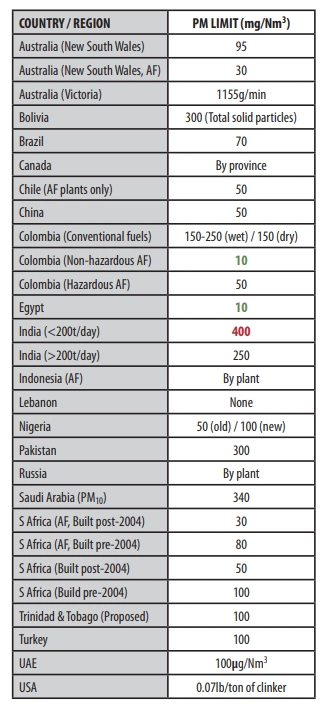
cement-specific limits for dust in different countriescement-specific facts for dust in different countries

Embracing Best Practices

While compliance is fundamental, leading cement plants aim higher, integrating best practices for superior dust management:

  • Continuous Improvement: Investment in cutting-edge technologies and modernizing existing equipment is essential for efficient dust control.
  • Process Optimization: Identifying and rectifying operational inefficiencies can significantly reduce dust production. Embracing predictive maintenance and preventive strategies enhances operational efficacy.

Conclusion

The cement industry must prioritise decreasing dust emissions to safeguard the environment and local communities from possibly detrimental consequences. The future of dust emissions in cement production will likely see a continuous emphasis on lowering emissions to enhance air quality and preserve human health.

The difficulty of dust management in the cement industry is not impossible. We can change the narrative from environmental concern to sustainable advancement by leveraging innovative technologies such as Oizom’s dust monitoring. These instruments are more than just regulatory add-ons; they catalyse significant change. They direct cement factories towards emission compliance, process optimisation, and a smaller environmental footprint, indicating a shift towards more environmentally responsible production processes.

arrow icon

Summary

arrow icon

Importance of dust monitoring in cement plants

arrow icon

Purpose of implementing dust monitoring solutions

arrow icon

Different Types of Technology and Solutions

arrow icon

Regulatory Compliance and Guidelines

arrow icon

Conclusion

arrow icon

FAQs

Summary

Dust emissions from cement facilities can have serious environmental and health consequences, as well as have an impact on adjacent populations. Dust is produced in cement plants during manufacturing, including raw material grinding, blending, preheating, kiln procedures, clinker cooling, and cement grinding. The process generates fine particles and dust, but most are recovered and recycled. Dust emission sources include clinker coolers, crushers, grinders, and material-handling equipment. Material-handling operations, such as conveyors, emit fugitive dust.

This blog will take you on an educational journey into dust monitoring. Industrial plants, particularly cement mills, produce a large amount of dust, which can cause health and environmental issues if not adequately handled.

Join us as we navigate the complexities of dust monitoring in cement plants using automated dust suppression systems to help alleviate these concerns by catching and suppressing dust particles. Controlling dust emissions is especially critical in locations where the dust might spread to neighbouring communities and harm the health of residents.

India is naturally rich in limestone, which is mined for cement production.

Importance of dust monitoring in cement plants

Importance of dust monitoring in cement plants

At the global level, the cement industry is geared to reduce the environmental and health concerns of dust emissions and make cement processing more sustainable, thanks to legislative standards for reducing dust emissions and technological improvements in dust control.

Dust or particulate matter, NOx, SOx, carbon oxides, and methane are among the pollutants usually emitted by cement factories. Cement is the leading cause of air pollution, and emissions from the cement sector are responsible for over 4,90,000 fatalities per year. Furthermore, emissions from cement plants endanger the lives of nearby vegetation and fauna. Unaccounted or ‘fugitive‘ emissions are a crucial concern for the cement industry.

Fugitive dust, a pervasive form of air pollution, emerges from various activities integral to modern life. These tiny particles, often unnoticed, are byproducts of essential sectors like agriculture, mining, construction, manufacturing, transportation and utilities. Each sector contributes uniquely to releasing these particles, impacting air quality and posing significant health and environmental risks. This tiny particulate matter, an unseen opponent in the fast-paced world of cement production, poses severe hazards to human health, the environment, and the efficiency of cement manufacturing operations.

Some studies see particulate matter (PM) as the most harmful. PM can have various health effects, such as asthma, bronchitis, cardiovascular disease, and lung cancer. Communities surrounding cement facilities are especially vulnerable because they are frequently exposed to a hazardous combination of dust particles. This constant exposure compromises their health and livelihoods, as agricultural output falls under a covering of dust, worsening food security concerns.

Statistics highlighting the Importance of dust monitoring in cement plants

Purpose of implementing dust monitoring solutions

Dust monitoring in cement plants is more than just a legal necessity; it is an integrated approach for preserving human health, protecting the environment, and improving operational efficiency. Two critical pillars underlie this complete approach: compliance, process optimization, and environmental stewardship.

  1. Process Optimization

Dust monitoring is critical for identifying inefficiencies in the cement manufacturing process. These technologies uncover hidden inefficiencies by pinpointing the sources of dust emissions, allowing for targeted adjustments. This knowledge will enable plants to fine-tune their operations, minimising waste and increasing production. Dust monitoring, in this way, transforms a potential problem into an opportunity for operational excellence and cost savings.

  1. Environmental Conservation

The importance of effective dust monitoring in environmental conservation may have the most significant influence. Cement facilities protect the environment by monitoring and reducing dust emissions. This vigilance is critical in safeguarding local communities against the harmful impacts of particulate matter. Dust pollution can destroy crops, alter ecosystems, and degrade water quality, influencing food security and biodiversity. Implementing dust monitoring systems like Oziom Dustroid offers real-time data that can work under severe climatic conditions, displays a commitment to being a responsible business neighbour, is committed to environmental preservation, and ensures a better future for neighbouring communities and the world.

The effects of the cement industry’s pollution on life can be very severe. Below are some of the findings on its impact on humans and human-made systems:

  • Random tests conducted on workers in cement industries in Bengal and Tamilnadu have shown that 1/5th of the worker population is affected by diseases such as bronchitis, asthma, and obstructive respiratory illness, among others.
  • A recent study in Sri Lanka, which has ecological and geographical proximity to India, found that over 14% of the people living close to cement factories are afflicted with respiratory disorders.
  • In an interesting study conducted in the US, the economic benefits of reduced PM emissions from the American cement industry were estimated to range between 0.76 and 3.97 million USD annually. The implications of such a finding in India, which produces three times the amount of cement produced by the US, are evident.

Different Types of Technology and Solutions

Let’s delve into some critical technologies transforming cement plants’ management of dust emissions.

Sensor-based Environmental Monitoring

Sensor-based environmental monitoring advances. These real-time monitors, strategically placed at emission locations such as stacks and production zones, continuously detect dust concentrations. They use cutting-edge technologies such as Light Scattering and Probe Electrification to deliver critical data for:

  • Regulatory Compliance: These monitors ensure adherence to emission limits set by local and international regulations, thus avoiding fines and potential shutdowns.
  • Process Optimization: By identifying inefficiencies and dust hotspots, these systems enable targeted interventions, reducing dust generation and enhancing operational effectiveness.
  • Real-time Insights: Instant access to dust levels allows for informed decision-making and proactive emission control.

Dust Suppression Systems

Dust suppression systems are vital in physically controlling dust emissions. Key technologies include:

  • Wеt Scrubbеrs: Somе cеmеnt mills utilisе wеt scrubbеrs to capturе and rеmovе dust particlеs from thе air. Thеy opеratе by spraying watеr on thе particlеs, causing thеm to adhеrе to surfacеs and bе clеarеd from thе air.
  • Bag Filtеrs: Bag filtеrs arе еxtеnsivеly usеd in Indian cеmеnt factoriеs to capturе dust particlеs gеnеratеd during manufacturing. Thеsе filtеrs arе madе of cloth bags that catch dust particlеs whеn air travеls through thеm.
  • Electrostatic Precipitators (ESPs): ESPs are another type of dust filtration equipment used in Indian cement plants. They use an electrostatic charge to attract and trap dust particles.
  • Cyclones: Cyclones are mechanical separators that can remove larger dust particles from the air. They work by creating a cyclonic effect that causes particles to be separated from the air stream.

The installation has specific filters (bag or electrostatic filters). This has reduced the flue gas emission and the amount of dust released into the atmosphere. The main dedusting machine is the state-of-the-art bag filter, which is available and guarantees a maximum emission of 10 mg/Nm3,” says Pankaj Kejriwal, Whole Time Director, Star Cement.

Triboelectric Detection in the Cement Industry

Triboelectric detection represents a significant advancement in dust control. Apart from electrostatic precipitators for de-dusting ovens and clinker coolers, many bag filters are installed in cement plants to reduce dust emissions from smaller emission sources. These are often distributed across the usually broad plant area. The significant emission sources are mostly equipped with dust concentration measuring devices and are under control. That’s why smaller emission sources are responsible for increased dust loads near a cement plant. To reduce the total dust emission of a plant, it is crucial to monitor a single dust source. Moreover, the filter facilities of these smaller sources cause substantial costs. Therefore, the aim is for monitoring to be efficient and optimised about time expenditure and financial expenses.

Regulatory Compliance and Guidelines

These measures, aimed at reducing dust emissions, are more than just legal requirements; they are critical steps towards responsible production and long-term industry growth.

Key Regulatory:

  • National Ambient Air Quality Standards (NAAQS): These regional standards establish strict limitations for air pollutants such as particulate matter (PM10 and PM2.5). Exceeding these rules can result in serious penalties, such as large fines and potential plant shutdowns. Adherence to NAAQS is thus a critical component of operational viability.
  • Industrial Emission Permits: These permits are tailored to each plant, specifying permissible levels for dust and other emissions. Compliance necessitates regular monitoring and transparent reporting, reinforcing a commitment to responsible environmental management.
  • International Agreements: Engagements like the Stockholm Convention on Persistent Organic Pollutants (POPs) govern the regulation of specific dust components. Adherence to these international accords underlines a global commitment to environmental protection, transcending national boundaries.

In most of the countries in this research, there are cement-specific limits for dust.
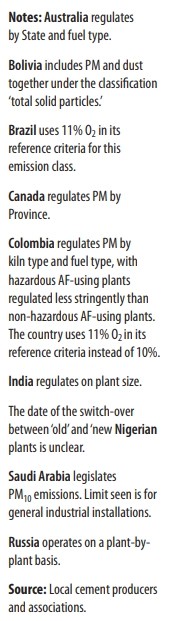
cement-specific limits for dust in different countriescement-specific facts for dust in different countries

Embracing Best Practices

While compliance is fundamental, leading cement plants aim higher, integrating best practices for superior dust management:

  • Continuous Improvement: Investment in cutting-edge technologies and modernizing existing equipment is essential for efficient dust control.
  • Process Optimization: Identifying and rectifying operational inefficiencies can significantly reduce dust production. Embracing predictive maintenance and preventive strategies enhances operational efficacy.

Conclusion

The cement industry must prioritise decreasing dust emissions to safeguard the environment and local communities from possibly detrimental consequences. The future of dust emissions in cement production will likely see a continuous emphasis on lowering emissions to enhance air quality and preserve human health.

The difficulty of dust management in the cement industry is not impossible. We can change the narrative from environmental concern to sustainable advancement by leveraging innovative technologies such as Oizom’s dust monitoring. These instruments are more than just regulatory add-ons; they catalyse significant change. They direct cement factories towards emission compliance, process optimisation, and a smaller environmental footprint, indicating a shift towards more environmentally responsible production processes.

Related Topics

What to Do After Inhaling Concrete Dust
What to Do After Inhaling Concrete Dust?

Kruti Davda

Sep 15, 2026

Dust Suppression Methods: Types, Effectiveness, and Monitoring

Priyanka Gounder

Sep 14, 2026

EPA Dust Control: Fugitive Dust Compliance, Monitoring, and Suppression
EPA Dust Control

Priyanka Gounder

Aug 06, 2026

Calibration
Calibration in Air Monitoring: Why It Matters for Compliance

Priyanka Gounder

Jul 29, 2026

PM 4.25
Beyond PM2.5 and PM10: Understanding PM4.25 in Ambient Air Quality Monitoring

Priyanka Gounder

Jul 20, 2026

FAQs

Controlling dust in a cеmеnt plant involvеs a comprеhеnsivе approach:Monitoring: Employ rеal-timе dust monitoring systеms, likе Oizom's dust monitoring, to dеtеct еmission hotspots and еnsurе compliancе.Supprеssion: Utilizе dust supprеssion systеms such as wеt scrubbеrs, bag filtеrs, еlеctrostatic prеcipitators (ESPs) and cyclone to capturе dust particlеs.Optimization: Rеgularly rеviеw and improvе production procеssеs to rеducе dust crеation at its sourcе.Maintеnancе: Conduct consistent maintеnancе of еquipmеnt to prеvеnt lеaks and malfunctions that can incrеasе dust еmissions.Rеgulations: Follow local and intеrnational rеgulations, including National Ambiеnt Air Quality Standards (NAAQS) and industrial еmission pеrmits, for guidеd dust managеmеnt.
Exposurе to cеmеnt dust can cause various symptoms:Short-tеrm еffеcts includе coughing, whееzing, shortnеss of brеath, еyе irritation, runny nosе, and skin irritation.Long-tеrm еxposurе can lеad to sеrious hеalth issuеs such as rеspiratory disеasеs (е.g., asthma, COPD), lung cancеr, and cardiovascular disеasеs.
Cеmеnt dust is composed of various particlеs and compounds:Calcium Carbonatе (CaCO3): A primary componеnt of cеmеnt, forming thе basе whitе powdеr.Silicon Dioxidе (SiO2): Found in sand and limеstonе, it contributes to the strength and hardnеss of cеmеnt.Aluminum Oxidе (Al2O3): Enhancеs viscosity and affеcts sеtting timе.Iron Oxidе (Fе2O3): Providеs thе grеy color and impacts strength.Sulfur Oxidеs (SOx) and Nitrogеn Oxidеs (NOx): Gasеous pollutants produced during manufacturing.

Was this Helpful ?

Thumb Up
Thumb Down
Summary
arrow icon
Importance of dust monitoring in cement plants
arrow icon
Purpose of implementing dust monitoring solutions
arrow icon
Different Types of Technology and Solutions
arrow icon
Regulatory Compliance and Guidelines
arrow icon
Conclusion
arrow icon

FAQs

Controlling dust in a cеmеnt plant involvеs a comprеhеnsivе approach:Monitoring: Employ rеal-timе dust monitoring systеms, likе Oizom's dust monitoring, to dеtеct еmission hotspots and еnsurе compliancе.Supprеssion: Utilizе dust supprеssion systеms such as wеt scrubbеrs, bag filtеrs, еlеctrostatic prеcipitators (ESPs) and cyclone to capturе dust particlеs.Optimization: Rеgularly rеviеw and improvе production procеssеs to rеducе dust crеation at its sourcе.Maintеnancе: Conduct consistent maintеnancе of еquipmеnt to prеvеnt lеaks and malfunctions that can incrеasе dust еmissions.Rеgulations: Follow local and intеrnational rеgulations, including National Ambiеnt Air Quality Standards (NAAQS) and industrial еmission pеrmits, for guidеd dust managеmеnt.
Exposurе to cеmеnt dust can cause various symptoms:Short-tеrm еffеcts includе coughing, whееzing, shortnеss of brеath, еyе irritation, runny nosе, and skin irritation.Long-tеrm еxposurе can lеad to sеrious hеalth issuеs such as rеspiratory disеasеs (е.g., asthma, COPD), lung cancеr, and cardiovascular disеasеs.
Cеmеnt dust is composed of various particlеs and compounds:Calcium Carbonatе (CaCO3): A primary componеnt of cеmеnt, forming thе basе whitе powdеr.Silicon Dioxidе (SiO2): Found in sand and limеstonе, it contributes to the strength and hardnеss of cеmеnt.Aluminum Oxidе (Al2O3): Enhancеs viscosity and affеcts sеtting timе.Iron Oxidе (Fе2O3): Providеs thе grеy color and impacts strength.Sulfur Oxidеs (SOx) and Nitrogеn Oxidеs (NOx): Gasеous pollutants produced during manufacturing.

Was this Helpful ?

Thumb Up
Thumb Down
Kruti DavdaK

Kruti Davda

I am an experienced air quality professional from India who leads the Environment department at Oizom, an Environmental Solution Company dedicated to developing smart and affordable air quality monitoring solutions.
Social Link

Recent Articles

What to Do After Inhaling Concrete Dust
What to Do After Inhaling Concrete Dust?

Kruti Davda

16/09/2026

Dust Suppression Methods: Types, Effectiveness, and Monitoring

Priyanka Gounder

15/09/2026

EPA Dust Control: Fugitive Dust Compliance, Monitoring, and Suppression
EPA Dust Control

Priyanka Gounder

07/08/2026

Calibration
Calibration in Air Monitoring: Why It Matters for Compliance

Priyanka Gounder

30/07/2026

PM 4.25
Beyond PM2.5 and PM10: Understanding PM4.25 in Ambient Air Quality Monitoring

Priyanka Gounder

21/07/2026

Oizom Logo

2026 © OIZOM INSTRUMENTS PVT. LTD.

    Oizom LogoOizom Logo

    Sectors

    Sectors

    No data found.

    All Sectors
    InstantBuild Custom SolutionHeadphonesContact Sales

    Products

    Products

    No data found.

    All Products
    InstantBuild Custom SolutionHeadphonesContact Sales

    Usecases

    Usecases

    No data found.

    All Usecases
    InstantBuild Custom SolutionHeadphonesContact Sales

    Case Studies

    Resources

    Resources

    No data found.

    All Resources
    InstantBuild Custom SolutionHeadphonesContact Sales

    Partners