
Summary
PM4.25 refers to airborne particulate matter with an aerodynamic diameter of 4.25 µm or less, an intermediate fraction that sits between the well-established PM2.5 and PM10 metrics. The term does not appear in ISO, WHO, or EPA definitions, nor in any other major regulator. The term arises due to the nature of certain optical particle counters. Though there is no formal standard for PM4.25, the parameter is a real, technically relevant measure of ambient aerosol particle size. PM4.25 captures a size range that neither PM2.5 nor PM10 fully accounts for. What science does not provide is a clear observational justification for PM4.25. Current health claims related to PM4.25 are based on PM2.5 and PM10 literature, while research on PM4.25 is only emerging. The blog explains what PM4.25 means, its technical origin, relationship to other standards, health implications, and its implications for air quality monitoring programs.
Introduction: The Gap in Air Pollution Monitoring
Particulate matter monitoring usually focuses on two fractions: PM2.5 and PM10. Since some important epidemiological studies were conducted throughout the 1990s, PM2.5 emerged as the primary metric in fine-particle health research. PM10 refers to particles with aerodynamic diameters ≤10 µm, representing a larger coarse fraction from mechanical processes, road dust, and construction activities. PM2.5 and PM10 form the basis of air quality standards around the globe, including the US EPA, NAAQS, WHO Global Air Quality Guidelines, and CPCB.
However, there is a gap in monitoring between these two well-studied fractions. This fraction is particularly relevant in industrial and occupational settings where mechanical processes generate dust across a wide range of particle sizes that existing regulatory metrics do not separate.
With modern laser-based sensors, one can measure the total concentrations of PM1, PM2.5, and PM10 particles, as well as other overlooked fractions. PM4.25 is one such fraction, a product of sensor architecture rather than regulatory design, but increasingly present in real-world monitoring data and worth understanding on its own terms.
What Is PM4.25? Defining This Particulate Matter Fraction
PM4.25 refers to airborne particulate matter with an aerodynamic diameter of ≤4.25 µm. It is more like a subset of PM10, a superset of PM2.5, and an intermediate fraction that overlaps significantly with both.
Origin: A Sensor Hardware Bin-Edge, Not a Regulatory Standard
The most important technical fact about PM4.25 is its source. PM2.5 and PM10 are professional terms that have been in use for decades. Many respected organizations have used them for similar measurement tools and methods. However, the term "PM4.25" is derived from measurements using optical particle counters. Optical particle counters work by allowing laser beams to pass through air samples for proper testing. As particles pass through the laser beam, they scatter light in ways that correlate with their size and concentration. This scattered signal is processed to estimate particle size distribution. The result is treated as a size distribution and classified into particle-size bins, with specific values set as threshold limits.
In certain sensor designs, 4.25 µm is one of the particle-size bin boundaries, yielding a cumulative particle count for particles at or below that threshold, labelled as PM4.25 in the sensor's firmware output.
This origin matters because it means PM4.25 is defined by hardware design choices rather than by a scientifically determined health-relevant cut-point. Different sensor manufacturers use different bin edges, and a sensor reporting PM4.25 from one architecture is not necessarily comparable to a PM4.25 output from a different sensor design without co-location validation.
The Critical Distinction: PM4.25 vs PM4
The terms PM4.25 and PM4 are often mistaken for similar, even though PM4 is a legitimate occupational hygiene term. PM4 refers to the respirable dust sampling convention defined in ISO 7708:1995 and EN 481, designed around 50% collection efficiency at approximately 4 µm aerodynamic diameter, approximating the fraction of particles capable of penetrating to the alveolar region.
It is worth noting the differences between these terms:
- PM4 is a sampling convention with a defined collection-efficiency curve, a recognized reference method (cyclone-based gravimetric sampling), and regulatory acceptance in occupational exposure assessment under standards such as OSHA 29 CFR 1926.1153 for respirable crystalline silica.
- PM4.25 is a sensor output bin with no equivalent reference method, no standardized collection-efficiency curve, and no current regulatory recognition.
A monitoring program that provides PM4.25 results does not provide PM4-equivalent data for compliance, even if numerical values are similar. Mixing these terms creates risks related to exposure assessments.
PM4.25 vs Standard Particulate Matter Fractions: A Comparative Look
The table below maps PM4.25 against the established particulate matter fractions most commonly used in ambient and occupational monitoring:
| Fraction | Aerodynamic Cut-Point | Standard Basis | Regulatory Status |
| PM1 | ≤1 µm | No formal ISO/WHO standard; sensor-derived | No regulatory limit in major frameworks |
| PM2.5 | ≤2.5 µm | US EPA 40 CFR Part 50; WHO AQG 2021; EN 14907 | Regulated NAAQS, NAAQS India, WHO guidelines, EU AQD |
| PM4 | ~4 µm (50% efficiency) | ISO 7708:1995; EN 481 respirable convention | Occupational compliance standard (OSHA, BOHS, etc.) |
| PM4.25 | ≤4.25 µm | No ISO/EN/WHO standard; OPC hardware bin-edge | No regulatory recognition |
| PM10 | ≤10 µm | US EPA 40 CFR Part 50; WHO AQG 2021; EN 12341 | Regulated NAAQS, NAAQS India, WHO guidelines, EU AQD |
| TSP | All suspended particles | Historical standard; largely superseded | Limited current regulatory use |
Sources of PM4.25 in Ambient Air Monitoring
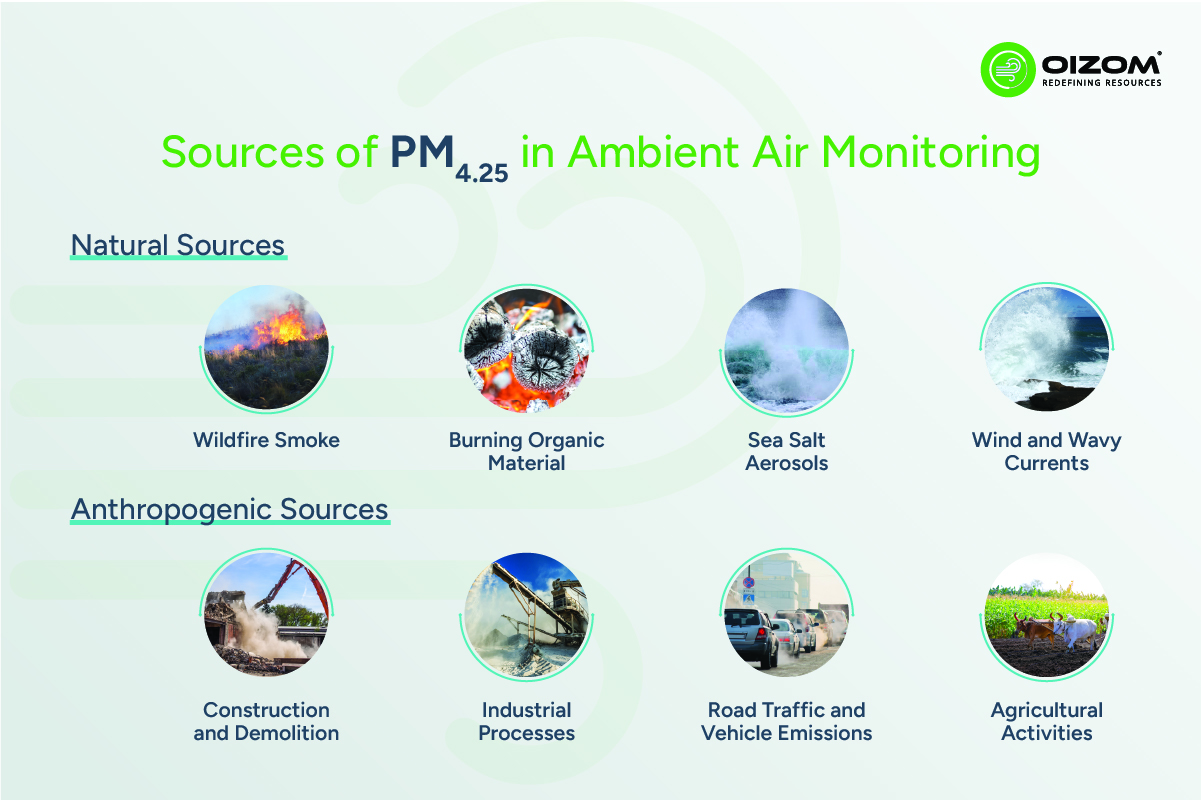
Sources of particles in the sub-4.25 µm size range can be classified as either natural or anthropogenic. However, since PM4.25 is an intermediate size range that overlaps with PM2.5 at the lower limit and approaches PM10 at the upper limit, its sources reflect emissions of both fine and coarse particulate matter.
Natural Sources
The resuspension of mineral dust particles, along with the influence of winds on soil and crust materials, generates particles of different sizes, most notably those between 2 and 10 µm, which fall under the category of PM4.25. Wildfire smoke is known for generating fine particles typically under 2.5 µm, but burning organic material at higher temperatures produces particles ranging from 2.5 to 5 µm. Sea salt aerosols, along with wind and wavy currents, have both fine and coarse fractions, with submicron and supermicron varieties generated depending on atmospheric processes.
Anthropogenic Sources
- Construction and demolition work is one of the largest sources of airborne dust in this particle-size range. Dust produced by concrete sawing, surface grinding, and aggregate crushing varies widely in size. Larger particles settle quickly, but smaller particles, 2–5 µm in size, can remain suspended in the air for long periods.
- Industrial processes such as cement making, metallurgy, ceramic production, and chemical handling create process by-products and dust at both accumulation and coagulation stages. The sub-5-micron range of the particles gives them an advantage over others because they can move like fine particles and accumulate like coarse particles.
- Road traffic and vehicle emissions contribute to particles. The particle size range produced by vehicle emissions and road traffic comes from both exhaust and non-exhaust sources. Tyre wear, brake dust particles, and road surface wear contribute towards this size range.
- Agricultural activities: tillage, harvesting, and application of pesticides in agriculture result in biological and mineral aerosols which are abundant in the size range of 2–8 µm.
This source profile indicates that PM4.25, as a fraction, captures a genuinely distinct slice of real-world particle emissions, not simply a subset of PM2.5 or a rough approximation of PM10. The question is whether monitoring programs and health frameworks have yet developed the tools to interpret it independently.
Health Relevance of PM4.25: What the Evidence Currently Shows
Understanding the health significance of PM4.25 requires differentiating between what science suggests and what epidemiological studies have directly demonstrated for this specific particle fraction. The current evidence shows these are not the same.
Deposition Physics: What Size Tells Us
Respiratory deposition in humans depends on particle aerodynamics, which affect the possibility that particles will deposit in a given region of the respiratory tract based on their size, shape, density, as well as the individual's breathing pattern.
For particles in the sub -4.25 µm range, the deposition picture is heterogeneous:
- Particles below 1 µm tend to penetrate deep into the lungs. The smallest particles deposit primarily through Brownian diffusion, while sedimentation becomes increasingly important as particle size approaches 1 µm.
- Particles in the 1–2.5 µm range generally have relatively low respiratory deposition efficiency because they are small enough to avoid upper airway impaction but too large for efficient diffusional deposition.
- Particles in the 2.5–5 µm range deposit with increasing efficiency in the tracheobronchial airways and, to a lesser extent, the alveolar region, making this size range relevant to both airway irritation and gas-exchange zone exposure.
As such, PM4.25 represents a broad range of particle sizes and behaviors, from alveolar-penetrating fine particles to tracheobronchial-depositing coarse particles of diverse sizes. PM4.25, as a cumulative fraction encompassing all of these size bands, therefore captures particles with diverse deposition behaviors from alveolar-penetrating fine particles to tracheobronchial-depositing accumulation-coarse particles.
Health Evidence: Where the Science Currently Stands
Emerging evidence linking particles in the PM4.25 size range to health outcomes draws primarily from two bodies of literature: PM2.5 epidemiology, which is extensive and well-established, and PM10 research, which has documented associations with respiratory and cardiovascular outcomes particularly in populations exposed to high-dust environments.
The impact of fine and accumulation-mode particles on health, such as respiratory inflammation, decreased lung function, worsening asthma and COPD conditions, significant cardiovascular problems, and mortality risks, is documented for PM2.5. The available information increasingly supports a link between PM2.5 and the number of hospitalizations for respiratory diseases, particularly in industrial and high-dust areas.
Research on PM4.25 particles is in its early stages. For PM4.25 specifically as a defined fraction, independent epidemiological studies remain limited. Current evidence does not yet support population-level exposure-response relationships for PM4.25 that are distinct from those established for PM2.5 or PM10. The health implications of PM2.5 are derived from research on related particle types; however, there are not yet sufficient studies demonstrating its relevance.
This is not a reason to dismiss PM4.25 monitoring. It is a reason to frame its contribution accurately: a more complete picture of the particle size distribution in a given environment, particularly in the accumulation-coarse overlap zone, where PM2.5 undercounts and PM10 overcounts the exposure most relevant to lower respiratory health.
Measurement Challenges: Calibration and Cross-Comparability
The absence of a standardized reference method for PM4.25 poses practical challenges for monitoring programs seeking to produce defensible, reproducible data.
The Reference Method Problem
Reference methods exist for PM2.5 and PM10, and the US EPA has adopted mass-based reference methods, such as the Federal Reference Method, which uses size-selective inlets as the baseline for approving its continuous monitoring systems. In the European context, EN 14907 and EN 12341 are referenced for PM2.5 and PM10, respectively. Before sensors can submit data for compliance reporting, they must demonstrate equivalence to these reference methods through co-location studies.
PM4.25, though, does not have a corresponding reference method. There is no gravimetric filter method with a 4.25 µm inlet; neither ISO nor EN standards address measurement uncertainty, and no regulatory body approves PM4.25 data for reporting compliance matters. Therefore, outputs from optical particle counters cannot be considered validated using conventional traceable reference methods.
Co-Location as the Practical Answer
Since a reference method for PM4.25 is not available, collocating with proven PM2.5 and PM10 devices is the most reliable method currently available for QA of the data. When PM4.25 devices are collocated with reference PM2.5 and PM10 devices, the following can be accomplished:
- Establish correction factors for the sensor's PM2.5 and PM10 outputs under local conditions
- Assess the internal consistency of the sensor's size-bin partitioning
- Identify environmental factors humidity, temperature, particle composition that affect the sensor's size-classification accuracy
Co-location periods of at least 15 days, with performance evaluated using 1-hour averaged data, are consistent with accepted sensor validation practice. In addition, co-location allows comparison among different devices, which is very important, as devices with different OPC designs could have different definitions of the bin edge at 4.25 µm.
Humidity and Composition Effects
Optical particle counters detect the hygroscopicity of particles, that is, how prone the particles are to attract water given their size and, therefore, to increase in size at high humidity. Since the PM4.25 range covers the size range of hygroscopic growth, this has a significant effect on PM4.25 measurements. In highly variable humidity conditions, it is crucial to use correction algorithms based on ambient relative humidity to achieve reliable PM4.25 data. Factors influencing the refractive index at the sensor's laser level, such as particle composition, also introduce measurement bias due to deviations from the composition used during factory calibration.
Practical Implications for Air Quality Monitoring Programs
What PM4.25 Adds to Multi-Fraction Monitoring
In circumstances where monitoring is limited to only PM2.5 and PM10, particles within the intermediate size range are missed. While mechanical operations in industrial settings and on construction sites produce dust with particles that vary widely in size, this lack of measurement can lead to an inaccurate picture of exposure conditions that PM2.5 or PM10 alone cannot adequately capture.
The presence of PM4.25 data provides a third data point to further enhance our understanding of the size distribution of collected particles. It allows programs to determine whether the elevated particulate concentrations are mostly due to fine combustion particles, intermediate mechanical dust, or coarse re-suspended particles. This information would help with source identification, control prioritization, and exposure assessment in ways that including only PM2.5 or PM10 would not.
- Construction Sites: Concrete dust, aggregate fines, and road dust are generated, and these sites often experience elevated PM4.25 levels during cutting and grinding. These high PM4.25 levels are produced because these processes generate coarse particles, which are known to produce PM4.25 but would not necessarily be detected by PM2.5 measurements.
- Industrial Facilities: Processing, production, or combustion facilities that generate dust emissions at a specific location may use PM4.25 to separate the dust from background air pollution in the area. Knowing this difference will help both in obtaining control measures and in assessing the risk of worker exposure to polluted air.
- Urban Air Quality Networks: Monitoring in the vicinity of busy roadways or building construction areas may utilize PM4.25 to improve the understanding of the contribution of non-exhaust particles from braking, tire wear, and road surface wear processes, which are primarily in the size range of 2-5 µm and increasingly acknowledged as an important traffic pollution contributor.
Reporting and Compliance Considerations
PM4.25 does not possess regulatory authority and, as such, cannot supersede PM2.5 or PM10 in compliance reporting. Programs that utilize PM4.25 data should consider it supplementary information, used primarily to aid in decision-making, source characterization, and for the exposure picture.
As monitoring technologies gain traction in regulatory compliance, which can be seen in the PMC Pune regulation requiring API data submission to the municipal dashboard, the treatment of intermediate fractions like PM4.25 will become more important. For now, the most defensible approach is to report PM2.5 and PM10 for compliance purposes, and PM4.25 as a contextual layer to enhance understanding of the particle-size distribution.
Conclusion: Filling the Gap Between PM2.5 and PM10
The existence of a gap in monitoring PM2.5 and PM10 is true; PM4.25 does not solve this problem by replacing any of the already adopted classifications either. Instead, additional granularity in particle size distribution is provided for the size range underrepresented in the current standards. PM4.25 is a sensor-derived measurement that captures a genuinely meaningful slice of the particle size spectrum. It is supported by deposition physics and consistent with emerging evidence on intermediate-fraction health relevance, but not yet backed by the independent epidemiological research or regulatory frameworks that give PM2.5 and PM10 their authority.
For tracking PM at locations where the PM2.5-to-PM10 gap might be important, like dusty industrial sites or construction zones, the point is a fuller picture: comprehensive multi-fraction monitoring does not require every fraction to have its own WHO guideline to be worth having. It requires that each fraction is understood for what it genuinely represents. Oizom's ambient monitoring systems are built to capture this fuller picture, tracking PM fractions across the size spectrum to give operators the data granularity that PM2.5 and PM10 alone cannot.






.be0dea41.svg)