Summary
There is an enormous gap between construction workers' actual exposure to Respirable Crystalline Silica (RCS) and what construction companies report. The primary reason is the widespread misconceptions about what each dust metric measures. Most construction dust programmes are built around PM2.5 and PM10 measurements. A PM2.5 reading can indicate the amount of fine dust present, but it doesn't specify whether that dust contains crystalline silica.
The purpose of this guide is to clarify:
- PM2.5 and PM10 are ambient air quality metrics; PM4 is the appropriate measurement for evaluating compliance with occupational silica exposure levels
- Optical dust sensors used for continuous PM monitoring cannot determine the amount of crystalline silica in the air; laboratory analysis using X-ray diffraction (XRD) or Fourier transform infrared spectroscopy (FTIR) is the only alternative for determining its concentration
- Continuous respirable crystalline silica (RCS) monitoring and compliance monitoring at compliance sites do not ask the same question; one provides information for operational purposes and the other for regulatory evidence
Introduction
Construction sites generate dust every day. As occupational health regulations tighten, many projects have adopted dust monitoring programmes, and this is where a critical mistake often enters. Measuring dust and measuring silica risk are not the same, but on most construction sites, they are treated as one.
A PM10 or PM2.5 monitor does not directly measure the crystalline silica. Even a measurement of respirable dust in the environment does not indicate how much crystalline silica is present in the air.
RCS causes some of the most serious occupational lung diseases in the world and, therefore, is one of the least effectively monitored hazards in the construction industry, largely because particle-size measurements are blended with material chemical composition. This guide explains what RCS actually is, why PM4, not PM2.5, is the correct occupational benchmark, and where continuous monitoring tools like Polludrone fit within a compliant silica management strategy.
What Respirable Crystalline Silica Actually Is
RCS is defined as tiny airborne particles that consist of crystalline silicon dioxide (SiO₂). When inhaled, it can reach deep into your lungs. Silicon dioxide is one of the most common minerals on Earth. It is found naturally in various building materials, such as concrete, cement, mortar, bricks, stone, granite, quartz-containing aggregates, and engineered stone.
They are small enough to avoid being trapped in the nose, throat, and upper airway cavities and can penetrate deep into the alveolar region of the lungs. Once there, the body's immune cells attempt to remove them. Crystalline silica damages those cells, triggering chronic inflammation and progressive scarring.
If repeatedly exposed to these particles over a period of time, a person is at risk of silicosis, chronic obstructive pulmonary disease (COPD), lung cancer, chronic kidney disease, or irreversible loss of lung function. Unlike other acute construction hazards, silica-related disease has a latency period lasting years or even decades. Silica-related diseases account for around 42,000 deaths annually worldwide, according to the Institution of Occupational Safety and Health (IOSH). This highlights the importance of proactive monitoring, over reactive investigation, as a professional standard.
“Silicosis has no cure. The best course of action is to prevent exposure to silica dust in the first place." World Health Organization (WHO), Silicosis Fact Sheet
RCS Exposure Risk Assessment Checklist for Construction Sites
Most failures in silica exposure are not due to inadequate sensors but to a lack of a systematic process. Complete this checklist before initiating any monitoring programme.
- Identify silica-containing materials on site: If these materials are to be cut, drilled, ground, or demolished, there is a risk of generating RCS.
- Map high-risk dust-generating activities: Concrete cutting, surface grinding, core drilling, jackhammering, demolition, stone fabrication, aggregate crushing, and road milling require immediate attention. Document task occurrence, location, and frequency.
- Create Similar Exposure Groups (SEGs): Define groups of workers who perform similar work under similar conditions, e.g., concrete cutters, demolition crews, stone masons, drill operators.
- Evaluate existing dust control measures: Is any equipment using wet cutting? How effective is the water suppression used? Is the local exhaust ventilation adequately positioned? Are the users of respiratory protection required to use it?
- Establish monitoring triggers: Events that would trigger monitoring include new work processes that generate silica or change how silica is controlled.
- Determine the proper monitoring strategy: Effective RCS monitoring requires both personal respirable sampling for worker exposure and continuous area monitoring for site-wide dust intelligence
- Confirm RCS monitoring uses PM4-appropriate sampling methods: A PM10 or PM2.5 measurement is insufficient for an occupational silica compliance analysis; therefore, cyclone-based respirable samplers calibrated to the PM4 standard will be required.
- Develop a plan for silica analysis in the laboratory: Measuring the mass of respirable dust alone does not provide silica exposure data; X-ray diffraction (XRD) or Fourier Transform Infrared Spectroscopy (FTIR) analysis is required to identify crystalline silica in collected samples.
- Assess the 8-hr TWA: The analytical result should be compared to the applicable occupational exposure limit. Determine which worker group requires immediate controls.
- Reassess, document, complete the circle: Silica risk management is not a one-time effort. The construction site continues to change. Review findings, implement corrective actions, conduct follow-up sampling, and keep exposure records for use in any health surveillance program.
The Measurement Gap Nobody Talks About: Total Dust vs Respirable Dust vs Silica
Different dust metrics were developed for different purposes, and treating them as interchangeable is where most construction monitoring programmes fail.
Inhalable, Thoracic, and Respirable Fractions
Occupational hygiene classifies airborne particles by their location in the respiratory system. The inhalable fraction consists of all particles that enter through the nose or mouth. The thoracic fraction consists of all particles that have passed beyond the larynx and into the chest (thorax). The respirable fraction, which is the only fraction that matters for silica, consists of particles small enough to penetrate the alveoli. Because silicosis and other silica-related diseases originate in the alveoli, occupational silica assessment is built entirely around the respirable fraction.
Why PM4, not PM2.5, is the Occupational Standard
The deposition of particles in the human respiratory tract is not a straightforward process; it depends on a particle-size distribution curve that reflects particle size, shape, density, and breathing patterns. To standardize this, occupational hygiene uses ISO 7708:1995, the international standard defining particle-size conventions for health-related sampling of airborne particles. When using the ISO method, respirable samplers are designed to achieve approximately 50% collection efficiency at an aerodynamic diameter of around 4 micrometers. This respirable fraction is commonly represented using a PM4 sampling convention.
The PM2.5 and PM4 standards overlap significantly; however, they serve different purposes. Using PM2.5 data as a proxy for occupational respirable dust introduces systematic error into exposure assessment.
More importantly, neither PM2.5 nor PM4 can identify whether particles contain crystalline silica.
Consider two construction sites with identical PM2.5 readings. One site is generating diesel exhaust. The other is cutting high-quartz concrete. The PM2.5 concentration is the same. The occupational health implications are entirely different. Particle size measurements reveal nothing about chemical composition.
“The most common gap we see on construction sites is not a lack of dust monitoring; it's monitoring the wrong fraction entirely. A PM2.5 network tells you there's dust. It tells you nothing about whether workers are breathing crystalline silica.”
Kruti Davda, Environment Lead, Oizom
Why Occupational Compliance ≠ Ambient Compliance
Occupational monitoring involves measuring the air in a worker's breathing zone (the air within around 30 cm of the worker's nose and mouth) during active work activities. Results are expressed as an 8-hour TWA and compared against occupational exposure limits.
Ambient monitoring, on the other hand, measures environmental conditions at the site boundary or at fixed receiver locations, such as PM10, PM2.5, and NO2, to assess impacts on the community or public health.
A site can satisfy ambient air quality thresholds while workers operating cutting equipment simultaneously experience exposures above occupational silica limits. A perimeter monitor at the site boundary may not accurately reflect the exposure a worker experiences 2m from a concrete saw.
OSHA's construction silica standard (29 CFR 1926.1153) mandates action levels at 25 µg/m³ and a permissible exposure limit of 50 µg/m³ as an 8-hour TWA, both of which require the PM4 respirable fraction, not PM2.5 or PM10, as the measurement basis.
Both kinds of monitoring are necessary and cannot be used interchangeably.
The CLEAR Framework for Effective RCS Monitoring
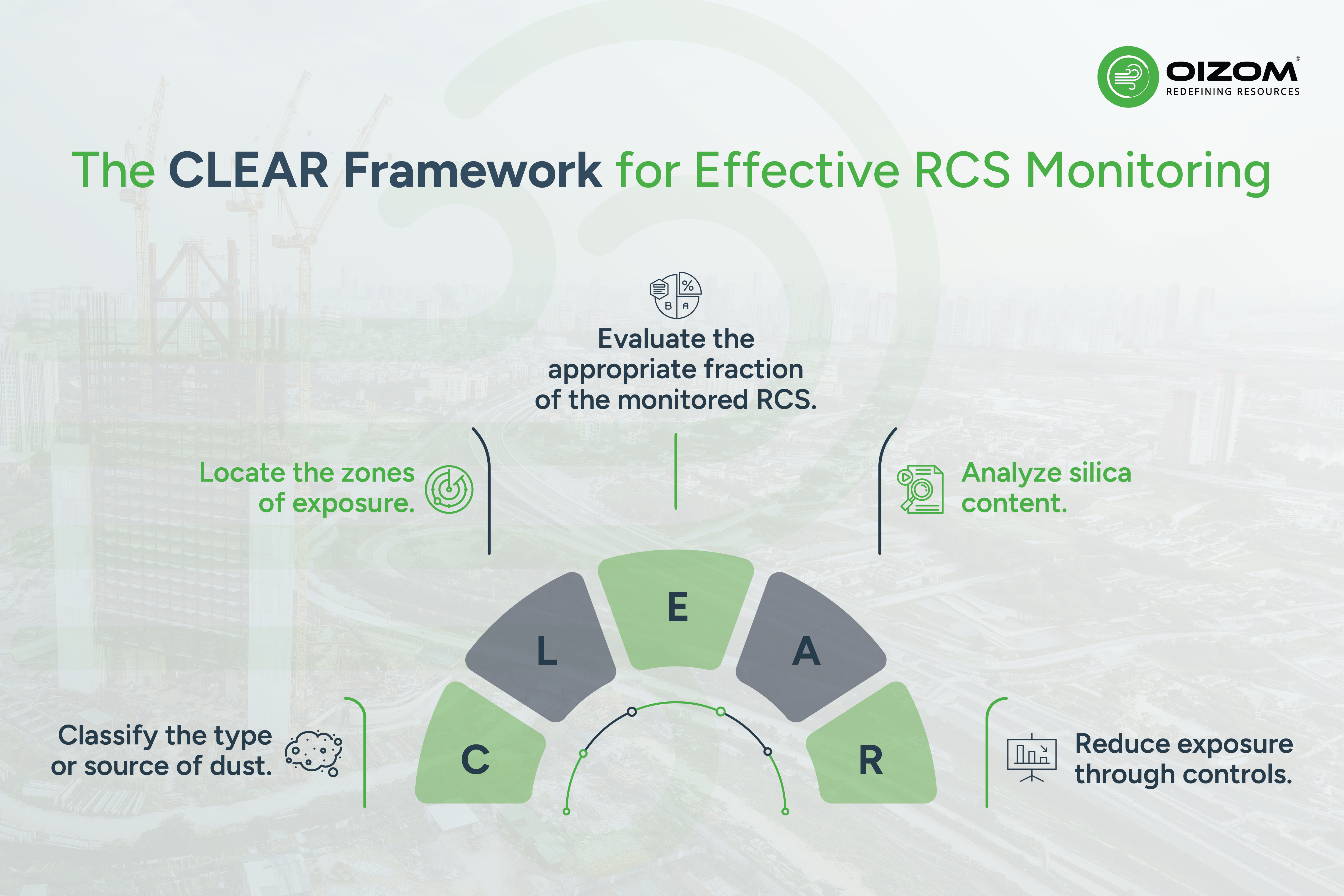
Many construction projects treat RCS monitoring as a one-time compliance activity. In practice, effective RCS monitoring requires a repeatable process connecting hazard identification, exposure assessment, monitoring, and control verification. The CLEAR Framework provides that structure.
C - Classify the type or source of dust: Not all construction dusts contain the same amount of silica; therefore, classifying dust sources can help identify tasks with the highest likelihood of producing RCS: i.e., cutting concrete, drilling holes, grinding, tearing down structures, crushing stone, and fabricating stone.
L - Locate the zones of exposure: In some cases, the exposure zone may be different from the emission zone. For example, an operation that cuts concrete will create concrete dust at one location but may have workers in another area, where active wind patterns are carrying respirable-sized silica particles to work areas. Evaluating worker positions, equipment locations, ventilation conditions, and wind patterns determines where both personal and area monitoring should be deployed.
E - Evaluate the appropriate fraction of the monitored RCS: Testing the total dust generated by work operations, including PM10 or PM2.5 particulate matter, does not equate to evaluating the respirable fraction of RCS dust. Therefore, the RCS monitoring programme must focus on the respirable fraction represented by the PM4 convention, using the PM4 standard for particle size. Selecting the wrong particle fraction produces data that cannot be compared against occupational exposure limits.
A - Analyze silica content: Two dust samples with the same respirable dust concentration can have very different amounts of crystalline silica. The only way to determine the amount of silica in a sample is laboratory analysis by gravimetric means to determine the mass of respirable dust, followed by XRD or FTIR to identify and quantify crystalline silica. Without this step, a monitoring programme cannot determine whether workers are overexposed.
R - Reduce exposure through controls: Monitoring results should guide the implementation of controls when the exposure risks have been determined. Examples of controls include wet cutting systems, water suppression, local exhaust ventilation, process modifications, enclosures, and respiratory protection. Once controls have been implemented, monitoring can be used to verify whether the controls are producing a measurable decrease in exposure.
How Respirable Crystalline Silica Is Actually Measured
RCS monitoring requires a sequence of analytical steps that cannot be performed by an optical sensor alone.
Personal Sampling and Gravimetric Analysis
The first step in assessing silica exposure is personal sampling, which is performed using a device worn by the worker. This device usually consists of a small battery-powered pump (with a cyclone separator and filter cassette) that draws air through the sampling device at a constant, controlled flow rate throughout the sampling period.
After sampling is complete, the filter is sent to a laboratory to analyze the respirable dust collected on it. The gravimetric method is used to analyze the filter by weighing it before and after sampling in humidity chambers. The increase in the filter's weight will equal the amount of respirable dust collected on the filter. If a filter gains 0.6 mg of particulate matter from 1 m³ of sampled air, the respirable dust concentration is 0.6 mg/m³.
This result quantifies the amount of respirable dust collected, but does not identify its chemical composition.
Cyclone Samplers and PM4 Convention
Once in a cyclone chamber, heavier particles are separated from the air by centrifugal force and drop onto the wall, while lighter particles remain suspended and pass through to a collection filter. This results in a size-selective sample that conforms to the ISO 7708 respirable convention, rather than being based on an arbitrary size cut-off.
This is why PM2.5 measurements alone cannot be used to assess respirable crystalline silica exposure. Although the two fractions overlap significantly, they are not equivalent, and use completely different sampling methodologies.
XRD and FTIR: Identifying Crystalline Silica
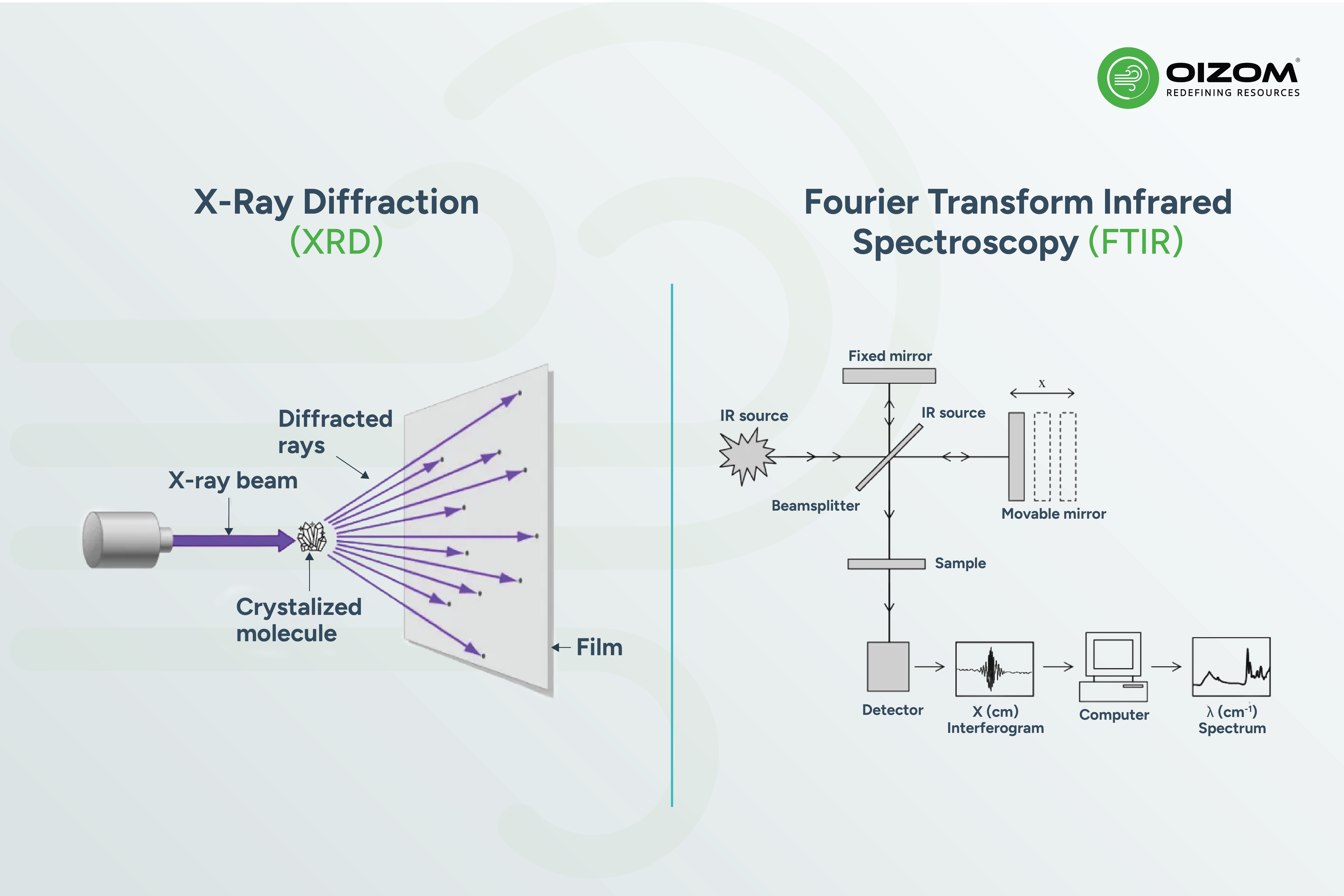
Once respirable dust mass is established, the next important question is how many particles in that dust are crystalline silica.
X-Ray Diffraction (XRD): X-Ray Diffraction (XRD) is considered the reference method. A collected dust sample is exposed to X-rays. Crystalline materials exhibit unique diffraction patterns: quartz, cristobalite, and tridymite each have their own signature. By comparing the measured signature with reference standards, laboratory personnel can identify and quantify the amount of each crystalline silica polymorph present.
Fourier Transform Infrared Spectroscopy (FTIR) measures a material's ability to absorb infrared radiation. Absorption occurs at characteristic wavelengths for each mineral, so FTIR allows identification of crystalline silica and estimation of its concentration. FTIR is widely used in routine occupational hygiene programmes, because it is faster and more economical than XRD, while producing reliable analytical results.
A dust monitoring programme based on neither of these techniques will measure dust, but cannot determine silica exposure.
Calculating the 8-hour TWA
The dust generated from construction activities fluctuates throughout a shift. A worker could spend two hours cutting concrete, three hours drilling, and the remaining time performing other operations. The occupational exposure limits that account for this variability utilize Time Weighted Average (TWA) calculations.
TWA = Σ (Concentration × Exposure Duration) ÷ Total Shift Duration
For example, a worker exposed to 0.18 mg/m³ RCS for 2 hours, 0.09 mg/m³ for 3 hours, and 0.03 mg/m³ for 3 hours accumulates a TWA of 0.09 mg/m³. This value can now be evaluated against the applicable occupational exposure limit.
Cumulative exposure over a working lifetime, not peak concentration alone, determines silicosis risk. This is why time-weighted averaging remains the cornerstone of occupational exposure assessment. — NIOSH, Hazard Review: Health Effects of Occupational Exposure to RCS
Can Optical Dust Sensors Detect Silica? What Polludrone Can and Cannot Tell You
The honest answer is no: optical dust sensors cannot directly identify crystalline silica. But understanding what they can do reveals where they create genuine value in a silica management programme.
Polludrone is one of the many continuous dust monitoring systems that employ laser-based light-scattering technologies to automatically determine real-time particulate concentrations across the PM1, PM2.5, and PM10 metrics.
The key limitation of optical sensors is their inability to identify particle composition; they measure how particles scatter light, not their chemical composition. For example, two separate airborne dust clouds would give the same measurement using a standard PM2.5 sensor. One cloud could be diesel emissions while the other could be quartz generated from a concrete grinding operation. From the sensor's perspective, the two measurements would be essentially indistinguishable; in reality, however, the significance of the two airborne dust clouds to occupational health differs substantially.
This is not a sensor deficiency, but a categorical distinction between two different monitoring objectives.
| Compliance Monitoring | Continuous Monitoring (Polludrone) | |
| Primary question | Was the worker overexposed to RCS? | When and where are dust events occurring? |
| Method | Personal sampling + XRD/FTIR + TWA | Real-time optical PM measurement |
| Output | mg/m³ RCS vs occupational limit | Time-resolved PM trends, alerts |
| Role | Regulatory evidence | Operational intelligence |
Construction sites present unique challenges for air quality monitoring due to dust accumulation, vibration, humidity, and weather exposure. Polludrone addresses these challenges through an IP66-rated enclosure and robust field design, helping maintain reliable PM measurements throughout long-term deployments.
High dust loading can cause particulate accumulation inside an optical sensing chamber, leading to measurement drift over time. Oizom's e-Breathing technology helps prevent this by periodically purging the sensing chamber, supporting measurement stability during extended deployments.
How Polludrone Adds Value to Silica Management
Identifying High-risk Activity Patterns: For example, recurring PM spikes during concrete cutting can help EHS teams determine where targeted personal silica sampling is most valuable.
Validating Dust Control Effectiveness: The effectiveness of a water spray, wet cutting rig, or misting array is generally evaluated visually. However, just because it looks like the water spray is working doesn't mean it is; the water pressure may have dropped, the nozzles may be worn, or the wind may have blown water or dust away from the spray. Polludrone data provides objective, time-stamped evidence of how particulate concentrations change before and after dust-control measures are implemented.
Prompting Investigation Before an Employee Suffers Excessive Exposure: By the time an employee receives the results of their personal sampling from a laboratory, they may have already been overexposed. When using Polludrone's real-time, on-site dust monitoring, EHS personnel can intervene during the incident rather than wait several weeks after the incident has occurred.
Consolidating Continuous and Compliance Data on One Dashboard: A persistent gap in construction silica programmes is that the data is spread across multiple systems; for instance, you may have PM results from a sampling instrument in one system, personal sampling results in a spreadsheet, and laboratory reports communicated via an email thread. Envizom's open data architecture enables a unified dashboard where continuous Polludrone PM data can coexist with manually entered laboratory results, gravimetric weights, XRD concentration data, and TWA calculations across different work hours, sites, or supervisors.
The strongest silica management programmes combine both layers. Continuous monitoring identifies where and when elevated conditions occur. Personal sampling and laboratory analysis quantify the actual worker exposure. Neither replaces the other; together they create the complete exposure picture.
Conclusion
RCS sits at the intersection of two monitoring worlds that construction EHS professionals must navigate simultaneously: occupational hygiene, focused on worker exposure and regulatory compliance, and environmental monitoring, focused on site conditions and community impact. The most persistent errors arise when these worlds are conflated. To properly manage silica, there are 3 sequential steps: identify the type of particle that is significant, perform laboratory analysis to identify which dust particles are crystalline silica, and finally, conduct RCS monitoring for operational intelligence to identify activities that generate dust, confirm the effectiveness of control measures, and allocate sampling resources to the highest-risk sites.
For construction projects looking to build this layered approach, Oizom's air quality monitoring system - Polludrone provides the real-time particulate intelligence to identify dust events and evaluate control performance, while Envizom makes that data actionable across sites and shifts. Protecting workers from RCS starts with one question: are you measuring the fraction that actually matters?



.be0dea41.svg)