Summary
BMC Mumbai, PMC Pune, NMMC Navi Mumbai, and Thane in Maharashtra now require air quality measurement at all construction sites using sensor technology. These are not guidance documents or voluntary programmes, but mandatory circulars with a list of approved vendors, technical specifications, data requirements, and active penalty enforcement for violations.
What this guide covers:
- The regulatory trigger that led to Maharashtra's construction monitoring mandates in practice
- The specific requirements imposed by BMC, PMC, NMMC, and the MPCB direction applicable to Thane
- Differences between the municipalities and how those differences affect developers' projects that are located in multiple municipalities
- The omission of the 15-day co-location study compliance requirement in the majority of development-related projects
- Data management from a single source for all developers with projects in 2 or more municipalities
The Regulatory Trigger: Why This Is Happening Now
Maharashtra's push toward mandatory construction site monitoring accelerated under a combination of legal pressure, regulatory requirements, and municipal action. Bombay High Court's PIL (SMPIL No. 3/2023) required municipal corporations to put construction dust as part of Maharashtra's regulatory system and provide measurable air quality control at construction sites. The Maharashtra Pollution Control Board (MPCB) also issued orders on monitoring requirements for project owners under the Environmental Protection Act, 1986, which must be implemented before construction can continue.
This has resulted in numerous city-level mandates across Maharashtra for air quality monitoring at construction sites, with varying technical requirements, vendor approval processes, and enforcement deadlines. In Maharashtra's construction industry, real-time sensor-based air quality monitoring of construction projects is now a mandatory compliance requirement, not an optional best practice.
City-by-City Mandate Breakdown
BMC Mumbai
- Circular: MGC/F/6526
- Applicability: All construction sites within BMC limits
The BMC has a two-part rule for installing Air Quality Monitors in construction projects, based on the total project cost. Construction projects with an estimated cost of less than ₹500 crore must install an ambient air quality monitoring (AQM) sensor that complies with Annexure A and is one of the pre-qualified makes and models identified in Annexure B (unless prior approval is obtained for another sensor). All construction projects with a total estimated project cost greater than ₹500 crore must install reference-grade Continuous Ambient Air Quality Monitoring Stations (CAAQMS) abiding by the CPCB's Technical Specifications for CAAQMS; this entails much higher technical and financial requirements for air quality monitoring.
Key Technical Requirements:
- Real-time PM2.5 and PM10 monitoring
- Fault notification and resolution within a stipulated time
- Continuous transmission of monitoring data to BMC's centralized Command & Control system
Enforcement: Non-compliance may result in a stop notice and other penal action. BMC has an approved vendor list; only sensors from listed manufacturers are accepted for compliance purposes.
PMC Pune
- Circular: Pune Municipal Corporation (PMC), dated 15 December 2025
- Applicability: All projects with a built-up area of 5,000 sq. m or more, both new and ongoing
PMC Pune's mandate is the most detailed of the confirmed circulars, with a complete technical annexure specifying sensor performance, installation criteria, data protocols, and maintenance obligations.
Key Technical Requirements:
- PM2.5 and PM10 monitoring: 0–1,000 µg/m³ range, R²>0.7 accuracy, response time under 10 seconds
- Temperature and relative humidity monitoring are mandatory alongside PM
- GSM/4G cellular connectivity is also mandatory, along with Wi-Fi
- Real-time monitoring with data transmitted to the PMC Command & Control Center every 10 minutes
- Local SD card storage for a minimum of 6 months, with zero data loss during network outages
- IP65 enclosure or above
- Every sensor must undergo a minimum 15-day co-location study with a reference-grade monitor before deployment
- Sensors shall be replaced at the end of their 30-month service life
- Sensors should be calibrated every 3 months against a reference-grade monitor, followed by a 15-day co-location study.
- The monitoring system must automatically detect offline or faulty devices every 6 hours. Faults that can be resolved on-site are to be addressed within 6 hours, while devices requiring replacement must be changed within 24 hours.
- LED display mandatory at site entrance, showing PM10 color-coded severity levels on a 15-minute running average
PM10 LED Color Codes (15-minute average):
- 0–100 µg/m³ → Green
- 101–350 µg/m³ → Yellow
- 351–430 µg/m³ → Orange
- 430+ µg/m³ → Red
Installation Requirements:
- Height: 3–5 meters above ground
- Position: downwind side of site, 3–5 meters inside site boundary
- Airflow: minimum 270° unobstructed
Enforcement: Enforcement through inspections and applicable actions under PMC directions for non-compliance.
NMMC Navi Mumbai
- Framework: 27-point Standard Operating Procedure for Air Pollution Control at Construction Sites, 2024
- Applicability: All construction sites within NMMC limits
Navi Mumbai Municipal Corporation (NMMC) has a strong enforcement-led approach among all municipal corporations in Maharashtra. Currently, under NMMC's SOPs, construction companies are mandated to install sensor-based devices to monitor air quality at all their sites, and enforcement has already begun.
According to the latest available enforcement statistics, NMMC has issued 19 work-halt orders to construction companies and fined 173 developers for failing to comply with air-quality monitoring requirements.
Thane
- Direction: Maharashtra Pollution Control Board (MPCB) Order No. MPCB/JD(APC)/B-0218, dated 7 February 2025
- Applicability: All construction sites within the jurisdiction of Thane Municipal Corporation
Unlike Mumbai, Pune and Navi Mumbai, Thane does not have a standalone municipal circular recommending specifications for construction air-quality monitoring. Instead, construction sites are governed by the Maharashtra Pollution Control Board's (MPCB) direction issued to Thane Municipal Corporation and other Urban Local Bodies (ULBs). This requires construction sites to deploy sensor-based air pollution monitors, making data available to authorities on demand, and ensure monitoring devices are centrally connected in accordance with the Bombay High Court's order.
Key Requirements:
- Mandatory deployment of sensor-based air pollution monitors at all construction sites
- Monitoring data must be available for inspection
- Central connectivity of monitoring devices
- BIS standards to be followed until CPCB issues standard guidelines
Enforcement: Local authorities are directed to ensure compliance, with non-compliant construction sites liable for regulatory action, including closure until compliance is achieved.
What the Mandates Have in Common: The Baseline Every Maharashtra Construction Site Must Meet
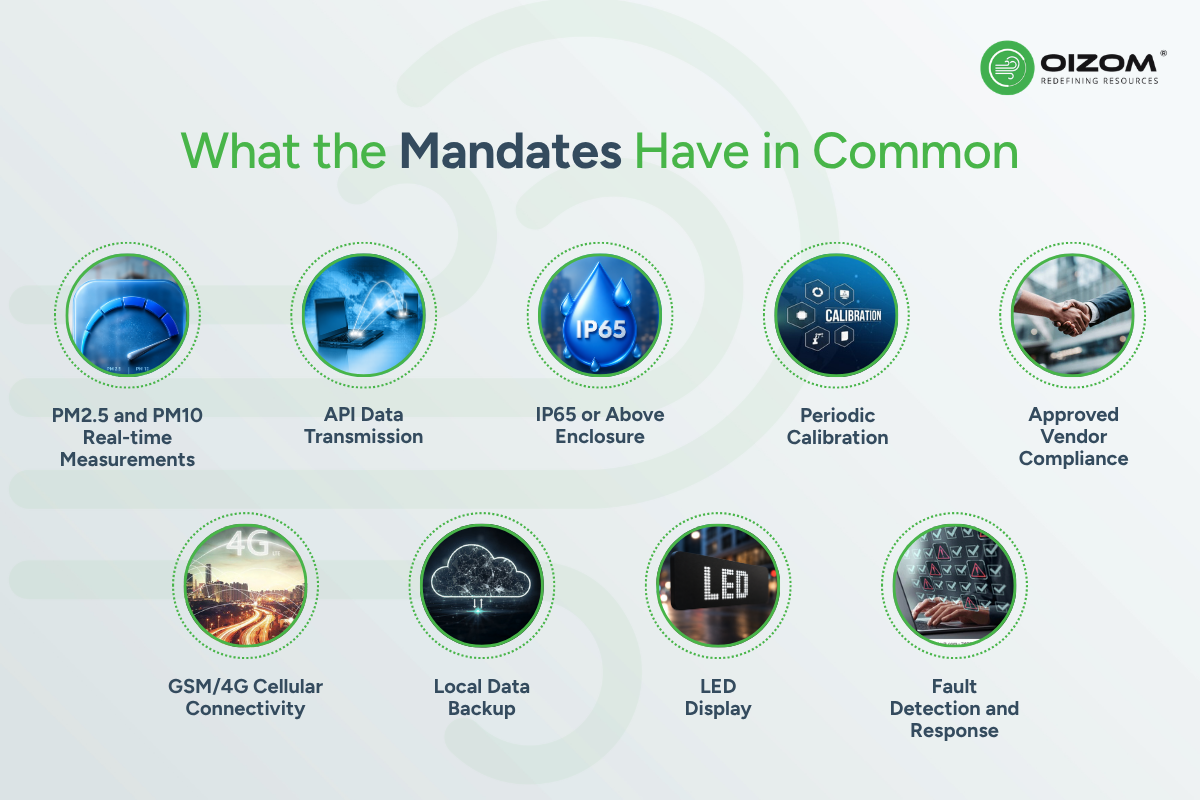
Across BMC, PMC, NMMC, and Thane, several requirements appear consistently. Regardless of which city a project operates in, the following represent the effective baseline for compliant construction site monitoring in Maharashtra:
- PM2.5 and PM10 real-time measurements are both mandatory across all confirmed mandates
- GSM/4G cellular connectivity is required since Wi-Fi-only sensors are not sufficient
- API data transmission to the relevant municipal command center
- Local data backup minimum 60 days (BMC) to 6 months (PMC); SD card-based storage where specified
- IP65 or above enclosure construction site conditions require weather and dust resistance
- LED display showing real-time dust severity at the site boundary
- Periodic calibration against reference monitors; frequency varies by city
- Fault detection and response a 6-hour notification window is specified in both BMC and PMC circulars
- Approved vendor compliance sensors must be from the relevant municipal corporation's approved list
Meeting this baseline across all sites is the starting point. The differences between city mandates are where the complexity and the compliance risk actually lie.
Though the individual mandates differ, they point at a common expectation: construction air quality monitoring systems must provide reliable measurements under harsh site conditions, provide continuous data, and support regulatory compliance. This shifts the focus from simply installing a sensor to selecting monitoring technology engineered for continuous outdoor operation, robust data integrity, and simplified maintenance throughout the project lifecycle.
Where the Mandates Differ: A City-by-City Comparison
| Requirement | BMC Mumbai | PMC Pune | NMMC Navi Mumbai | Thane |
| Circular date | 13 May 2025 | 15 December 2025 | 2024 SOP | 7 February 2025 |
| Project threshold | All sites (tiered by value) | ≥5,000 sq. m built-up area | All construction sites | All construction sites |
| Calibration frequency | Every 2 months | Every 3 months | To be confirmed | Not specified |
| Local data storage | 60 days minimum | 6 months (SD card mandatory) | To be confirmed | Not specified |
| Co-location study | Not specified | 15 days mandatory | To be confirmed | Not specified |
| Sensor life/replacement | Not specified | 30 months mandatory | To be confirmed | Not specified |
| LED display | Required | Required with PM10 color codes | To be confirmed | Not specified |
| Approved vendor list | Yes 15 vendors | Yes, 13 vendors (updated 19.05.2026) | To be confirmed | No |
| Active enforcement | Shutdown for non-compliance | Stop-work, show-cause, penalties | 19 shutdowns, 173 penalties issued | Regulatory action, including shutdown for non-compliance |
The Compliance Requirement Most Developers Miss: The 15-Day Co-Location Study
Before compliance approval, all sensors must have been co-located for 15 consecutive days alongside an equivalent established device. The sensor is placed within 10 meters of a reference monitor, typically a CAAQMS station, and both run simultaneously to develop a site-specific correction model. This process is designed to develop a correction model for the new sensor based on its performance under local environmental conditions, to help ensure higher precision in measurement data than the manufacturer's factory default.
The requirements for co-location studies, as established in the PMC circular, state that any project installing new sensors must complete its co-location studies before installation, whenever possible. If co-locating with the reference device at the time of installation is not possible, co-location must be completed within 30 calendar days following installation, and a report documenting the results of the co-location must be available to PMC upon their request.
A developer installing a sensor on day one without prior co-location has one month to complete the study; missing which, the site is out of compliance regardless of which approved sensor is installed. If developers don't plan for the co-location period, it can become a compliance issue.
For EHS managers coordinating compliance across multiple sites, co-location scheduling and documentation of the resulting calibration reports are material compliance obligations, not minor administrative steps.
Approved Vendor Lists: What They Mean and Why They Matter
BMC in Mumbai and PMC in Pune have approved vendor lists that require compliance only from vendors and manufacturers included on those lists. If a vendor manufactures a sensor that meets all technical specifications for compliance but is not approved by the city, then that sensor does not qualify under city regulations.
This creates a direct procurement risk; a sensor that meets all technical specifications but comes from an unlisted vendor does not satisfy the mandate, regardless of its performance. For developers operating across multiple cities, selecting a vendor approved in only one municipality creates a compliance gap in the other. Oizom's AQBot PM is confirmed on both the BMC Mumbai-approved vendor list and PMC Pune's Annexure B. For developers operating across Mumbai and Pune, this means a single vendor relationship covers regulatory pre-qualification in both jurisdictions simultaneously.
AQBot PM's enclosure rating of IP66 exceeds PMC's required rating of IP65 for construction sites exposed to dust and rain/moisture
Construction Site Dust Monitoring Beyond Compliance: Where Dustroid Fits
Regulatory compliance focuses on measuring ambient particulate matter at the site, but construction activities often generate site-specific dust emissions during excavation, demolition, material handling, and vehicle movement. Having worked across the construction and mining sectors, Oizom developed Dustroid to provide continuous source-level dust monitoring that complements regulatory ambient monitoring by helping site teams identify and control emissions at the source.
Oizom's Dustroid was developed specifically for construction sites and mining operations. Dustroid delivers continuous, real-time dust measurements at the point of activity, providing site crews with immediate visibility into the dust concentration generated by specific activities. While AQBot PM satisfies the regulatory reporting requirement, Dustroid satisfies the operational dust management requirement by enabling the identification of activities that produce significant dust, the evaluation of dust suppression methods' effectiveness, and the ability of site crews to respond to dust events as they occur rather than after they occur.
For large construction projects where both regulatory compliance and active dust management are priorities, both layers serve distinct and complementary purposes.
Managing Multi-Site Compliance: Where Envizom Comes In
For an EHS head or developer with multiple construction projects running simultaneously across Mumbai and Pune, the compliance challenges are not limited to installing the correct sensors. They face the difficulty of managing all the data collected by those sensors across multiple locations; complying with municipal submission requests; managing calibration schedules and timelines for submitting reports; and maintaining visibility into / consistency of records on compliance.
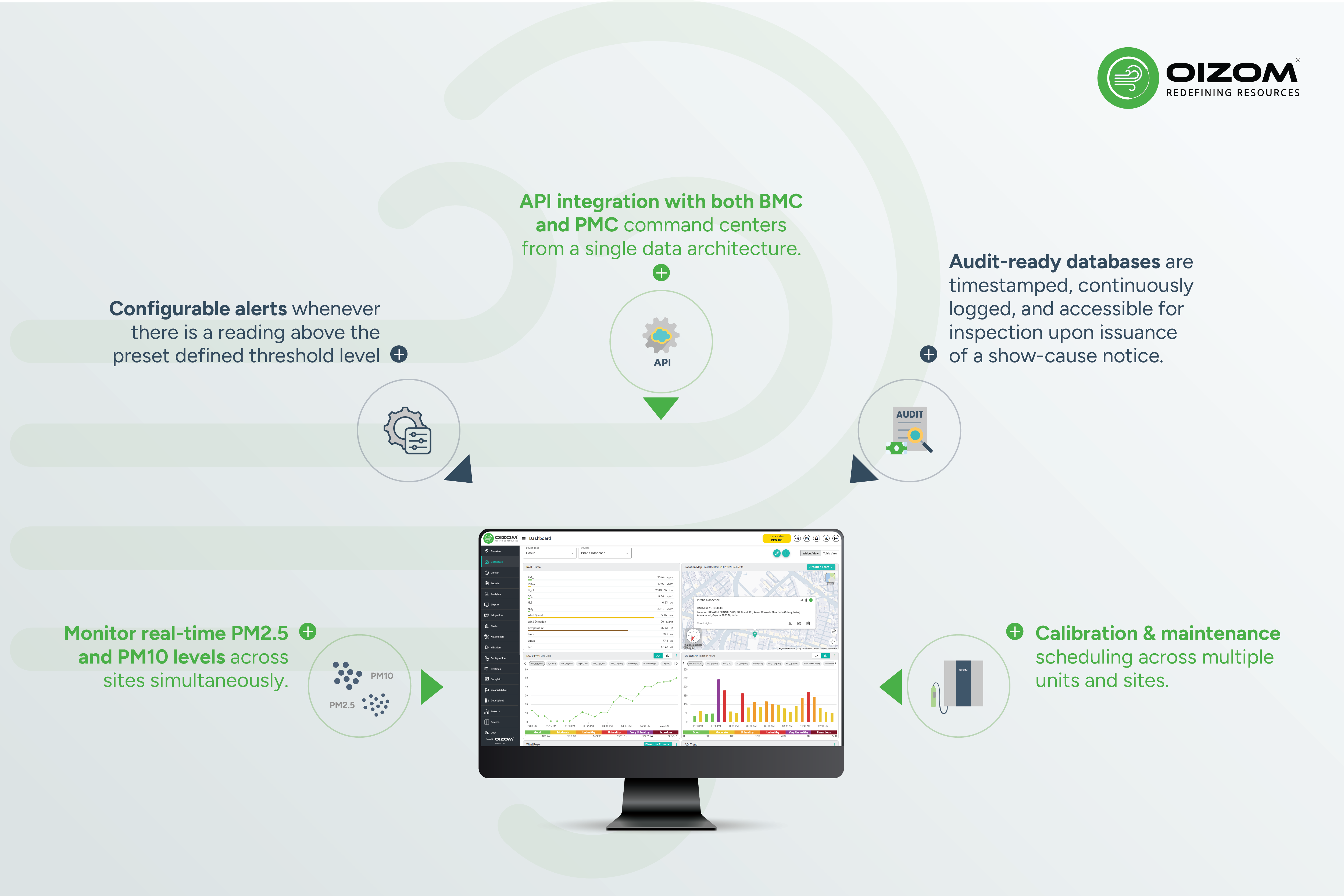
Oizom's Envizom platform provides a centralized dashboard for exactly this scenario. Given the dashboard setup, each PM unit will feed all collected data (reporting on all pollutants) into a single interface. Built for scalable monitoring, Envizom enables organizations to manage multiple sites through a single platform while maintaining historical records, calibration logs, and real-time operational visibility for compliance audits. This allows for:
- Monitor real-time PM2.5 and PM10 levels across sites simultaneously
- Configurable alerts whenever there is a reading above the preset defined threshold level
- API integration with both BMC and PMC command centers from a single data architecture
- Audit-ready databases are timestamped, continuously logged, and accessible for inspection upon issuance of a show-cause notice
- Calibration and maintenance scheduling across multiple units and sites
Conclusion
Maharashtra's construction air quality mandates are not a regulatory direction to monitor but an active compliance obligation with enforcement already underway. Rather than questioning the compliance requirements, developers and EHS Managers working in Mumbai, Pune, Navi Mumbai, and Thane must determine whether their existing monitoring infrastructure meets the specific requirements of each air quality jurisdiction.
Getting that answer right across multiple cities, multiple sites, and multiple regulatory frameworks simultaneously is what separates a construction programme that operates without interruption from one that receives a stop-work notice at the worst possible moment. For organizations planning long-term compliance strategies, selecting monitoring technology with proven field performance across India's diverse environmental conditions can reduce operational complexity as regulations continue to evolve.







.be0dea41.svg)