
Summary
The term “EPA certified” appears frequently in brochures for air sensors. However, this certification is rarely applicable. The only real EPA certification the Federal Reference Method (FRM) and Federal Equivalent Method (FEM) program applies to is expensive, station-based regulatory analyzers. The EPA has clearly stated that it has not certified any air pollution sensor equipment. But there is another reason why the EPA is significant. While it doesn't certify low-cost sensors, it has developed methodologies that include elements such as collocation instructions, siting rules, data analysis tools, and direct research organized as the so-called Air Sensor Toolbox.
This blog outlines the system developed by the EPA, discusses its implications, and compares the U.S. methodology with that of other countries.
Introduction
The term “EPA certified air sensor” appears in multiple places: advertisements, brochures, specifications, social media, sales calls, etc. The basic assumption is almost always the same: somewhere, EPA must have tested this specific product and signed off on it. However, in reality, this is not the case. As the agency states, testing protocols are voluntary, and testers do not receive certification or endorsement by the EPA.
This single phrase clarifies multiple misunderstandings regarding air sensors. However, that doesn't mean EPA has stayed out of the low-cost sensor space; it's actually been quite active. The agency's Office of Research and Development has conducted numerous sensor-based developments and has established its Air Sensor Toolbox.
First, Rule Out What People Actually Mean by "EPA Certified"
Before getting into the real subject, it's worth clarifying the one place where 'EPA certified' is a legally accurate term. This relates specifically to the Federal Reference Method and the Federal Equivalent Method Program established under 40 CFR Part 53. A manufacturer conducts a prescribed battery of tests on the instrument, following procedures that EPA has specified in exacting detail, and submits the resulting data to EPA as an official request. EPA reviews the data against its predefined performance criteria, tied to the National Ambient Air Quality Standards (NAAQS), and decides whether to grant the designation.
If the instrument meets the criteria, EPA publishes the designation in the Federal Register and requires a permanent label that permits identification of a specific methodology by its number. The Federal Reference Method and the Federal Equivalent Method cover instruments such as the Beta Attenuation Monitor, which measures particulate concentration by tracking the degree of attenuation of a beta-ray source as particles accumulate on a filter tape.
The FRM/FEM program was developed for a small range of expensive stationary regulatory analyzers. No commercially available low-cost or mid-cost sensor-based monitoring device holds FRM/FEM status, and that's not a shortcoming of these devices, just a different category of instrument evaluated for a different purpose.
So the one-line takeaway before moving on: if you're evaluating a sensor-based monitor, FRM/FEM isn't the relevant question. The Air Sensor Toolbox is.
Inside EPA's Air Sensor Toolbox: The Six Pillars
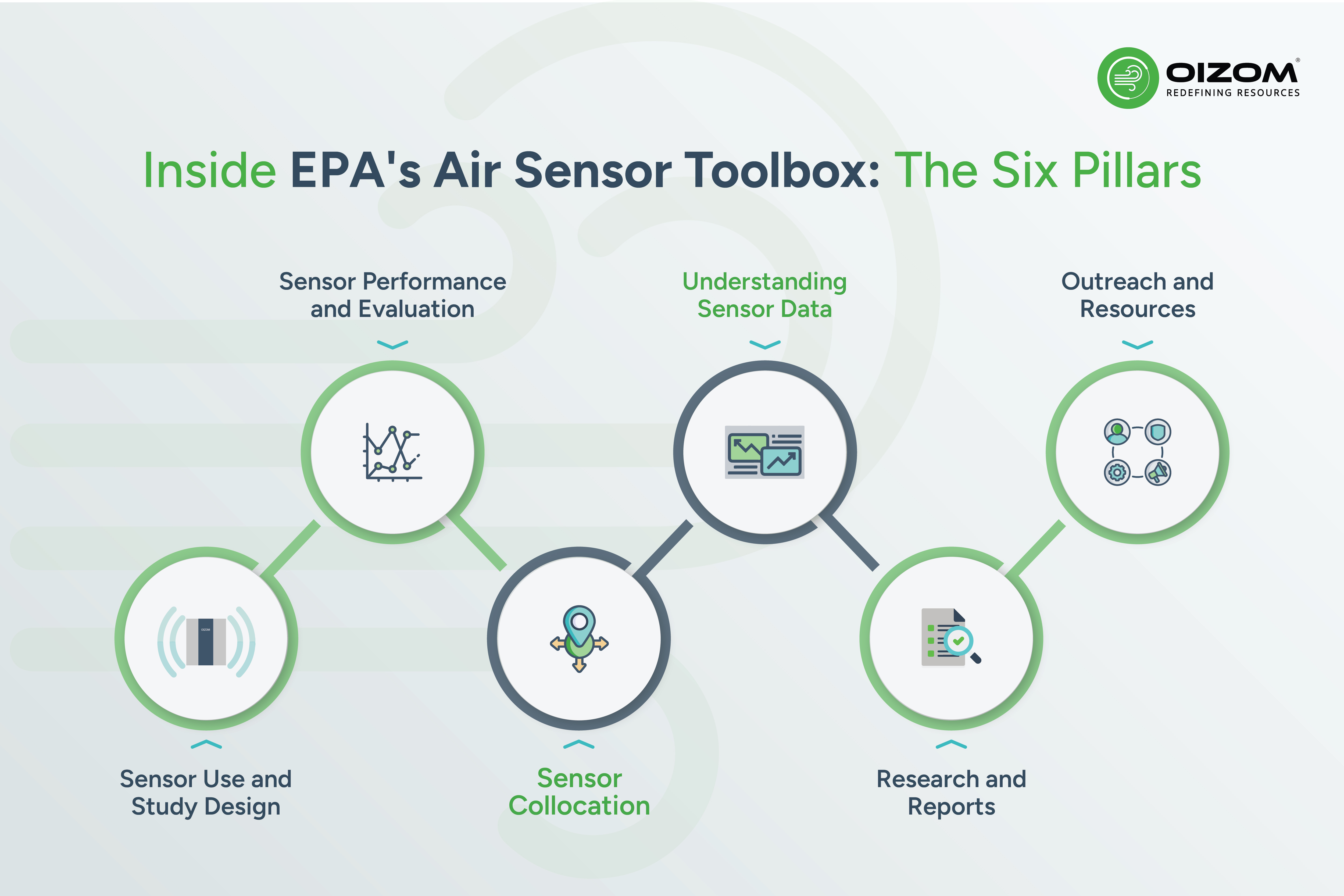
The Air Sensor Toolbox is organized around six areas, and the real substance lives inside each one, far more detail than the shorthand 'EPA has voluntary protocols' usually conveys.
Sensor Usage and Study Design
In this part, the EPA discusses its approach to planning, even before taking a single measurement. EPA recognizes that the primary use of air sensors is non-regulatory supplemental and informational monitoring (NSIM), including day-to-day trend monitoring, air quality forecasting, participatory science, education, emergency response, mobile monitoring, personal exposure monitoring, and indoor air monitoring.
The most valuable resource in this section is the Enhanced Air Sensor Guidebook published in 2022, which guides readers on interpreting sensor data and planning monitoring, treating planning as a necessary part to ensure quality.
Apart from this, the EPA maintains a Guide to Siting and Installing Air Sensors, addressing issues of where a sensor is to be placed to maximize the usefulness of its data, and a set of Standard Operating Procedures (SOPs) developed by EPA scientists for sensors used in their evaluations and field projects, ensuring consistent device operation.
Sensor Performance and Evaluation
This is the most detailed of the six pillars: the EPA performance targets and testing protocols developed in the workshops in Research Triangle Park in 2018 and 2019 and published in several reports. However, one important fact is commonly omitted. The same section directs users to two distinct types of independent assessment: regular evaluations carried out by external agencies, such as AQ-SPEC and similar organizations, and the EPA's evaluations of sensor performance conducted by its own scientists.
Moreover, there are more details worth knowing, which are not usually discussed. The first is that the EPA recommends that sensor performance data be reported twice: the first time, present raw, uncorrected results; the second time, present results after applying the correction model. This matters for interpreting any accuracy statement: an R² value is only useful when it's clear whether it reflects raw sensor output or data that's already been calibrated against the reference instrument.
Second, EPA is not the only body to develop this kind of framework; the EU and UK have each published their own data quality objectives for low-cost sensors. However, there are a few distinctions; EPA's method treats the reference monitor as the error-free "gold standard" when calculating a sensor's performance metrics. The EU and UK methods instead apply an "uncertainty" metric that reflects the reference instrument's uncertainty, so a sensor being evaluated isn't unfairly penalized for noise that actually comes from the reference monitor rather than the sensor itself.
Sensor Collocation
Collocation is the mechanism that makes all of this testable. It works by having one sensor run alongside a reference monitor to determine how closely its readings match the reference monitor's. The EPA's own language specifies that, since sensor settings usually can't be adjusted the way a regulatory instrument's can, the raw sensor data is corrected mathematically instead with a multiplier, an additive factor, or both, so that the sensor reading closely matches the reference monitor's reading.
The EPA provides three specific resources to support this. The first resource is the Air Sensor Collocation Instruction Guide, which explains the importance of collocation and how to perform it in practice. The second resource is the list of Collocation Opportunities, which lists regulatory monitoring agencies that collect sensor readings using reference instruments and allows researchers, communities, and companies to collocate their sensors. Each site is independently operated, with its own eligibility rules and available pollutants. Finally, the Sensor Collocation Macro Analysis Tool is an Excel-based resource that enables non-expert users to compare their own sensor data with regulatory monitoring data without needing to process it with custom statistical software.
Understanding Sensor Data
Acquiring the necessary comparable data is merely half the task; interpreting it comes next. Among the available EPA resources on the topic are a video series on how air quality data is collected and interpreted, and a set of software tools (the Air Sensor Data Tools) that can help process and visualize sensor data.
Research and Reports
This section discusses EPA's direct research activity conducted at its facilities, apart from voluntary programs. The researchers at the EPA study sensor technology, develop novel integrated measurement methods, and place sensors side by side with reference-grade monitors while collecting data to compare the precision and dependability of low-cost sensor technology. The EPA publishes the results of such research in both technical reports and scientific articles. The agency also maintains a list of its current and past research projects for transparency.
Moreover, EPA continues to conduct such studies through federal technology transfer agreements with other organizations, and also through various grants and competitions.
Outreach and Resources
The last pillar is where the EPA shares information with wider audiences. This includes creating Air Sensor Loan Programs through the regional offices of the EPA (usually in cooperation with libraries and museums), developing educational curricula adaptable from elementary classrooms to community workshops, and organizing several conferences and workshops, with webinars, on sensor parameters, best practices, and EPA’s latest findings. Additionally, the EPA publishes articles, infographics, and newsletters to inform the public about progress in its sensor studies.
When these six pillars are summarized, they represent the real answer to the question ‘What has EPA done about sensor technologies?’: not a certification, but arguably a more comprehensive body of applied guidance than certification alone would have provided.
What the Protocol Actually Prescribes for Collocation
Zooming in on the collocation methodology specifically, since it's the part most directly relevant to how a company would actually validate a sensor-based product: for evaluating a PM2.5 sensor, the EPA's recommended approach is to co-locate the PM2.5 test sensor next to a reference monitor (FRM or FEM). This needs to be done for a minimum of 30 days, at a minimum of two testing sites representing different climatic regions. This is because 30 days is not an arbitrary number; testing a sensor for a few days under favorable conditions does not yield conclusive results about its performance in difficult weather conditions.
Also, it is recommended to test at least three units of the same sensor model and hardware-and-software configuration to determine whether their performance is linked to the sensor's design or simply reflects the luck of an individual unit. This is where Oizom's own validation practices offer a concrete, real-world example rather than merely claiming a certification. For instance, Dustroid has been placed next to a reference station that includes a BAM-1020 analyzer. The BAM-1020 analyzer carries an EPA FEM designation for PM measurement. The data received from both devices is compared over the agreed co-location period to calculate metrics such as R².
It's worth noting that a formal certification program for this category of devices does exist, but not through the EPA. The UK's Environment Agency operates MCERTS, which includes a specific product certification standard for indicative ambient particulate monitors in the same low-cost/mid-cost sensor category EPA's voluntary protocols address without certifying. MCERTS certification involves formal laboratory and field testing conducted by an accredited third-party body, and Dustroid holds this certification.
Why Voluntary Doesn't Mean Optional
It's common to interpret ‘voluntary, no certification’ as an indication that the framework is merely a luxury rather than a serious effort. That undersells what's actually happening. The voluntary structure exists in part possibly because setting the bar too high risked pushing manufacturers to avoid the framework altogether, which would undermine the very consistency it was meant to create. The voluntary structure isn't a compromise on rigor. It's what makes broad adoption possible in a fast-moving product category where no mandatory regime exists yet. It arguably shouldn't, given how quickly the underlying technology continues to evolve.
Seen this way, a manufacturer that follows the protocol closely for the full co-location duration, multiple sites and units, and transparent metric reporting is opting into a level of transparency it isn't legally required to provide. This may, in fact, be more of a trust signal than any badge of certification.
The Geography Problem: Why EPA Protocol Isn't a Universal Passport
There is one restriction that seldom appears in vendors’ marketing, but it should be emphasized much more than just mentioned. EPA's approach to testing and target values has been developed from workshops held in the U.S. and from literature reviews and field studies conducted mostly in the U.S., taking into account the country's various climatic conditions. Even the collocations presented by the EPA refer to regulatory agencies in the U.S. This is not an error but rather reflects the statistical population from which the framework was drawn.
The practical distinction is between methodology and target values. The methodology- how long the collocation lasts, how many devices are tested, which parameters are measured, and how sensor readings are correlated with the reference instrument is sound experimental design that transfers well anywhere in the world. However, standards and even adjustment equations obtained under U.S. field conditions cannot be assumed to hold outside the U.S. without re-derivation.
In a market such as India, this is more than a simple drawback. The humidity levels differ from those at most U.S testing stations because they are higher and vary greatly throughout the year. The composition of PM varies significantly, with higher amounts of crust and dust in industrial areas compared to PM from combustion, as studied in the U.S. literature. Baseline ambient concentrations of some pollutants sometimes exceed the ranges the original U.S. target-value studies were built around.
None of this invalidates using EPA's testing approach as a methodology. It does mean that a sensor validated solely against U.S.-derived findings, with no local co-location data, tells only half the story. The preferred option is to implement EPA methods alongside local co-location processes and methods for obtaining local data.
Where AQ-SPEC and EPA ORD Testing Fit In
Two other names come up often enough in this space that are worth placing correctly, since they're easily confused with the framework above. AQ-SPEC (Air Quality Sensor Performance Evaluation Center) is known for conducting independent field and lab tests on affordable sensors, with results publicly accessible. AQ-SPEC is the type of independent evaluation program that EPA's Sensor Performance and Evaluation guidance directs users to, making it easy to mistake it for an EPA program. AQ-SPEC is run by the South Coast Air Quality Management District, a California regional air agency operating entirely independently of EPA.
As for the agency's Office of Research and Development, it occasionally tests specific low-cost sensors directly, often in cooperation with local agencies. For example, field evaluations have been conducted with Maricopa County Air Quality in Phoenix. The research falls under the EPA's Research and Reports pillar and provides data generated by the EPA, published in technical reports and peer-reviewed journals.
Comparison Table
| What | Who | Mandatory? | Result |
| FRM/FEM | U.S. EPA | Legally required for regulatory monitors | Formal certification, published in the Federal Register |
| Air Sensor Toolbox (Performance Targets, Collocation, Study Design, etc.) | U.S. EPA (voluntary framework) | No | Shared testing methodology, siting guidance, and analysis tools; explicitly no certification or endorsement |
| AQ-SPEC | South Coast AQMD (not EPA) | No | Independent third-party field and lab evaluation reports |
| EPA ORD Field Testing | EPA scientists | No | Research findings, not approval |
How to Read a Manufacturer's Claim, in Practice
Since no formal certification exists for this product category, the more useful skill isn't checking a compliance box, but knowing which questions separate a validated claim from an unverified one.
- Does it name specifics? Does the collocation claim actually name the reference instrument and the testing duration?
- Does the testing match EPA's protocol shape? Does it follow 30-plus days, multiple sites across different climates, and multiple identical units, with sensible siting per EPA's own guidance, or is it a single short-duration test being generalized into a broader accuracy claim?
- Is it locally validated? Is target-value performance drawn from the U.S. reports being applied without any local validation to confirm it holds in the actual deployment geography?
- Is the R² figure specified? Is a quoted R² figure specified as raw sensor output, or as data after calibration against the reference instrument?
Conclusion
EPA didn't build a certification system for sensor-based air quality monitoring yet. Instead, it built a genuinely substantial, voluntary body of protocols: tests, collocation protocols, siting advice, analytical tools, and research that gives manufacturers a real, scientifically grounded way to prove their own performance, and gives everyone else a way to tell the difference between a substantiated claim and an inflated one. Following that framework rigorously, using its methodology and tools where they genuinely apply, and staying transparent about local validation on top of any U.S. derived benchmark is the actual credibility marker in this space, not an 'EPA certified' badge that doesn't exist for this product category, and never has.






.be0dea41.svg)