Summary
Dust suppression is used in construction, mining operations, industrial facilities, smart-city, and odour-management installations globally. Suppression methods are well established. However, the challenge almost always lies in suppression: suppression is deployed, assumed to be working, and never verified.
What this guide establishes:
- Suppression methods are not universally effective: water suppression fails in high-wind conditions, chemical suppressants degrade over time, while physical barriers have coverage limits
- Dust suppression applies across distinct use cases: construction, mining, industrial emissions, smart cities, and odour management, each requiring different measuring methods and monitoring approaches
- The most common failure in dust suppression programmes is treating suppression as a set-and-forget measure; operational status alone does not confirm effective dust control
- Real-time particulate monitoring shows whether suppression is actually reducing airborne dust, rather than simply confirming if the system is running
What Is Dust Suppression?
Dust control and dust suppression may sound similar; however, the difference matters for operations.

- Dust suppression refers to the actions taken to prevent dust particles from becoming airborne or to settle them. Dust suppression is a physical or chemical intervention that involves watering haul road surfaces, deploying mist cannons, stabilising piles, or installing barriers around a demolition site.
- Dust control, on the other hand, refers to a set of measures that includes dust suppression methods, process monitoring, recordkeeping, administrative processes, weather-related scheduling, etc. Most sites practice suppression, but fewer practice control.
The gap between these two is where compliance failures, community complaints, and regulatory penalties rise.
Where Does Dust Suppression Apply?
Fugitive dust suppression applies across various sectors, not only construction. Each operational context has its own emissions profile, suppression needs, and monitoring obligations. Some contexts include:
- Construction and Demolition Activities: Regulations for C&D activities continue to evolve. BMC Mumbai, PMC Pune, and NMMC Navi Mumbai now require real-time boundary air quality monitoring alongside dust suppression measures.
- Mining and Quarrying Operations: Mining operations generate dust to an extent that construction suppression methods alone cannot address; haul roads extend for kilometres, multiple crusher points operate simultaneously, and tailings areas span tens of hectares. In mining, measures require coordination across multiple emission sources and haul routes.
- Industrial Facilities Emissions: Dust emitted by industrial facilities, including cement plants, steel mills, aggregate terminals, and chemical handling facilities, is a type of fugitive emission that requires dust suppression and monitoring at the facility’s fence line.
- Municipal Road Dust and Smart Cities: Anti-smog gun networks, mechanical road sweeping, and construction zone monitoring are increasingly integrated into smart-city air-quality management frameworks. Municipal agencies need data from suppression systems to justify infrastructure investments and measure system effectiveness.
- Odour Management: STPs, landfills, WWTPs, and fertiliser facilities use misting suppression with neutralising agents to control odorous gases including H2S, NH3, and mercaptans.
Dust Suppression Methods: What Each One Does and Where It Fails
Dust suppression practices are well established across most EHS operations. However, operational limits and the rationale for requiring measurement-based verification remain largely overlooked.
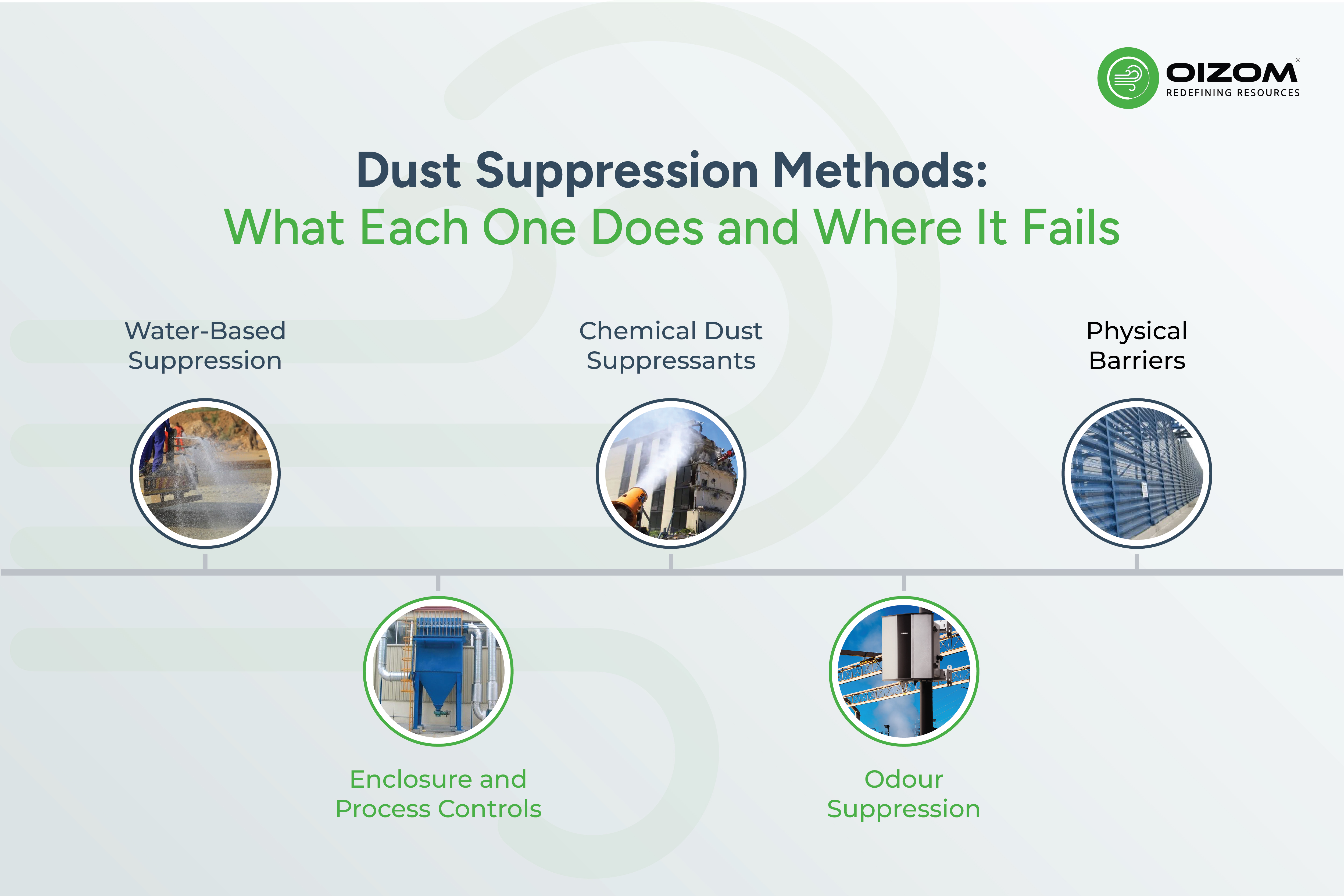
1. Water-Based Suppression
Water application increases the moisture content of surface materials. This enables better inter-particle cohesion and minimises the risk of wind and mechanical disturbances generating airborne particles. It is a widely deployed dust suppression method across construction, mining, and road environments and the most frequently misapplied.
The main source of confusion is the perception that water suppression is a one-time solution rather than a continuous process. A road that has been watered at 8 o’clock in dry and windy conditions may be successfully suppressed only for 45 minutes. By 10 o’clock, the surface moisture is gone, and PM10 resurfaces again. A site that records water suppression frequencies in its daily log has documented an activity, not a suppression outcome.
Effective application parameters:
- Active Earthmoving and Grading: Minimum 2-hour watering intervals, or more frequently when wind speed exceeds 15 km/h
- Unpaved Haul Roads: 30-45 minute intervals during active vehicle use
- Demolition Zones: Continuous misting or pre-wetting before material disturbance
- Stockpile Surfaces: Misting at least every 4 hours during dry, windy conditions
Where water suppression fails:
- Dry fine-material stockpiles where evaporation rate exceeds absorption capacity
- High-wind conditions where droplet drift prevents effective surface application
- Areas where vehicle traffic immediately disturbs treated surfaces
- Off-hours periods when no suppression is active, but emissions continue
Anti-smog guns and mist cannons can increase suppression range from 50 to 100 meters and are particularly useful in large open areas, active demolition sites, bulk transfer areas, and around crushers, where point-type watering is difficult.
2. Chemical Dust Suppressants
Chemical agents are meant to overcome the major drawback of water suppression: its limited duration of action. As chemical suppressants can adhere to surface particles, form crusts, or undergo hygroscopic processes, they can extend effective suppression from hours to days. Common types of chemical suppressants include:
Hygroscopic salts (CaCl2, MgCl2) can absorb atmospheric moisture to maintain surface dampness. They are appropriate for unpaved haul roads in moderate humidity; a properly treated road maintains the required suppression level even at 60–70% humidity. However, they are not suitable for very dry conditions where the air is insufficiently humid.
Polymer emulsions and lignosulfonates bind surface particles into a cohesive crust, resisting both wind erosion and vehicle-induced disturbances. They are used to maintain haul road surfaces between water applications and to protect stockpiles long-term. However, they have to be reapplied after rain or any substantial disturbance.
Petroleum-based products like emulsified asphalts are used in mining operations, especially when haul roads require constant maintenance. They are highly effective, but their use should be carried out with caution near water bodies and in areas with strict soil regulations.
When choosing chemical suppressants, consider site-specific material properties, relative humidity, legal constraints, and total application cost, including application frequency. No chemical suppressant eliminates the need for monitoring; it extends the suppression window but does not guarantee compliance with boundary concentration limits.
3. Physical Barriers: Reducing Wind Energy at the Source
One way to reduce wind speed and wind-erosion force during dust mobilisation is to use physical barriers. The efficiency of these barriers depends on the location, height, and blockage capacity.
Indian municipal regulations increasingly mandate solid hoarding at least 3 metres high, and it is standard practice in most developed-market construction environments. When positioned perpendicular to current wind direction, hoarding reduces surface wind speed in the protected zone by 50-70%.
Scaffolding debris netting protects work areas by preventing concrete dust, demolition debris, and fine particles from being blown up by the wind. This is especially important when discussing multi-storey buildings.
Vegetation establishment (revegetation or reclamation) on inactive, disturbed areas and post-construction zones is one of the few suppression measures that improve over time as plant cover develops.
4. Enclosure and Process Controls
Enclosed material handling, wet scrubbers, bag filters, and covered conveyor systems capture particles at the source instead of managing their dispersal after release. They are standard in industrial process environments but are capital-intensive and largely impractical for open-site earthwork.
In construction and demolition works, covered waste chutes at high construction sites and casing during saw-cutting processes can significantly reduce local emissions from operations that otherwise cause short-lived, severe dust emissions.
5. Odour Suppression: A Distinct Category
Odour suppression at STPs, landfills, and industrial fencelines uses misting systems with neutralising chemical agents, typically targeting H2S, NH3, mercaptans, and VOCs rather than PM. The suppression mechanism is chemical reaction and odour neutralisation rather than particle binding or settling.
Effective odour suppression requires wind rose studies to determine where odour plumes could reach receptors, plus monitoring odorous gas concentrations to show whether the chosen method reduces odour units appropriately at the boundary.
Dust Suppression Across Industries: What Changes by Use Case
Construction and Demolition
Construction dust suppression regulations have now become much more stringent. BMC Mumbai's Circular M/6526 (May 2025), PMC Pune's circular (December 2025), and NMMC Navi Mumbai's 27-point standing order procedure make it mandatory to monitor real-time PM10 and PM2.5 levels and implement dust suppression measures. The circulars not only make dust suppression compulsory but also require proof of its effectiveness.
Devices such as Oizom’s Dustroid and Polludrone enable continuous monitoring of particulate matter, gaseous pollutants, and meteorological conditions across construction sites.
At a site where Oizom deployed its services, PM10 monitoring revealed that fixed-time water suppression was inadequate during dry afternoons. Adjusting suppression based on real-time data made dust control more responsive and measurable.
Mining and Quarrying: Scale and Continuity Are the Challenge
Dust control in mining can be more complex than in construction. Because haul roads can be many kilometres long, and crushing stations and waste areas can span several hectares, dust can swirl even at night and on weekends, when no dust-suppression personnel are on duty.
Key dust control activities in mining include timing blasting operations based on wind speeds; wet suppression at the crusher input and output; covering or mist-spraying conveyors during cargo transfer; and chemically treating waste surfaces. In mining operations, continuous perimeter control, rather than monitoring specific fixed points, helps identify the causes of excessive dust levels under certain wind conditions.
Industrial Facilities: Process Dust Meets Fenceline Compliance
Industrial establishments pose a unique suppression challenge; the dust produced in a cement plant differs in particle size distribution, density, and surface chemistry from that produced in a steel plant or a chemical processing facility. Suppression systems such as wet scrubbers, bag filters, and local exhaust ventilation must be selected and adjusted according to the material involved.
Fenceline monitoring of industrial installations must also be set according to the type of particles likely to be present. A PM10 sensor set to monitor standard mineral dust aerosol will yield inaccurate measurements when monitoring a plant that produces alkaline calcium silicate dust. Co-location with a reference sensor is required to derive the correction factors needed for reliable fenceline monitoring.
Smart Cities and Municipal Road Dust
Cities have become more assertive in their requests and expectations for applicable air quality measures. Anti-smog networks, mechanical street cleaning, and watering in construction zones are just some of the measures being used and expected to yield significant air quality improvements as cities make pollution control part of their smart city systems.
Oizom’s Envizom platform integrates smart city monitoring systems across numerous cities, enabling anti-smog project managers to continuously monitor PM reduction levels after implementing measures such as anti-smog guns and mechanical street cleaning. It does this by comparing PM levels before and after implementation.
Odour Management: STPs, Landfills, and Industrial Fencelines
Odour monitoring at wastewater treatment facilities and waste disposal areas is challenging because odour complaints are infrequent and depend on weather conditions, sometimes occurring during wind-direction shifts or temperature inversions that increase odours in specific zones. Without continuous monitoring of H2S, NH3, and TVOC emissions at the boundary, operators cannot link misting suppression to smell reduction at the receiver location, preventing them from optimising the system.
The Verification Gap: Why Most Dust Suppression Programmes Don't Know If They're Working
The most consistent finding across construction, mining, and industrial dust suppression is that most operators know their suppression systems are running. However, very few can demonstrate that their suppression systems are working effectively. An operational water suppression system is functioning equipment. A water suppression system that demonstrably reduces PM10 boundary concentrations to regulatory limits is a compliance asset.
In most cases, visual inspection is the primary validation method across construction sites. However, visual inspections cannot detect PM2.5, let alone PM10. That is why, in some places, visual inspections can still yield satisfactory results even when particulate emissions exceed accepted levels. Regulators across major jurisdictions are increasingly moving away from visual inspection as the primary compliance mechanism toward real-time particulate monitoring at site boundaries.
"The most common gap we see on construction and industrial sites is not a lack of suppression measures, but a lack of measurement. A site can run water suppression all day and still exceed boundary limits if the method, frequency, or coverage doesn't match current conditions. Monitoring is what tells you which of those variables needs adjusting." Kruti Davda, Environment Lead, Oizom
The shift from operational to performance compliance is the defining regulatory trend in global dust management. It makes real-time monitoring not merely an enhancement to suppression programmes, but the layer that makes their performance measurable and defensible.
Dust Suppression Checklist: Is Your Programme Actually Working?
Before the next inspection, audit, or community complaint, this checklist might help assess whether your dust suppression programme manages outcomes or just activities.
- Have all dust-generating sources been identified by activity type, not just location? The same physical area generates different dust profiles during grading, vehicle trafficking, and material placement. So, source identification must be activity-based.
- Is water suppression applied at the correct frequency for current weather conditions? A fixed suppression schedule that does not adjust for wind speed, temperature, and humidity is time-driven, not weather-based.
- Are chemical suppressants reapplied on schedule after rain or vehicle disturbance? Crust-forming suppressants lose effectiveness after rainfall and heavy vehicle passes. Reapplication schedules must account for these reset events.
- Are physical barriers positioned perpendicular to prevailing wind direction? Barriers positioned parallel to wind direction provide minimal protection. Review positioning when seasonal wind patterns shift.
- Is suppression effectiveness verified by measured PM concentrations, not visual inspection? Individual PM2.5 and PM10 particles are invisible, so visual inspection cannot confirm boundary exceedances.
- Do weather conditions trigger changes in suppression protocol? Wind speed thresholds, humidity levels, and temperature ranges all trigger defined suppression responses, not just observation.
- Are off-hours emissions covered by passive suppression or continuous monitoring? Stockpile dust, tailings erosion, and exposed surface emissions do not stop at the end of the shift.
- Are suppression records and monitoring data maintained in an audit-ready format? Records stored across email threads, spreadsheets, and site diaries cannot be assembled on short notice for a regulatory inspection.
- Does real-time PM data feed into suppression scheduling decisions? If PM data is reviewed weekly rather than in real time, it is a reporting tool, not a management tool.
Conclusion
Dust suppression is necessary, but insufficient on its own. At most construction, mining, industrial sites, smart city monitoring systems, and odour management systems apply suppression measures, but rarely verify their effectiveness. Sites that achieve and maintain low boundary concentrations are not the ones with the most suppression equipment. They are the ones that measure the efficiency of the suppression measures applied, understand why it is sometimes insufficient, and make changes before the measured data become compliance records rather than management tools.
The question is not whether you are suppressing dust. It is whether your suppression is working, and you can only answer that with data.







.be0dea41.svg)