Industrial Air Quality Audit at a Plastic Processing & Recycling Plant, Hungary

Hungary

March 2025

Industrial EHS

Klarwin

Pollusense

EHS Monitoring
Introduction
Air quality inside a plastic processing facility is shaped by the processes themselves. Injection molding, vacuum forming and regranulation each release their own mix of fine particulates and volatile organic compounds, and concentrations can vary dramatically from one hall to the next, even under the same roof, on the same shift.
At a plastic processing and recycling plant in Hungary, no air quality monitoring had ever been installed. The facility had no measured baseline for the conditions its workers were exposed to, at a time when Hungarian industrial sites face frequent environmental audits and periodic inspections, and when the organisation itself had committed to sustainability and ESG objectives that require verifiable environmental data rather than assumptions.
To establish that baseline, Oizom's partner, Klarwin, conducted a structured occupational health, safety, and environmental audit using a single Pollusense portable air monitoring station. Over a two-hour window, the unit measured 15 parameters across four production halls at two-minute sampling resolution, with all data analysed and visualised in Envizom. The audit converted an unmeasured working environment into a hall-by-hall exposure map, and into a concrete roadmap for permanent monitoring.
01 | 15 | 04 | 36x |
The Challenge
A plastic processing plant concentrates several distinct emission sources in adjacent spaces. Thermal processing of polymers releases volatile organic compounds; mechanical handling, regranulation and extrusion of recycled material generate dust across the full particulate range. Without measurement, it's challenging to understand which hall drives which risk, or whether the risk exists at all.
The project brought together four specific difficulties:
No prior monitoring, no baseline. The facility had never operated any air quality instrumentation. Every decision about ventilation, protective equipment and compliance documentation was being made without data. The first requirement was not continuous monitoring but a credible, quantified snapshot of actual conditions.
Four halls, four different atmospheres. Large injection molding, small injection molding, vacuum forming, and regranulation and extrusion each involve different materials, temperatures and mechanical processes. A single fixed measurement point could not characterise the site; the audit had to resolve conditions hall by hall, at the locations where workers actually stand.
A tight audit window demanded high-resolution data. The full assessment had to be completed within a single two-hour window across all four halls. That meant roughly thirty minutes per measurement point, enough to characterise each hall only if the instrument sampled fast enough to capture process-driven peaks rather than averaging them away.
An active compliance and ESG context. Hungarian industrial facilities face frequent environmental audits and periodic checks, and the organisation's sustainability commitments require precise environmental data for ESG reporting. The audit results had to be defensible: classified against recognised exposure limits, timestamped, and traceable.
The project required a monitoring approach that could:
- Measure particulates, gases and VOCs simultaneously from a single portable station, at the point of worker exposure.
- Relocate between measurement points in minutes, without recalibration or data interruption.
- Sample at a resolution fine enough to capture short-lived process peaks within a thirty-minute window per hall.
- Classify every reading against recommended 8-hour occupational exposure limits, in a format suitable for audit and ESG documentation.
- Translate a one-morning audit into a long-term monitoring and mitigation plan.
Why Oizom
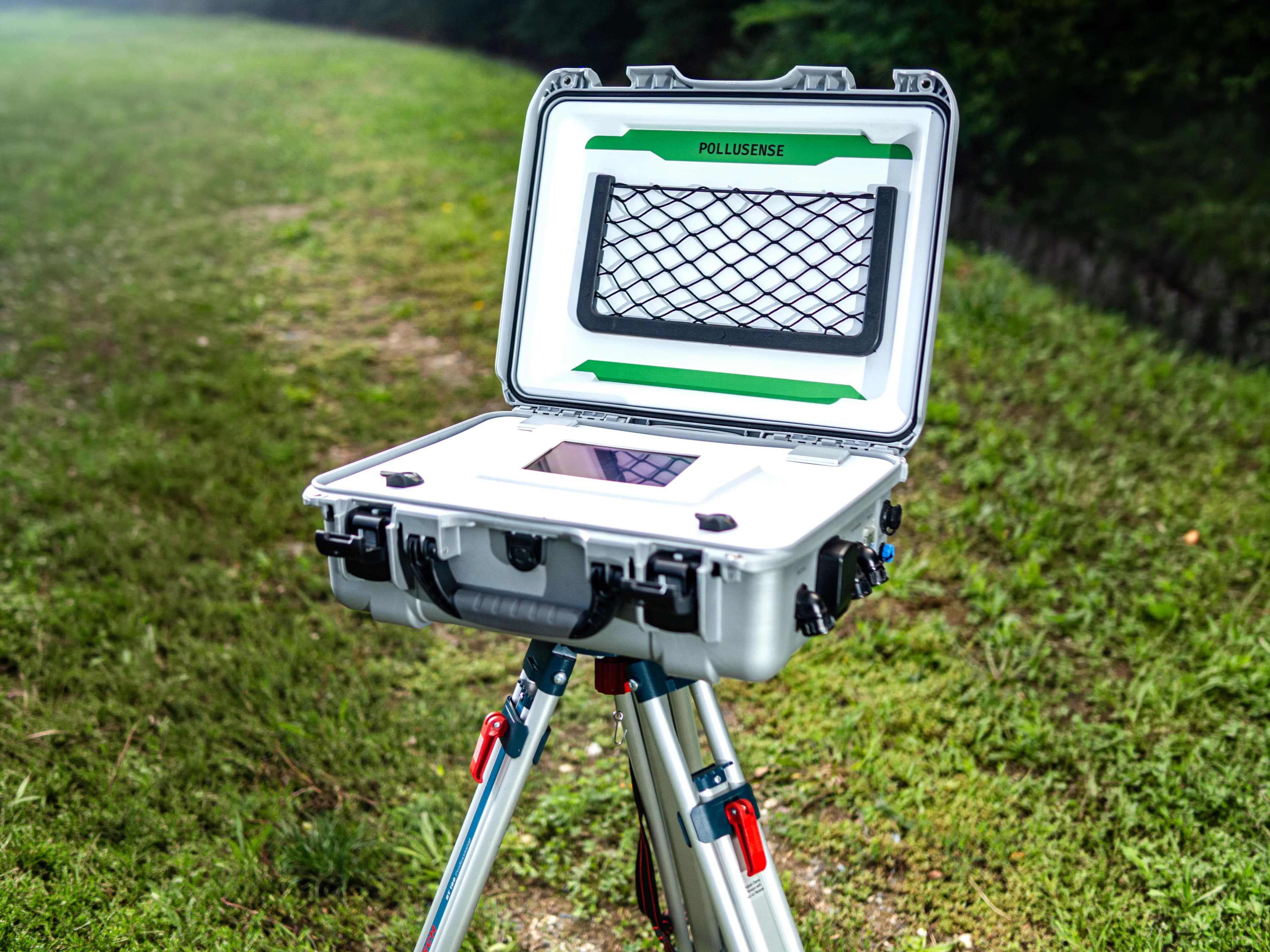
The Pollusense portable air monitoring station was selected for the audit, with Envizom as the analysis and visualisation layer. The decision came down to what a single portable case could measure, how fast it could measure it, and what the data could be turned into afterwards.
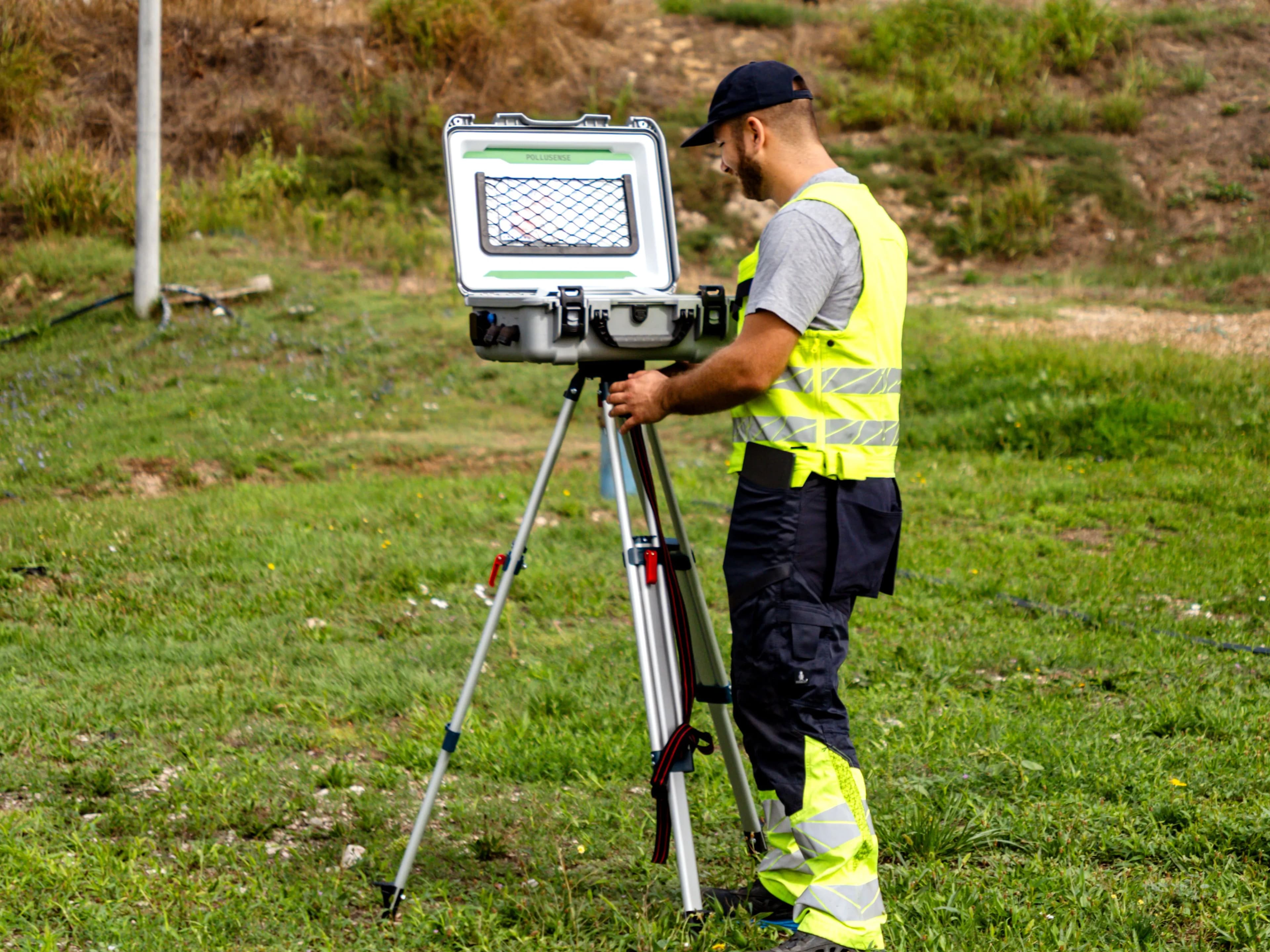
Fifteen parameters in one portable case. PM1, PM2.5, PM10 and PM100 across the full particulate range, eight gases including CO₂, NO₂, NH₃, NO, SO₂ and Cl₂, TVOC and CH₃SH for the volatile and odorous compounds characteristic of polymer processing, plus temperature, humidity and pressure, all from one tripod-mounted unit that moves with the auditor.
Two-minute sampling resolution. With samples taken every two minutes, each thirty-minute measurement point produced a genuine time series rather than a single spot value. This allowed the audit to distinguish a stable background from process-driven spikes, most importantly, the TVOC excursion in the vacuum forming hall, which peaked at over 11,800 µg/m³ and would have been flattened by longer averaging.
Rapid redeployment. The audit covered four halls in two hours because the station could be repositioned and measured again within minutes, keeping the full assessment within a single working morning with no disruption to production.
Envizom analysis and classification. Every reading was streamed into Envizom, where values were visualised as time-series charts, classified on a colour-coded scale from Good to Extremely Poor against the recommended 8-hour exposure limits, and rolled into the Environmental Air Quality Index (EAIQ), which was tracked across the full audit. The output was not a table of raw numbers but an interpreted, audit-ready record.
A path from audit to permanent monitoring. Because the portable audit maps directly onto Oizom's fixed monitoring range, the findings converted cleanly into a hall-by-hall specification for continuous monitoring, a step the plant had lacked the data to design before.
The Deployment
The audit was conducted on March 4, 2025, between 10:30 AM and 12:30 PM. The Pollusense unit, mounted on a tripod at working height, was deployed sequentially at four measurement points in the following order: the hall of large injection molding machines, the hall of small injection molding machines, the hall of vacuum forming machines, and the hall of plastic regranulation and extrusion machinery.
At each point, the station measured continuously for thirty minutes, sampling every two minutes. All data streamed into Envizom, where each parameter was plotted as a time series and classified against recommended 8-hour occupational exposure limits on a six-band scale from Good to Extremely Poor. The Environmental Air Quality Index (EAIQ) was tracked throughout the audit window, yielding a single continuous curve of overall air quality as the station moved through the plant.
| Category | Parameters Measured |
| Particulate Matter | PM1, PM2.5, PM10, PM100 |
| Gases | CO₂, NO₂, NH₃, NO, SO₂, Cl₂ |
| Volatile & Odorous Compounds | TVOC, CH₃SH |
| Meteorological | Temperature, Humidity, Atmospheric Pressure |
Results
The two-hour audit produced a sharply differentiated picture of the plant. The four halls did not share one atmosphere; they had four distinct exposure profiles, each pointing to a different source and a different mitigation priority.
Hall | PM1 (µg/m³) | PM2.5 (µg/m³) | PM10 (µg/m³) | PM100 (µg/m³) | TVOC (µg/m³) |
Large Injection Molding | 45 - 50 | 95 - 100 | 190 - 220 | 230 - 250 | 950 - 1,000 |
Small Injection Molding | 17 - 19 | 20 - 23 | 40 - 48 | 55 - 57 | 550 - 590 |
Vacuum Forming | 45 - 47 | 47 - 48 | 85 - 87 | 87 - 89 | 10,000 - 11,000 |
Regranulation & Extrusion | 121–126 | 125 - 135 | 220 - 230 | 230 - 240 | 150 - 170 |
Reference: Recommended 8-hour exposure limits of 30 µg/m³ (PM2.5), 50 µg/m³ (PM10 and PM100) and 300 µg/m³ (TVOC).
Three findings stood out.
The regranulation and extrusion hall was the plant's particulate hotspot: PM1 at 121–126 µg/m³ and PM2.5 at 125–135 µg/m³, more than four times the recommended PM2.5 exposure limit, placing the finest, most respirable fractions in the Extremely Poor band, while TVOC in the same hall remained in the Good range. The problem there is dust from mechanical processing of recycled material, not fumes.
The vacuum forming hall showed the inverse profile: particulates in the Moderate band, but TVOC at 10,000–11,000 µg/m³, more than 33 times the recommended limit, peaking above 11,800 µg/m³ during the measurement window. The dominant risk in that hall is volatile organic compounds released during thermoforming, which are invisible and undetectable without instrumentation.
The small injection molding hall, measured with the same instrument on the same morning, returned Good to Moderate values across nearly every parameter. This contrast is itself a finding: it demonstrated that the elevated readings elsewhere were process-driven and local rather than a building-wide condition, and it gave the plant a realistic internal benchmark of what its air can look like.
The audit also documented the contributing conditions: relative humidity of 25–34% across the halls, reliance on cross-draft for ventilation with no dedicated exhaust system in place, and inconsistent use of personal protective equipment, which together turn the concentration data into an actionable safety picture rather than an isolated dataset.
Key Outcomes
Source Identification Hall by Hall
- Two hours of portable measurement resolved the plant into distinct exposure zones: a particulate-driven risk in regranulation and extrusion, a VOC-driven risk in vacuum forming, combined elevation in large injection molding, and near-benchmark conditions in small injection molding.
- Each hall now has a named dominant pollutant, which separates an "improve air quality" claim from a specific engineering task.
A Defensible Compliance and ESG Baseline
- Every reading is timestamped, classified against the recommended 8-hour exposure limits, and recorded in Envizom, a documented baseline that the plant can present during the frequent environmental audits and periodic inspections that Hungarian industrial facilities undergo.
- The same dataset feeds the organisation's ESG commitments, replacing assumptions with measured evidence of workplace conditions.
High-Resolution Data From a Single Morning
- Two-minute sampling across four thirty-minute measurement points captured process-driven peaks, including a TVOC excursion above 11,800 µg/m³, that spot checks or longer averaging intervals would have missed entirely.
- The team completed the full plant assessment within a two-hour window without interrupting production.
A Concrete Roadmap to Permanent Monitoring
- The audit findings were converted directly into a hall-by-hall specification for continuous monitoring: Dustroid units covering PM1–PM100 in all four halls, supplemented by Odosense stations with TVOC and CH₂O sensors in the large injection molding and vacuum forming halls where volatile compounds dominate.
- Recommended next steps: dedicated exhaust extraction, mandatory protective equipment, threshold-based alarms and automated daily air quality reports through Envizom, and integration of monitoring with ventilation control for energy savings, giving the plant a sequenced mitigation plan grounded in its own data.
Impact
Before the audit, the plant's air quality was unmeasured, not known to be good or bad, simply unknown, at a facility subject to regular external scrutiny and internal sustainability commitments. A single portable station and one working morning changed that.
The value of the exercise is not only in the numbers, striking as some of them are. It is in the differentiation: the audit showed that the plant does not have an air quality problem so much as three different ones, in three different halls, with a fourth hall demonstrating that better conditions are achievable on site.
That resolution makes the findings actionable: extraction where the dust is generated, VOC control where the fumes are released, protective equipment matched to actual exposure, and a permanent monitoring architecture specified hall by hall rather than guessed at.
For the workforce, exposure is now quantified and classifiable rather than assumed. For the organisation, the audit delivers the measured baseline its compliance obligations and ESG reporting require, and a clear, data-backed path from a one-day assessment to continuous, alerted, automated monitoring across the site.
About Oizom
Oizom’s innovative technology has redefined environmental monitoring by providing highly accurate and actionable data on various atmospheric parameters. Our offerings include weather stations, pollution tracking, and noise monitoring solutions. With seamless integration into smart city infrastructure, Oizom’s tools enhance decision-making, compliance monitoring, and community engagement towards a greener planet.

Case Studies



.svg)



.webp&w=3840&q=75)