
Summary
Governments and their environmental agencies across the globe are dedicated to monitoring air quality by tracking pollution levels, developing air quality standards, and providing the public with AQI (Air Quality Index) data to help them stay safe from harmful pollutants. This blog describes how some of the largest air quality monitoring agencies from around the world build systems that allow the public to understand who monitors air quality, what motivates their work, and how these measurements influence policy decisions at both national and personal levels. By understanding how these agencies operate, readers will have a clearer picture of how AQI data is produced and why consistent monitoring is essential for accurate information. As pollution challenges continue to evolve, awareness of the agencies behind our AQIs will become increasingly important for everyone, everywhere.
What Government Agencies Monitor Air Quality?
Air quality is frequently discussed during pollution surges, but behind every AQI reading lies an extensive network of scientists, monitoring systems, and regulatory checks that work continuously in the background. Each country is responsible for collecting air pollution data through its designated environmental agency to set standards and provide accurate, real-time information about the air we breathe. Knowing which agencies supply the information you rely on and why their work matters helps you better understand the values assigned to air quality readings. These agencies create national air pollution policies and guide everyday decisions about outdoor activities.
The agencies presented in this section are among the most significant worldwide, helping keep you informed about the quality of the air around you.
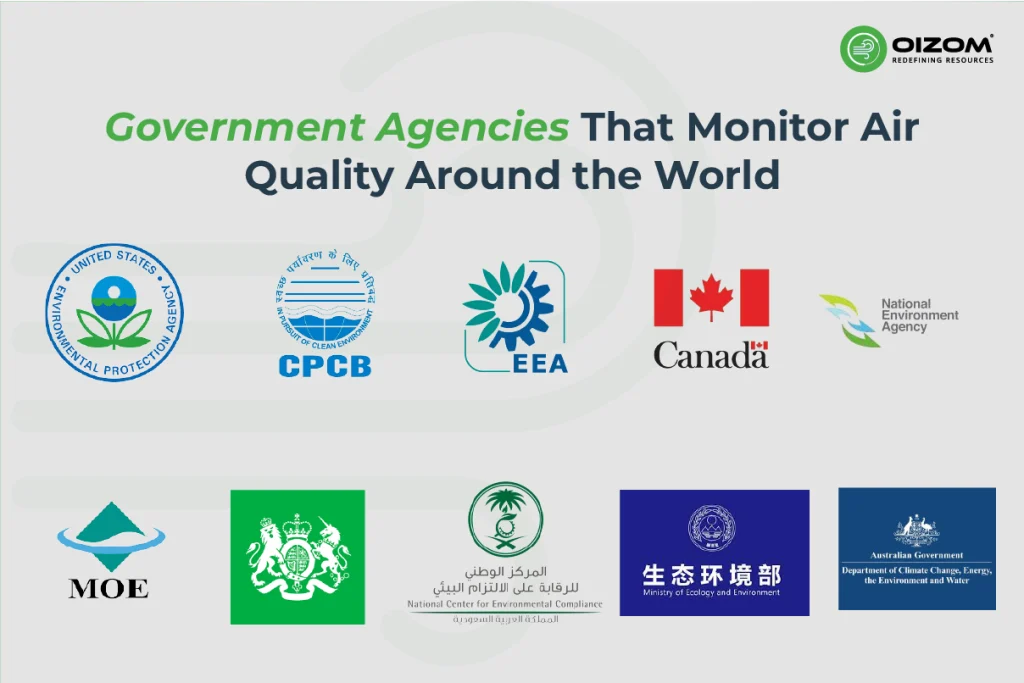
Government Agencies That Monitor Air Quality Around the World
In shaping the future of air quality management, numerous governmental agencies create rules and regulations and establish maximum acceptable levels of pollutants in ambient air through air monitoring networks and the accurate reporting of air quality data on a global scale. Examples of these governmental agencies include those in large industrialized countries, the European Union, and smaller developing nations with strong environmental legislation and agencies that create and enforce air monitoring standards. As a consequence, the quality of available air quality data has improved significantly, providing a high degree of trust and reliability in air quality information and allowing policymakers, researchers, and the public to use it from all air monitoring and reporting entities worldwide.
1.United States – Environmental Protection Agency (EPA)
EPA in the U.S. oversees the world’s largest air quality monitoring network. Under the Clean Air Act, the act establishes national air quality standards using thousands of monitoring stations that track pollutants, including PM, ozone, NO₂, and SO₂. As part of its broader role in regulating air pollution in the United States, the EPA also supplies data to multiple U.S. AQI systems and serves as a reference point for international research. With ongoing advances in measurement technologies, the EPA will continue to play a key role in shaping the future of AQI reporting worldwide.
2.India – Central Pollution Control Board (CPCB)
The Central Pollution Control Board manages India’s National Air Quality Monitoring Program (NAMP) and operates the Continuous Ambient Air Quality Monitoring Station (CAAQMS) network. Through its CPCB guidelines for ambient air quality monitoring, the agency has standardized methodologies, equipment requirements, and reporting protocols across the country. CPCB also built India’s uniform AQI calculation method, backed by the Commission on Air Quality Management (CAQM). By working closely with State Pollution Control Boards, the CPCB remains central to regulatory bodies and public reporting.
3.European Union – European Environment Agency (EEA)
The European Environment Agency collects, verifies, and compiles air quality data from every EU Member State through the Air Quality e-Reporting platform. This approach allows comparison of AQI and pollution levels throughout the EU. EEA assessments greatly influence local air quality policies, turning the EU into one of the most transparent and uniform regions globally in environmental reporting.
4.United Kingdom – Department for Environment, Food & Rural Affairs (DEFRA)
DEFRA runs the Automatic Urban and Rural Networks (AURN), which offers reliable, accurate air pollution data across the UK. It releases the UK AQI and assists national emission-reduction strategies while maintaining multilateral compliance with air-quality regulations. DEFRA’s high standards make UK data a reliable source for global comparisons.
5.Canada – Environment and Climate Change Canada (ECCC)
ECCC directs national air monitoring initiatives, like the NAPS system, to analyze pollution trends and report Canada’s Air Quality Health Index. It ensures consistent access to monitoring data across provinces, even when local networks operate alongside federal ones. ECCC reports are widely used to evaluate environmental conditions across North America.
6.Australia – Department of Climate Change, Energy, the Environment and Water (DCCEEW)
DCCEEW oversees the coordination of Australia’s National Air Quality Monitoring Framework; most of Australia’s air quality monitoring stations are located on a State or Territory basis. Working with State authorities provides consistency in data collection and reporting, helps create a more unified National System, and improves public understanding and communication between State and National Air Quality programs.
7.China – Ministry of Ecology and Environment (MEE)
MEE operates the rapidly evolving Air Quality Index system throughout China via a growing network of more than 1,000 air quality monitoring stations located in major urban areas and near major industrial sites. Each hour, MEE publishes the latest air quality data for the country through its Official National Air Quality Reporting System and has made great strides in improving the nation’s Air Quality Standards and in providing transparent air quality information to the public.
8.Singapore – National Environment Agency (NEA)
NEA manages a complete monitoring network that tracks pollutants tied to haze and urban emissions. It issues Singapore’s Pollutant Standards Index (PSI) and gives public advisories amid transboundary haze events. NEA’s advanced, frequent monitoring makes Singapore one of the most data-rich nations in the region, with clear and consistent reports.
9.Japan – Ministry of the Environment (MOE)
Japan’s MOE established the Atmospheric Environmental Regional Observation System (AEROS), a nationwide network that measures major pollutants across various environments. AEROS supports standardized monitoring procedures and contributes to Japan’s AQI and long-term policy development. Japan’s rigorous monitoring tradition makes its reports among the highest-quality worldwide.
10.Saudi Arabia – National Center for Environmental Compliance (NCEC)
NCEC monitors air quality through a broad system of fixed and mobile stations. It defines national air quality standards, monitors industry compliance, and offers real-time data, promoting transparency across the region. As NCEC continues to broaden its capabilities, it is becoming recognized as a leading force in air quality governance in the Middle East.
Why Understanding These Agencies Matters
Knowing which agency monitors air quality and the method it uses to collect and provide data helps you better understand the AQI value you see on your mobile device. The agency uses information on which pollutants to monitor, the frequency of data collection, and the scientific method(s) to determine the value derived from aggregated data in the AQI report. When agencies maintain strong, uniform networks, citizens across cities and countries can trust that air quality information is credible and comparable.
When an agency fails to monitor consistently, uses outdated technology, or lacks regulatory oversight, poor air quality monitoring can lead to misunderstandings, such as assuming pollution levels are safe when they are not, making unsafe choices outdoors, or delaying necessary interventions because the data no longer reflects reality. By knowing how to interpret AQI reports, citizens can apply AQI data correctly in their day-to-day lives. Air pollution today affects public health, urban planning, and overall societal well-being. Understanding who monitors the air is just as crucial as understanding whether the air is clean.
Conclusion
Air quality monitoring is something most of us encounter daily, often without recognizing the layers of science, regulation, and coordination that underpin it. Government agencies across the world play a quiet but essential role in ensuring that the air quality data we use is credible and consistent. Knowing who these agencies are and how they operate helps us better understand the systems that protect public health and shape environmental policy. As air pollution evolves with expanding cities and shifting climates, modern solutions like an advanced Air Quality Monitoring System become increasingly important in supporting these agencies. Together, these systems and institutions shape how we interpret, act on, and improve the world’s air quality.