
Summary
The atmosphere surrounding a mine tells a story, often even before anyone sees the dust. This blog discusses the drivers of pollution near mine sites, including blasting, haul roads, diesel fleets, and weather patterns, which all exacerbate the spread of particulates. It discusses the primary pollutants and parameters that mines measure, along with the integration of regulatory stations, real-time on-site sensors, and meteorological instruments used to monitor them. The blog demonstrates how mines use data to take action, including modifying blasting windows, tracking dust control, regularly assessing workforce and community health and safety. Overall, the blog underlines how structured, real-time monitoring is the heart of responsible and compliant mining.
How are Air Quality Impacts Monitored near Mine Sites?
Mining generates the resources that sustain modern economies. Yet, every tonne extracted comes with an unseen footprint: airborne dust, diesel fumes, and chemical by-products that impact everything from worker health to community well-being. With the rapid global industrialization, understanding the impacts of air quality is more crucial than ever. The ambiguity of this issue lies in the fact that the source of mining emissions is dynamic dust plumes that rise and settle depending on activity and cycles, weather can enhance or suppress plumes, and combustion sources move around the site. This blog breaks down how air pollution originates around mine sites, how it is monitored, and how real-time insights, like the approaches taken in modern sensor-based monitoring, help site-based mining operations mitigate risk, stay compliant, and operate more responsibly.
What Causes Air Pollution Around Mine Sites?
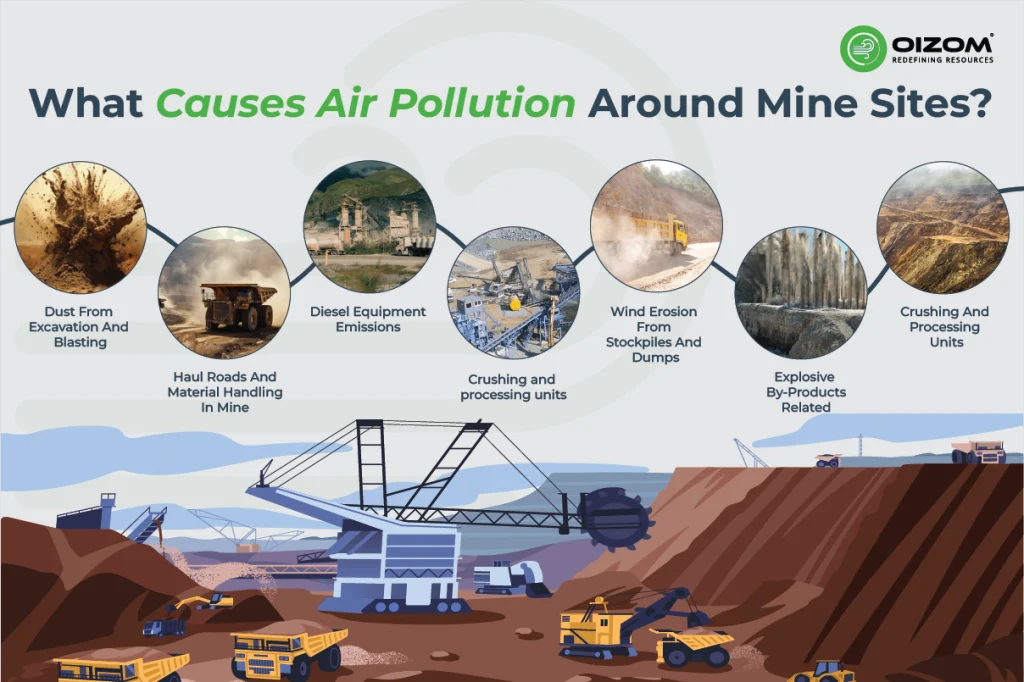
Dust-generating activities and combustion-related gas emissions near mine sites result from the industry’s mechanical nature and can contribute to air pollution.
1. Dust from excavation and blasting
There are large amounts of particulate matter, PM₁₀ and PM₂.₅, resulting from blasting, drilling, and excavation. Blasting can exceed underlying conditions, especially in dry environments.
2. Haul roads and material handling
Heavy trucks on unpaved haul roads are one of the largest contributors, accounting for 50–70% of total mine dust emissions. Loading, dumping, and conveyor transfer points also contribute to fugitive dust emissions.
3. Diesel equipment emissions
The mining fleets produce NOx, SO₂, CO, and black carbon emissions. Diesel equipment around active mine sites may account for 30-40% of total NOx emissions, and the secondary PM related to this additional emissions source worsens air quality.
4. Crushing and processing units
Crushers, screens, and other systems that enable ore processing, produce additional fine particulates from mechanical breakage to produce fine particulates. Even enclosed systems can produce measurable PM from mechanisms such as vibration and drop points of materials.
5. Wind erosion from stockpiles and dumps
Elements such as overburden dumps, coal stockpiles, and tailings can be susceptible to wind-blown dust erosion. Dust plumes can travel hundreds of meters to several kilometers during high-wind events, depending on the topography.
6. Explosive by-products
Blasting also produces gases like NO₂, CO, and unburnt hydrocarbons, especially when charge ratios aren’t optimized. Poor post-blast ventilation can lead to localized pollution peaks.
7. Meteorological amplification
Low wind speeds, dry seasons, and winter temperature inversions trap dust down at ground level. Many Indian mining regions record PM levels 20–40% higher in winter due to poor dispersion.
Why Monitoring Air Quality Near Mines Is Critical
Mining activities affect air quality, mine employees, communities near the mine, and environmental regulators, making continuous air quality monitoring crucial. By monitoring air quality, mines can identify pollution sources, respond as needed, and ensure compliance with International Standards.
1. Health of employees
Being exposed to dust and diesel exhaust is a daily occurrence for miners. Continuous monitoring can measure and log PM₁₀, PM₂.₅, NOx, and SO₂ in active working areas, potentially reducing the occurrence of respiratory diseases and associated illnesses, along with long-term injuries.
2. Health of communities
Many surface mines operate near communities, and due to the impact of dust and gaseous emissions on nearby settlements, immediate and continuous monitoring is necessary. This allows for monitoring to quantify emissions as they leave the mine boundary and create safe buffer zones.
3. Regulatory compliance
Most countries require periodic and continuous monitoring of air quality in a radius surrounding mines to fulfill social and environmental expectations. Continuous monitoring can provide documented evidence of continual compliance, support environmental audits, and lessen the potential for penalties and/or complaints.
4. Diminishing environmental effects
Dust fallout negatively impacts vegetation, water bodies, and soil health in and around mine sites. Tracking dust fallout helps identify the location of pollution. It can aid in assessing the effectiveness of pollution mitigation strategies, such as misting, haul-road watering, or implementing an enclosure system around the activity. Tracking dust fallout enables mines to adjust their operational activities in a timely manner, while also recognizing unfavourable weather patterns, such as low wind speeds or inversions.
5. Enhancing sustainable practices in mining
Modern mining practices utilize data and existing conditions to maximize operational effectiveness. Air quality data can be used in real-time to assess the time when blasting occurs, determine whether to limit haul road activity, or avoid equipment use in polluted air. These practices not only mitigate pollution but also enhance fuel efficiency and improve overall operational planning.
What Parameters Are Monitored Around Mine Sites?
Air quality monitoring near mines addresses both particulate and gaseous pollutants, along with meteorological factors that affect dust movement and dispersion.

Particulate Matter
- PM₁₀ & PM₂.₅: Primary indicators of dust from blasting, excavation, and haul roads.
- TSP (Total Suspended Particulate): Captures coarse dust loads across large mine footprints.
- Respirable Crystalline Silica (RCS): Critical for worker health, especially in coal, metal, and stone mines.
Gaseous Pollutants
- NOx (NO & NO₂): Emissions from diesel machinery and blasting fumes.
- SO₂: From diesel combustion and high-sulphur ore processing.
- CO: Generated by incomplete combustion in equipment and explosives.
- VOC & Hydrocarbon Vapours: Common near fuel storage, maintenance yards, and processing plants.
- Ozone (O₃): Secondary pollutant formed by NOx–VOC interactions, significant for broader air quality assessments.
Blasting & Processing-Related Parameters
- Ammonia (NH₃): Residual emissions from ammonium-based explosives.
- H₂S: May appear in sulphide-rich ore bodies or tailings.
- Dust fallout rates: Helps assess long-term dust deposition on nearby land and vegetation.
Meteorological Parameters
- Wind speed & direction: Primary drivers of dust dispersion and plume travel.
- Temperature & humidity: Influence dust suspension and particle behaviour.
- Rainfall: Reduces airborne dust but affects runoff and sediment spread.
- Atmospheric pressure & solar radiation: Used for dispersion modelling and predicting inversion conditions.
How Air Quality Impacts Are Monitored Near Mine Sites
1. Continuous Ambient Air Quality Monitoring Stations (CAAQMS)
CAAQMS platforms deliver regulatory-ready data for PM, gases, and meteorology, serving as the baseline compliance network surrounding mine boundaries. CAAQMS enhances the mine’s ability to demonstrate compliance with national standards and can support long-term environmental reporting.
2. Real-Time Air Quality Monitoring Systems
Small, sensor-based systems measure PM₂.₅, PM₁₀, NOx, SO₂, and VOCs in real-time, giving mines the ability to monitor gas and particulate spikes in real-time. Equipment like Oizom’s continuous monitors can provide an indication of modifying operational procedures during rounds of blasting, peak haul traffic, or unfavourable weather.
3. Portable or Mobile Air Quality Monitors
Handheld or vehicle-mounted monitors are sometimes a more convenient alternative for rapid onsite checks, evaluations of worker exposure, and short-term investigations. They prove useful for early-stage mapping of areas subject to high dust levels inside the mine, as well as in verifying the effectiveness of dust control methods.
4. Real-Time Dust Monitoring Systems
Real-time dust monitors are designed to specifically measure particulate loads within the mining workplace setting near crushing areas, haul roads, and stockpiles. Real-time notifications can help monitor the frequency of actions needed to adjust watering schedules or improve traffic flow, thereby reducing particulate matter in the same areas.
5. Meteorological Sensors to Understand Dust Movement
Wind speed, direction, humidity, and temperature sensors reveal how dust plumes travel across the mine. This data helps mines predict high-risk periods and integrate proactive controls, especially when used along with real-time monitoring systems.
6. Remote Monitoring and Data Dashboards
Cloud-based dashboards merge data across all monitoring points, enabling managers to track trends, receive alerts, and generate compliance reports from anywhere.
How Mines Use Air Quality Data to Reduce Pollution?
Optimizing blasting schedules:
Real-time data on particulate matter (PM) and gas spikes enable mines to adjust blasting operations to low-wind, low-exposure windows, thereby reducing dust drift toward workers and neighboring communities.
Proactively managing haul-road dust:
Continuous trending of PM₁₀/PM₂.₅ air-quality metrics informs watering cycles, chemical suppressants, and traffic re-routing, resulting in a 20–40% reduction in fugitive dust emissions during the peak activity hour.
Controlling emissions from diesel equipment:
The data on NOx and SO₂ levels identify specific high-emissions spots, prompting engine maintenance, fleet rotation, or idle-time improvement to address combustion byproducts.
Improving crusher and plant operations:
Dust monitoring in close proximity to crushers and screens identifies dust generation hot spots and informs mines regarding improving effective enclosure, sealing, and misting for immediate reduction in PM.
Strengthening management of worker exposure:
Portable monitor readings can influence the planning of shifts worked, the allocation of personal protective equipment (PPE), and the restrictions on temporary access in areas experiencing dust or fume spikes.
Improving environmental protection measures:
Dust fallout and meteorological data can help guide the daily designation of areas for establishing windbreaks, plantation belts, and buffer zones to prevent dust from traveling longer distances.
Aiding compliance and community transparency:
Dashboards and continuous data streams provide documented evidence for management, regulators/communities, and help maintain trust.
Automate alerts and rapid response actions:
Monitoring systems, such as Oizom’s, enable the detection of PM or gas time trends or surge activation alerts, allowing mining operators to respond instantaneously during an inversion or sudden spike event.
Choosing the Right Air Quality Monitoring Setup for a Mine
Identifying the appropriate monitoring framework essentially starts with a better understanding of the emission profile of the minedust, which can be heavy, diesel-heavy, or processing-heavy, and then being able to visualize where pollution is likely to be dispersed. From that point, mines can determine how much visibility they require in real-time boundary stations, primarily for compliance, in-pit sensors for the operation’s process control, or portable units for workers’ exposure. Following that, mines identify the meteorological conditions that drive dust dispersal, ensuring their sensor networks are in place along wind corridors and sensitive locations. Finally, mine integrates these monitoring needs into a system that is scalable for production, delivers reliable data, and enables timely decision-making when issues arise.
Conclusion
Air quality at mine sites is influenced by a complex combination of dust, gases, and weather conditions, making good mining practice dependent on effective monitoring. When mines have situational knowledge of where emissions are coming from, where they are going, and when they reach elevated levels, they can take action quickly, change operating conditions, protect workers, and minimize off-site impacts. Advanced monitoring systems, including real-time sensor networks and consecutive dashboards, will facilitate the transition from reactive to preventive management at mining operations. As environmental expectations grow and regulations tighten worldwide, mines that invest in accurate, continuous air quality data not only safeguard communities and ecosystems but also build more resilient, transparent, and sustainable operations.