
Summary
Air quality monitoring is evolving toward software-driven platforms that analyze data collected by sensors, a trend expected to accelerate by 2026. The future of environmental technology lies in intelligent software platforms that analyze, visualize, and interpret data collected by sensors. IoT sensors, dashboards displaying real-time air-quality information, cloud-based AI analytics, and automated reports will enable companies, cities, and other environmental organizations to make quicker, better-informed air-quality management decisions, allowing them to focus on proactive air-quality management rather than passive data collection.
How Air Quality Software Is Transforming Environmental Tech in 2026
Sensors, monitoring stations, and air-quality monitoring software measure pollutants such as PM₂.₅, PM₁₀, NO₂, O₃, CO, and VOCs. The real shift in environmental technology right now is taking place at the software layer, where platforms combine data from multiple sensors into a single real-time dashboard. Through AI-based analytics, automated reporting tools, and cloud-based access, this is achieved by integrating sensor data with cloud-based software platforms. We are seeing a shift from hardware-centric to software-centric approaches to creating environmental intelligence for air-quality management across industries, municipalities, and environmental professionals.
Evolution of Air Quality Monitoring: From Sensors to Smart Software
The way we monitor air quality has evolved considerably. Environmental monitoring traditionally relied on fixed monitoring stations and individual sensors to record air pollution parameters like PM₂.₅, PM₁₀, NO₂, O₃, and CO. The availability of such equipment is essential for obtaining environmental data; however, in many traditional monitoring setups, the data were stored locally and reported periodically rather than analyzed continuously in real time.
One major limitation was the delay caused by manual data evaluation, which meant that environmental pollution was monitored reactively rather than taking proactive measures to reduce overall pollution before it occurred.
The rise of IoT air quality monitoring sensor networks has changed how air quality is monitored. With smaller sensor networks that can monitor continuously across multiple locations, organizations can collect air pollution data more precisely. However, as the amount of data being collected increased, monitoring systems alone were still insufficient for air quality monitoring.
Air quality monitoring software has become the missing piece in air quality monitoring technology. By aggregating data from sensor networks, air quality monitoring software can collect sensor data, process it in real time, and convert raw measurements into actionable insights through dashboards, analytics, and automated alerts.
Organizations now have access to intelligence software platforms that work together with sensor networks, allowing them to assess pollutant patterns, predict events, and respond rapidly during environmental hazards.
As we move forward, the focus of air quality monitoring is shifting from hardware to software. The shift to software-based environmental intelligence solutions is enabling industries, cities, and regulators to move from merely monitoring to managing the environment through data analysis.
Why More Industries Are Adopting Air Quality Software in 2026
Air quality monitoring is no longer limited to environmental agencies and research institutions; it has become a standard practice across industries, with many sectors adopting air quality software as part of their operational, regulatory, and sustainability strategies. This shift is driven by:
a) stricter regulations from government agencies and regulatory bodies
b) growing public awareness of the dangers of air pollution
c) the need for better data-driven decision-making for both operational and regulatory purposes.
Governments and regulatory agencies across regions are imposing stringent air quality regulations and reporting requirements on industries that produce pollutants or operate in urban areas. There is a growing demand for continuous pollutant monitoring and maintaining compliance with environmental standards across manufacturing plants, construction sites, distribution centers, and energy-generating facilities. The use of air-quality software streamlines the collection, analysis, and reporting of required regulatory data.
Companies also use monitoring systems for other reasons, like improving worker safety and operational visibility. Sustainability and ESG reporting are also important factors in the adoption of air quality software. Businesses face greater demand from stakeholders, including investors, regulators, and customers, to better understand their environmental impact.
The adoption of cloud-based platforms, IoT sensors, and sophisticated analytics technologies has enabled organisations to scale and access these systems much more easily. It is the software component of the system that will turn that data into actionable environmental intelligence.
Given this, companies across sectors, including manufacturing, construction, smart-city development, and environmental consultancy, are rapidly implementing air-quality software to go beyond basic monitoring and adopt proactive environmental management practices.
Core Features That Are Reshaping Environmental Tech
While air quality monitoring has always relied on some form of data collection, today’s environmental monitoring software systems do more than collect pollution data; they also provide advanced software to analyze and present the data for organizations that need to make decisions based on air quality information. Some of the features are listed below:
Real-Time Data & Live Air Quality Dashboards
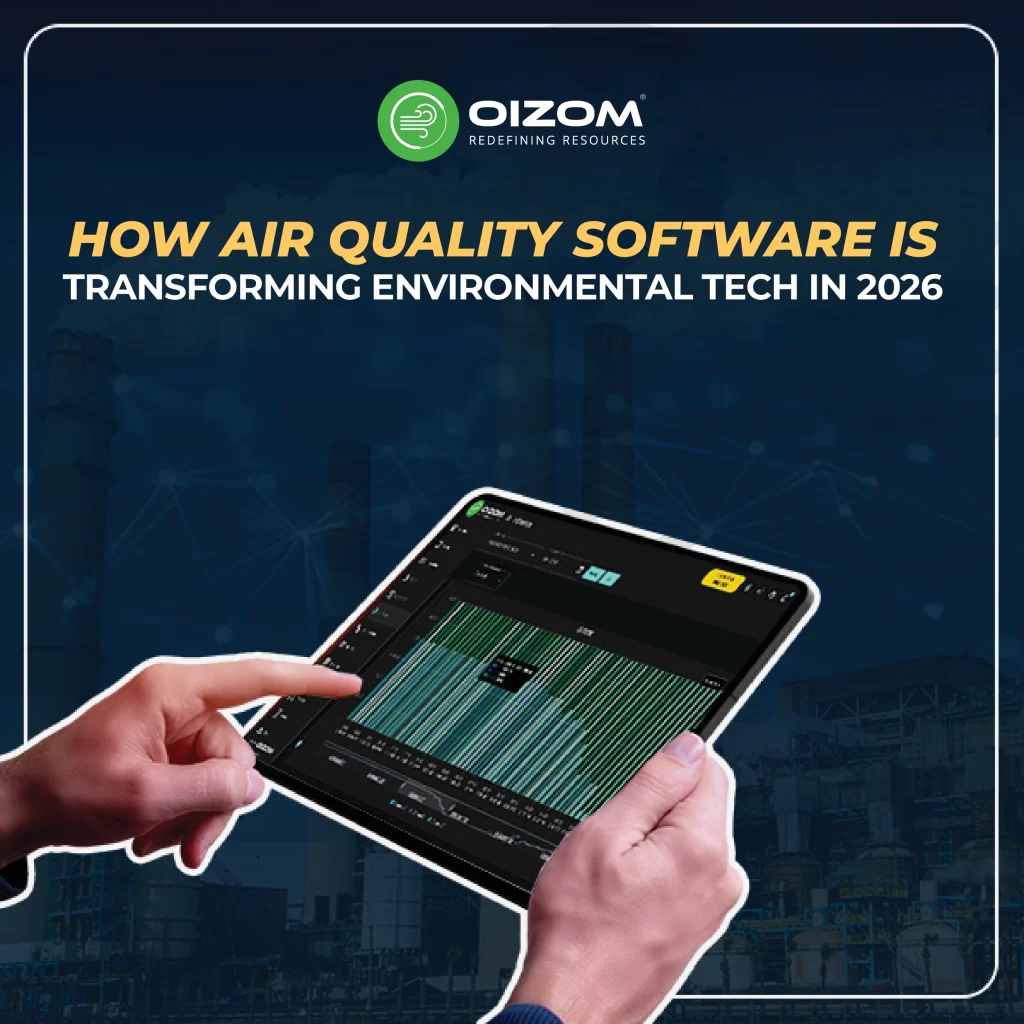
Interactive dashboards are a key feature of today’s air quality software, offering real-time monitoring and data visualization. They can now monitor real-time pollutant concentrations at all monitoring locations.
Platforms like Envizom provide centralized dashboards that combine data from multiple monitoring stations, allowing environmental teams to track pollutant levels, identify anomalies, and respond to air-quality events in real time.
These dashboards include measurements of CO, NO₂, PM, O₃, VOCs, along with humidity and temperature. In addition to allowing users to chart data, these dashboards also let users visually identify when a pollutant spike occurs by viewing graphs or spatial maps showing pollutant levels over time and across locations.
AI-Powered Pollution Forecasting
AI and machine learning analyze historical and real-time air quality data. AI-powered models can identify pollution-level trends and generate short-term forecasts of expected air-quality changes. These models analyze factors such as weather conditions, traffic patterns, and industrial activity to help predict when pollutant concentrations will increase.
Automated Compliance & Reporting
Modern software platforms can streamline environmental reporting, environmental compliance monitoring, and management, simplifying regulatory compliance. Environmental monitoring platforms can automate the collection and organization of pollutant data into standard formats and produce the reports required by environmental regulators. Automation significantly reduces manual efforts in completing all necessary reports and provides consistent records for all required regulatory audits, environmental assessments, and sustainability reports.
Remote Monitoring Across Multiple Locations
Organizations operate several sites, including facilities and construction sites, and various urban monitoring points. Air quality software enables centralized monitoring of environmental conditions across geographically distributed locations.
Cloud-based platforms allow environmental managers to access monitoring data from multiple locations through a single interface. A manufacturing business might monitor emissions across all its plants, while a city authority could track air pollution across multiple districts. Remote monitoring capabilities improve operational oversight and make it easier to identify pollution hotspots and system-wide issues.
How Industries Are Using Air Quality Software Today
Across many industries where accurate environmental information is crucial for regulatory compliance, safe operations, and sustainable management, air quality monitoring tools have become an essential asset. For instance, Air Quality Measurement Systems (AQMS) use sensors to monitor pollutant levels; while air quality software platforms help organizations analyze those results, detect trends, and enable timely, effective responses to environmental emergencies.
Industries like manufacturing, energy generation, and city planning use air quality software to monitor emissions and make data-driven environmental decisions.

Manufacturing & Heavy Industries
With industrial air-quality monitoring and software, organizations can effectively track multiple pollutants generated during production processes, like PM₂.₅, PM₁₀, NOₓ, and VOCs.
Integrating monitoring sensors with centralized software enables managers to monitor and manage real-time emissions, detect and verify abnormal pollutant concentrations, and receive notifications. This facilitates a quicker response to compliance-related matters and improves working conditions for workers in an industrial setting.
Smart Cities & Urban Planners
Air quality monitoring software is becoming increasingly important for smart-city initiatives and urban development, and is now part of many such initiatives. City planners and government officials are using data to track pollution trends, polluted hotspots, and their relationship to high-dust activity that affects air quality in their cities.
These software platforms collect data from multiple air quality monitors located throughout the city. The data is typically displayed on maps and analytic dashboards to help government officials monitor areas of their cities that regularly experience elevated pollution levels. These platforms can then be used to identify potential interventions to reduce air pollution through city traffic systems, the installation of green infrastructure, or the setting of parameters to lower industry emissions.
Construction & Infrastructure Projects
Construction sites generate higher levels of construction dust monitoring challenges and airborne particulates from excavating, demolition, and material transport. Monitoring airborne particulates is required to ensure compliance with environmental regulations and to protect adjacent communities from adverse air-quality effects.
When particulate matter exceeds allowable limits, the software generates notifications to the site manager to take actions to mitigate the amount of airborne particulates released from the construction site, such as using water-spraying or dust-suppression systems, or temporarily changing work operations.
Environmental Consultants & Regulators
Professionals use air quality systems to collect, interpret, and analyze environmental data from multiple monitors across different locations. The data from these monitoring locations can be used to assess and evaluate pollution patterns that may indicate regulatory non-compliance, conduct environmental impact assessments, and identify compliance with environmental regulations for organizations or companies. The air quality systems allow consulting professionals to prepare detailed documents for industrial activities, construction, and urban development projects.
Limitations of Standalone Air Quality Monitoring Hardware
Sensors and devices that monitor air quality are essential for detecting atmospheric pollutants, but relying solely on stand-alone hardware creates limitations. Traditional air quality monitoring devices are designed to measure different environmental parameters. These types of measurements are important; however, the devices themselves contain limited analytical capabilities.
In some systems, raw sensor data must still be manually retrieved to produce meaningful results through analysis. It can result in slower response times and take longer for organizations to identify spikes in pollutants or indications of a potential compliance issue.
Stand-alone hardware contributes to fragmentation in monitoring systems, particularly given the installation of numerous sensors across various locations. Without a centralized platform to manage data from various monitoring devices, environmental managers may find the data difficult to manage and interpret. This makes it difficult to track trends, compare locations, or create standardized reports. Another limitation of stand-alone devices is that they may prevent organizations from efficiently expanding their monitoring networks over time. As new sites are added to the network and the volume of air quality data increases, having automated analysis and visualization tools becomes necessary.
Because of these limitations, using only sensors will not be sufficient for modern-day environmental management. Software platforms like Envizom bridge this gap by aggregating data from multiple monitoring devices, analyzing trends, and converting raw measurements into actionable environmental insights through dashboards, alerts, and automated reports.
However, hardware remains the basis for collecting air quality data; increasingly, the need for software platforms to collect, process, and translate it into actionable results will become more important for actionable environmental insights.
The Future of Environmental Tech: What’s Coming Beyond 2026
Businesses, governments, and cities are adopting new methods to manage air quality and mitigate environmental hazards. Environmental monitoring systems will progress from simply gathering data to providing users with fully integrated environmental intelligence systems.
Artificial intelligence and machine-learning technologies are expected to play a vital role in processing large volumes of environmental data, using air-quality data analytics to develop accurate pollution-forecasting models. These technologies will allow organizations to predict how air quality will change based on factors like weather, traffic patterns, and industrial activity. As predictive analytics become more advanced, environmental monitoring systems will enable earlier interventions and improved long-term environmental planning.
Environmental sensor networks based on the IoT will also continue to grow, allowing cities, businesses, and research institutions to access thousands of real-time environmental data streams connected via the cloud for analysis. Digital twins of urban environments will leverage advanced technologies to create virtual models of cities, simulating environmental conditions and testing mitigation measures before they are implemented in the real world.
Environmental technology will increasingly focus on transforming environmental data into actionable intelligence. While monitoring hardware will remain essential for collecting measurements, the future of environmental management will rely more heavily on software platforms that can interpret, predict, and guide responses to changing air quality conditions.
Conclusion
Environmental monitoring is evolving beyond simple data collection. It focuses on interpreting data and enabling timely environmental action. The current monitoring systems are based on sensors; however, modern air quality software applications and air pollution monitoring platforms enable organizations to analyze trends, predict pollution events, and manage compliance. By enabling real-time analytics, predicting outcomes, and centralizing monitoring, these software solutions will become major contributors to environmental technology. As more industries and municipalities seek smarter ways to manage air quality, they will increasingly need to implement intelligent air-quality software.
FAQs
Air quality software enables real-time pollution monitoring by analyzing data from IoT air quality sensors and visualizing pollutants like PM₂.₅ and NO₂.
AI-powered analytics predict air pollution trends by analyzing historical air quality data, weather conditions, and emission patterns.
Yes, it supports environmental compliance through automated monitoring, real-time alerts, and regulatory reporting.
Choose platforms with real-time dashboards, AI analytics, cloud monitoring, and automated compliance reporting.