
Summary
Rising pollution levels and stricter regulatory expectations make it difficult for organizations to rely on delayed reports from limited monitoring networks. Instead, AI and IoT-based solutions enable real-time information collection, proactive risk identification, and the delivery of actionable risk notifications, while integrating with other system processes and providing predictive reports to ensure regulatory compliance. The air quality monitoring industry will transition to a more predictive compliance model and use AI-based tools to better manage the environment.
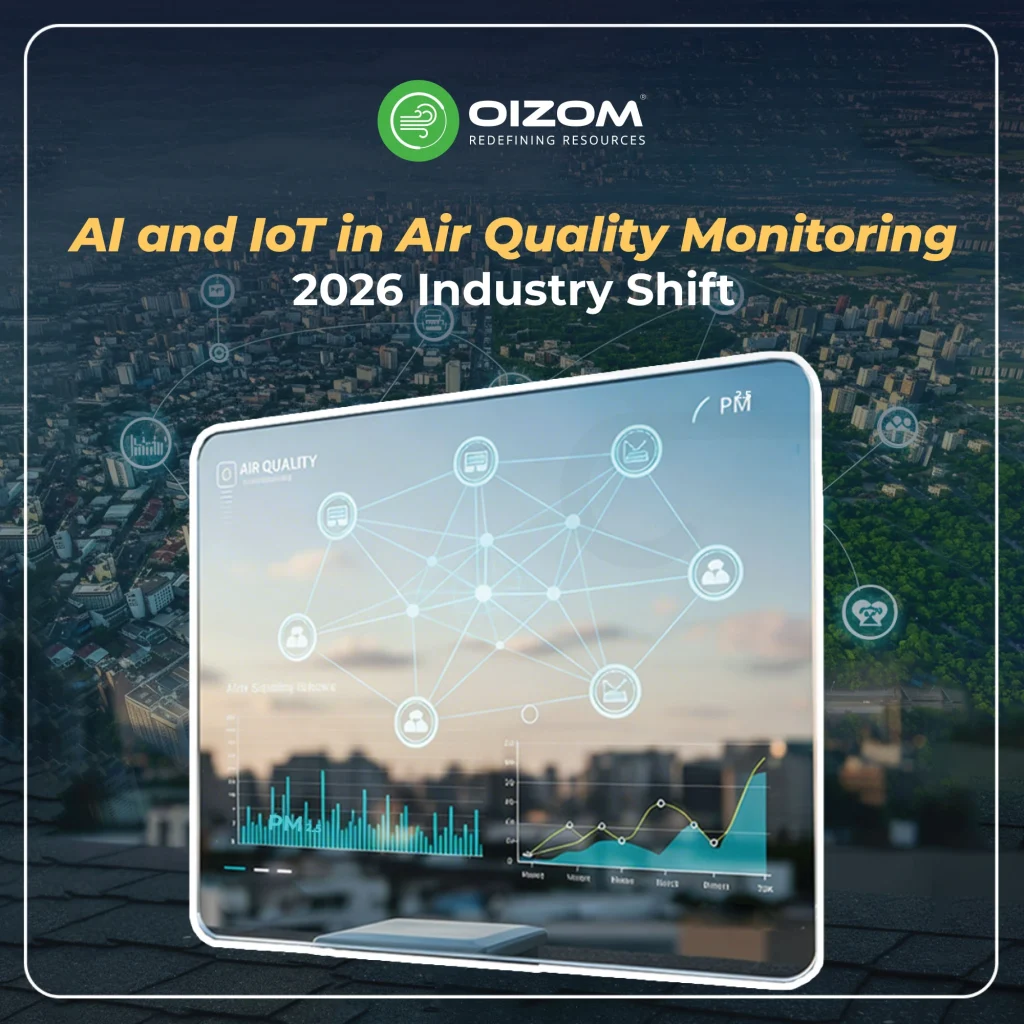
AI and IoT in Air Quality Monitoring: 2026 Industry Shift
Air pollution poses a serious threat to the environment and human health. According to the WHO, the majority of the world’s population breathes air well above acceptable levels. In an increasingly connected world, where air-quality monitoring stations are often isolated and slow to report data, traditional monitoring methods are no longer sufficient. The convergence of AI and IoT technologies is changing how air-quality monitoring is performed by enabling continuous data collection and analysis and providing faster action to support better-informed decisions on environmental issues.
Real Problems Industries Face With Traditional Monitoring
Though useful, traditional monitoring methods create a gap between data generation and practical decision-making. One of the primary limitations of traditional air monitoring networks is the lag time for collecting and later reporting relevant information. In many cases, data is reported months after the fact. Reference-grade monitoring stations require major capital investment, specialized calibration, and maintenance, all of which contribute to high establishment and operation costs.
Another major issue with traditional air quality monitoring systems is that organizations spend significant time on reporting and maintaining compliance with environmental regulations. These systems measure pollutants accurately, but they do not interpret patterns, identify root causes, or provide predictive guidance.
How AI Turns Pollution Data Into Action
Predictive forecasting is one of the most significant advancements in implementing AI. By analyzing historical pollution patterns, weather data, traffic patterns, and industrial operations, AI can detect early signs of an approaching pollution event before it reaches a critical level. This enables the organization to implement mitigation strategies before violations occur, such as adjusting ventilation systems, modifying production processes, or providing appropriate public notice to its customers and community.
AI can provide automated alerts and continuous anomaly detection. Instead of manually checking the dashboard, it can monitor live data streams in real time and send alerts when pollutants exceed safe levels, thereby integrating with operational systems and greatly reducing response time.
Another area where AI has made significant progress is source identification and pattern recognition. AI models can identify patterns that recur at specific times of day, such as spikes at certain times, correlations between traffic congestion and particulate matter, and emissions increases caused by certain industrial processes.
Another benefit of AI is error reduction. Since sensors tend to drift due to environmental changes (e.g., humidity or temperature), advanced algorithms dynamically recalibrate them using time-stamped, previously validated datasets to improve reliability without significantly increasing hardware costs.
AI + IoT Together: The New Standard for 2026
AI analytics have enabled a new type of monitoring system that uses IoT as the connectivity layer. IoT sensors stream data to centralized/cloud platforms, and AI analytics can process and interpret it in real time. IoT offers a tremendous increase in environmental visibility by enabling very dense, distributed sensor networks. Rather than having just a few fixed stations, cities and organizations can now have hundreds or even thousands of connected devices throughout their neighborhoods, universities, or manufacturing facilities.
The system can automatically adjust building ventilation based on indoor air quality, optimize emission control processes in industrial settings, and assist in managing traffic flow to alleviate city pollution hotspots. Scalability is another primary benefit of using IoT-based systems. IoT-based systems are modular and offer easier expansion than traditional systems. New sensors can be added to an existing network without completely rebuilding infrastructure, allowing municipalities and organizations to expand their coverage over time.
Over time, the air quality monitoring landscape will be increasingly defined by continuous connectivity, predictive compliance, and automated response mechanisms.
Where This Technology Is Making the Biggest Impact
The integration of AI and IoT in air quality monitoring is not limited to one sector. Its impact is visible across industries where environmental visibility, compliance, and public health are critical. While adoption levels vary, certain areas are seeing particularly strong transformation as monitoring shifts from reactive measurement to proactive management.

1. Manufacturing & Heavy Industries
When using a reactive approach to monitor emissions, problems are typically identified but often not addressed until after emission thresholds are exceeded.
AI-based IoT monitoring systems provide facilities with continuous, real-time analysis of emissions data, allowing the facility operator to detect anomalies and take corrective action before equipment or process issues arise. Predictive analysis can also help facilities identify trends in production cycles and develop accurate emission control practices.
2. Smart Cities & Urban Monitoring
The intricate challenges posed by urban air quality can come from diverse sources, such as heavy vehicle traffic, construction activities, and dense populations. In most urban settings, air quality monitoring is provided through traditional, stationary reference stations located throughout the city.
Cities can employ IoT-enabled sensors to build denser, more distributed monitoring networks, enabling real-time access to hyper-local air quality information.
3. Construction & Infrastructure Projects
Construction worksite conditions frequently change, so dust, particulate matter, and equipment emissions can vary quickly. Historically, construction site monitoring has been periodic and compliance-based rather than continuous. Most traditional construction site monitoring methods require temporary devices and manual monitoring.
By using real-time alerts (notifications), project managers can respond quickly when particulate levels exceed acceptable limits. Examples of these responses include adjusting work schedules, using dust-suppression techniques, and modifying equipment use.
4. Environmental Agencies
With AI-assisted monitoring, agencies can move from static reports to a more comprehensive approach, analyzing both historical datasets and real-time sensor data to assess pollution trends, predict seasonal variations, and evaluate the effects of policy interventions on the environment.
What to Look for in an AI & IoT Air Quality Monitoring System
Since not all monitoring technologies are equal, it is necessary to choose the right technology for the long term and to look beyond hardware specifications to assess how well it fits with evolving needs, including functionality, adaptability, and intelligence.
One important consideration is whether or not the monitoring solution can be scaled up in the future. As the needs change, one may need to add sensors in other areas of your facility, expand urban coverage, or track additional air pollutants. A modern monitoring solution will seamlessly support adding these new sensors and additional data points without requiring the replacement of the entire infrastructure.
Another important aspect of monitoring solutions is the accuracy and calibration of sensors. While low-cost sensors have made it easier for people worldwide to monitor air quality, their long-term reliability will depend heavily on how well they were calibrated and validated. Many advanced solutions use algorithmic calibration techniques that validate sensor data against a reference station or historical baseline to account for drift caused by humidity, temperature, or other environmental variables. The best monitoring solutions will be built on reliable hardware and intelligent data correction mechanisms, enabling ongoing, consistent, and accurate monitoring.
The best platforms use integration to interconnect with many other systems. Integration enables automatic responses based on air quality data (e.g., adjusting ventilation, creating alerts, or producing a report that meets compliance standards). The true value of air quality data lies in the analytics layer, system design, and interoperability.
How Modern Monitoring Solutions Are Already Enabling This Shift
Cities and local governments are installing air-pollution detection networks and interconnected IoT devices to measure air pollution at hyper-local levels, rather than relying on a few fixed stations. This approach expands coverage, improves visibility into pollution hotspots, and enables better urban planning decisions through real-time, cost-effective data.
These systems can forecast air quality issues before they reach critical levels by analyzing historical pollution, meteorological, and traffic data, providing city administrators and facility operators with information to take action before standards are exceeded.
What the Air Quality Monitoring Industry Will Look Like by 2026
Instead of focusing primarily on reporting pollutant levels in the atmosphere, firms will begin using systems that predict risk and automate responses. Connecting infrastructure will enable continuous oversight of environmental conditions throughout municipal and industrial areas. As prices for the underlying technologies fall and analytics capabilities improve, adoption barriers will decrease, enabling even greater deployments across both developed nations and emerging markets.
The air quality monitoring industry is in a transition period in which traditional monitoring systems are progressively enhanced with connectivity and analytical capabilities. Thus, future air quality monitoring will be defined by large-scale, intelligence-driven networked systems that support the observation of environmental conditions and enable the understanding, prediction, and real-time response to such issues.
Conclusion
The future of air quality monitoring consists of advanced, integrated systems that not only collect air quality parameters but also proactively manage the environment. The use of AI will improve how data is interpreted through predictive analytics, anomaly detection, and automation, while the IoT can create large-scale, real-time monitoring networks that provide deep insights into air pollution in both urban and industrial settings. As these technologies gain wider adoption across the industry, the shift towards predictive compliance and integrated environmental intelligence will continue, driven by the increased use of AI & IoT-enabled air quality monitoring solutions.
FAQs
AI improves accuracy by analyzing sensor data in real time, detecting anomalies, and recalibrating measurements to reduce drift and environmental interference.
IoT connects distributed sensors to cloud platforms, enabling continuous transmission and real-time processing of air quality data.
Yes. AI uses historical data, weather patterns, and activity trends to forecast potential pollution spikes in advance.
It requires initial investment, but scalable IoT networks and automated analytics often lower long-term operational and compliance costs.
No. Traditional systems will remain important, but they are increasingly enhanced by AI and IoT technologies.