
Summary
Formaldehyde’s (HCHO) environmental chemistry is such that it affects indoor, outdoor air quality, along with public health. The blog explores the science of HCHO formation, lists the primary sources of HCHO, and presents global safe exposure limits for HCHO. The blog also includes methods for measuring outdoor HCHO concentrations and for real-time monitoring. Strategies for reducing HCHO emissions in urban and industrialized areas are also discussed. However, at the end of the blog post, an overview is provided of HCHO’s role in smog formation, the health implications of exposure to HCHO, and the steps communities, companies, and governmental bodies can take to manage exposure.
Formaldehyde in Outdoor Air: Sources, Impacts, and Monitoring
HCHO may not be the first pollutant people think of when discussing outdoor air quality. Yet, it quietly shapes everything from smog formation to how cities breathe during hot afternoons. It is a “hidden-in-plain-sight” chemical released by traffic, industry, and burning activities, which forms naturally in sunlight. Because it reacts quickly and appears almost everywhere, from bustling roads to forested regions during wildfire seasons, understanding HCHO is essential for decoding modern air pollution.
HCHO concerns scientists and regulators due to its nature of effects. It is also important to understand HCHO’s global standards, their impact on ecosystems, and how real-time monitoring tools (such as those from Oizom) help capture this rapidly changing pollutant. Whether you’re a researcher, policymaker, or simply curious about the air around you, this guide will help you see HCHO in an entirely new light.
What Is HCHO in Air Quality?
HCHO is a colorless, highly reactive substance that strongly affects outdoor air quality. By both direct emission (primary pollutants) from industrial processes, cars, and biomass burning, and by indirect formation (secondary pollutants) by reacting with sunlight through VOCs in the air, HCHO is present in many outdoor environments, ranging from urban centers with high population density to areas affected by industrial clusters or wildfire smoke.
HCHO plays an important role in photochemical smog formation and contributes to the development of ground-level ozone during warmer days. Its irritant effects the eyes, nose, and throat, though long-term exposure poses increased health risks. The outdoor HCHO monitoring system helps identify pollution sources and provides information on how human activities and the environment shape our air quality and contribute to ozone formation.
Why HCHO Is a Major Air Quality Concern
HCHO is a major outdoor air quality concern because even at relatively low concentrations, it can trigger immediate health effects and long-term risks. As a highly reactive gas released from vehicle exhaust, industrial combustion, biomass burning, and photochemical reactions involving VOCs, HCHO is almost always present in areas with strong urban or regional pollution. Its short-term exposure can irritate the eyes, nose, throat, and respiratory tract, while prolonged exposure increases the risk of chronic respiratory problems and certain cancers.
These impacts are especially concerning in densely populated or high-traffic regions where people spend long hours outdoors. Environmentally, HCHO accelerates the formation of ground-level ozone and photochemical smog, two pollutants strongly linked to heatwaves, poor visibility, and harmful oxidative stress in ecosystems. Because HCHO forms quickly in sunlight and reacts just as quickly, spikes can occur suddenly, especially during summer, wildfire outbreaks, or heavy traffic periods, making continuous monitoring essential to protect public health and maintain stable outdoor air quality.
Primary Outdoor Sources of HCHO Emissions

Outdoor HCHO originates from a combination of combustion activities, industrial operations, natural VOC emissions, and sunlight-driven chemical reactions. Since these sources are widespread across both urban and rural areas, formaldehyde often appears as a persistent background pollutant that rises or falls with traffic, temperature, and seasonal conditions.
Primary emission sources include:
- Vehicle Exhaust: Incomplete fuel combustion in cars, trucks, and buses releases HCHO with higher levels during traffic congestion or idling.
- Industrial Processes: Petrochemical plants, refineries, and manufacturing units emit formaldehyde through high-temperature or VOC-intensive operations.
- Biomass Burning: Wildfires, agricultural burning, and waste burning lead to major short-term spikes.
- Fuel Use in Public Spaces: Diesel generators, tourist transport hubs, and cooking activities.
- Natural VOC Emissions: Forests and vegetation release VOCs that form HCHO through photochemical reactions in sunlight.
HCHO Standards, Guidelines & Outdoor Exposure Limits
Many global organizations have implemented exposure limits for HCHO due to its reactivity and potential health risks. These thresholds help evaluate outdoor air quality, particularly in areas with high-density traffic, large-scale biomass burning, or significant industrial activity.
Key International Guidelines
The World Health Organization (WHO) recommends an average HCHO concentration limit of 0.1 mg/m³ (100 µg/m³) for 30 minutes to avoid sensory irritation and limit long-term health risks. U.S. EPA / NIOSH defines a ceiling limit of 0.1 ppm (124 µg/m³) for HCHO. Most European Union member countries follow the WHO-recommended threshold of 100 µg/m³ for short-term exposure for outdoor environmental assessment.
Even though the regulations vary slightly across regions, the message is clear: even low concentrations of HCHO can be harmful. Real-time monitoring supports compliance and enables faster response during pollution events.
How HCHO Affects Outdoor Air Quality & Local Environments
HCHO is a reactive VOC that impacts both indoor and outdoor air quality. Even at trace levels, it alters atmospheric chemistry and affects ecosystems.
Air Quality Effects
HCHO contributes to:
- Ground-level ozone formation
- Secondary organic aerosols
- Rise in smog and haze in cities and industrial regions
These pollutants lead to health risks, reduced visibility, and environmental degradation.
Ecosystem Effects
- Microorganisms present in plants and soil can absorb HCHO, but high concentrations limit growth or disrupt microbial activity.
- HCHO’s entry into water bodies can negatively affect aquatic organisms, especially in sensitive ecosystems.
Chemical Interactions
When HCHO reacts with NOx under sunlight, it increases ozone formation, thereby contributing to regional air pollution.
Spatial Variability
- Higher concentrations: Urban, industrial, and traffic-heavy zones.
- Lower concentrations: Rural and forested areas under normal conditions.
- Wildfires & biomass burning: Sharp short-term increases anywhere.
Monitoring & Regulations
Because of its reactivity and toxicity, many countries now include HCHO in their air monitoring frameworks to protect public health and contribute to pollution control strategies.
How to Measure HCHO Outdoors
Outdoors HCHO monitoring requires consistent monitoring due to rapid shifts influenced by weather, sunlight, and changing emissions.
Measurement Techniques
Measurement involves two main approaches: Active Sampling, which draws air through chemical traps/absorbers, and passive sampling, which draws air naturally without pumps.
Sensor Technology Examples
- DNPH cartridge sampling with later HPLC analysis
- Laser-based spectroscopic sensors
- Portable outdoor devices for rapid surveys
Accuracy & Sensitivity
Low-ppb detection is essential for outdoor safety limits. Proper sensor placement & regular calibration play a crucial role in improving accuracy.
However, readings can be influenced by:
- Temperature changes
- Humidity
- Sunlight intensity
- Influence from other VOCs
Data Collection & Comparison
Researchers often combine frequent sampling with long-term averaging to identify trends. Frequent monitoring reveals:
- Daily traffic patterns
- Seasonal shifts
- Emission spikes during burning or industrial disturbances
Oizom’s Outdoor HCHO Monitoring Solutions
Oizom utilizes specialized formaldehyde-sensing modules in its ambient monitoring systems to deliver stable VOC measurement in unpredictable environments.
Purpose-Built CH₂O Module
- The module is primarily built for stable, repeatable readings
- Minimizes VOC interference
- Suitable for ppb-level outdoor monitoring
Integrated in AQBot & Odosense
Real-Time Environmental Insights
- Real-time trend insights
- Emission spike alerts
- Cloud-based access for investigation & compliance
These features allow for quicker action to protect workers and nearby communities.
Mitigation Strategies to Reduce Outdoor HCHO Levels
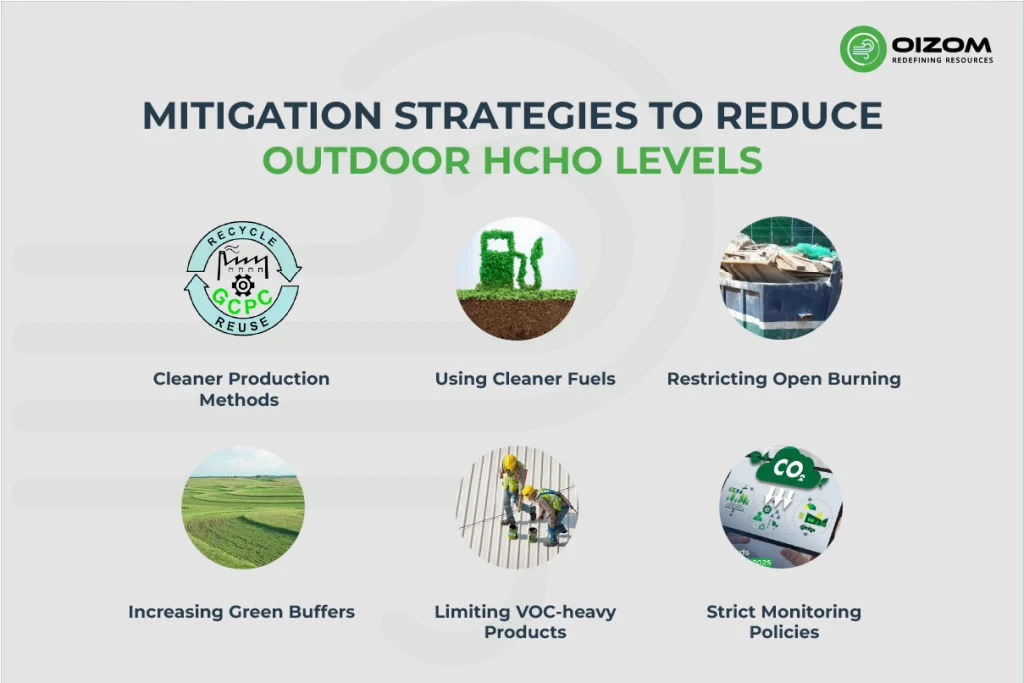
Reducing outdoor HCHO requires coordinated actions between industries, urban infrastructure, and emission-heavy activities. Though some HCHO is formed naturally in the atmosphere, human activities are linked to the highest levels, highlighting the importance of practical, targeted solutions. Key mitigation strategies include:
Control Industrial VOC Emissions: Industries associated with resin production, wood processing, chemicals, and oil refining can adopt cleaner production methods, closed-loop systems, and VOC capture technologies to reduce HCHO emissions to the atmosphere.
Improve Fuel Quality & Combustion Efficiency: Since incomplete combustion in vehicles and generators can emit HCHO, using cleaner fuels, regularly maintaining engines, and promoting low-emission vehicle standards can significantly reduce outdoor concentrations.
Strengthen Emission Controls at Construction & Burning Sites: Restricting open burning, ensuring proper disposal of construction adhesives and solvents, and enforcing better on-site ventilation practices can minimise localised HCHO spikes.
Adopt Urban Planning Measures: Cities can redesign high-emission zones by increasing green buffers, regulating traffic flow, and reducing congestion, actions that indirectly reduce HCHO formation from traffic and photochemical reactions.
Regulate Consumer Product Use Outdoors: Limiting or managing the outdoor use of VOC-heavy paints, coatings, and solvents reduces local emissions, especially during large maintenance or construction projects.
Implement Strict Compliance & Monitoring Policies: Governments and local authorities can implement VOC limits, mandate emission reporting from high-risk sectors, and promote cleaner alternatives in industrial and commercial operations.
Conclusion
HCHO may be a minor pollutant, but its impact on outdoor air quality is far from negligible. From contributing to smog and ozone to affecting health and ecosystems, HCHO plays a steady, often overlooked role in shaping local environments. Understanding its sources, behaviour, and real-time levels is key to managing cleaner outdoor air. With stricter standards and improved monitoring solutions, reducing outdoor HCHO is both practical and impactful. Through smarter combustion practices, VOC controls, and thoughtful urban planning, communities and industries can work toward safer, healthier air for all.
FAQs
High outdoor HCHO levels are mainly caused by vehicle exhaust, industrial emissions, biomass burning, and sunlight-driven reactions of VOCs.
Outdoor formaldehyde can irritate the eyes and respiratory tract, and prolonged exposure raises the risk of long-term health effects.
Real-time HCHO is measured using advanced sensors or spectroscopic monitors that continuously detect ppb-level concentrations.