
Summary
Air pollution is rarely confined to its origin; it may seem local, but pollutants disperse across borders, making it a global issue. Airborne pollutants, including particles, nitrogen oxides (NOₓ), sulfur dioxide (SO₂), and ozone (O₃), can harm people, ecosystems, crops, and the climate beyond their point of emission. This blog explains how transboundary air pollution occurs, the major sources of pollutants, examples of transboundary air pollution, and why it complicates efforts to regulate and hold parties accountable for related actions. This highlights how monitoring, forecasting, and regional cooperation help identify pollution pathways and enable coordinated action to reduce transboundary air pollution.
Introduction
Air pollution is often framed as a local/national problem, with multiple emission sources contributing to poorer air quality in urban areas. In fact, air knows no socio-political boundary. It can carry pollutants released in one location and travel hundreds or, in some cases, thousands of kilometres or miles over land and sea, regardless of national borders, ultimately affecting air quality in regions far from the source.
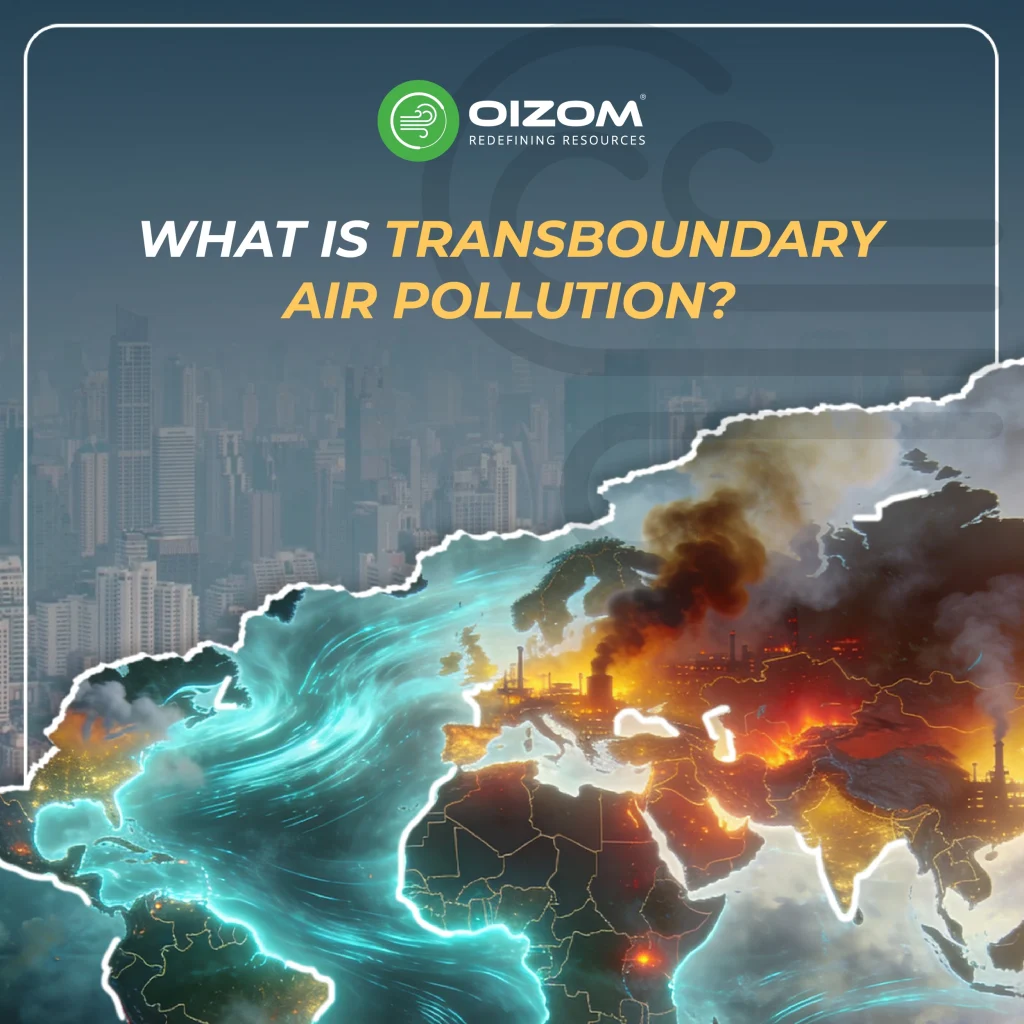
The long-distance transport of air pollutants across international borders is called transboundary air pollution. The challenges related to the transboundary transportation of pollutants range from industrial emissions travelling from continent to continent to the seasonal burning of crops by farmers in one nation that impacts air quality in neighbouring nations.
A shared understanding of transboundary air pollution is critical for scientists, policy-makers, and the general public, particularly those working to improve air quality, like industrial companies, metropolitan planners, and environmental professionals. Additionally, as air monitoring technology, atmospheric research, and our understanding of meteorological phenomena continually evolve, it is increasingly evident that addressing air pollution must involve establishing regional partnerships, using shared data, and coordinating activities.
What Is Transboundary Air Pollution?
When pollutants originating in one country travel through the atmosphere, negatively affecting air quality in another, it is called transboundary air pollution. Local air pollution is usually attributed to nearby sources, while transboundary air pollution originates from distant sources and is influenced by long-range atmospheric transport (e.g., wind patterns, temperature layers, and chemical processes).
Airborne pollutants can remain suspended in the atmosphere for periods ranging from a few hours to a few weeks, depending on their physical and chemical properties. For example, fine particulate matter (PM₂.₅), nitrogen oxides (NOₓ), sulfur dioxide (SO₂), ozone (O₃), and some volatile organic compounds (VOCs) are frequently found in transboundary air pollution and can have secondary pollutant formations due to chemical reactions occurring during transit that change their nature and increase their potential to harm.
Because of the international movement and consequences associated with transboundary air pollution, the country affected may not be responsible for the emissions causing the problem, thereby complicating the regulation and diplomatic resolution of the issue.
How Does Air Pollution Cross National Borders?
Airborne pollutants can travel beyond national boundaries due to the meteorological and chemical processes involved in their atmospheric transport. Pollutants move from one location to another through numerous mechanisms. The following is a brief description of four significant pollutant mechanisms of transport:
1. Wind Patterns and Atmospheric Circulation
Air moving through the atmosphere creates large-scale, long-range winds that transport pollutants. This is evident in the transfer of industrial emissions between nations via prevailing westerly winds, and in the transfer of smoke and dust from wildfires or other sources between neighboring countries due to regional wind patterns.
2. Vertical Mixing and Temperature Layers
Pollutants don’t typically stay close to the ground. There are thermal currents (the upward movement of warm air) that can lift pollutants to high levels in the atmosphere. As a result, strong winds at higher altitudes can carry pollutants over much longer distances than stronger surface winds.
3. Chemical Transformation During Transport
As pollutants are transported through the atmosphere, they react with sunlight, humidity, and other atmospheric chemicals. This can result in the formation of secondary particulate matter and acid-forming pollutants (e.g., SO₂ and NOₓ), which may contribute to acid rain and fine particulate matter pollution hundreds of miles from their sources.
4. Long Atmospheric Lifetimes
Some pollutants (e.g., fine particulate matter or pollutants that form ozone) remain in the atmosphere long enough to cross multiple national borders before they either deposit, settle, or degrade.
Common Sources of Transboundary Air Pollution

Transboundary pollution originates from a mix of human activities and natural processes.
- Industrial Emissions – Power plants, refineries, and heavy industries release SO₂, NOₓ, and particulate matter that can travel far.
- Fossil Fuel Combustion – Coal-fired power generation is a key driver of cross-border sulfur and nitrogen pollution.
- Agricultural Burning – Seasonal crop-residue burning can produce large smoke plumes that drift into neighboring countries.
- Transport Emissions – Shipping lanes and international aviation release pollutants that disperse regionally.
- Urban and Regional Smog – Large metropolitan regions can influence air quality in downwind areas.
- Dust Storms and Wildfires – Natural events can also transport massive amounts of particulate matter across national boundaries.
Why Transboundary Air Pollution Is a Serious Global Issue
1. Public Health Impacts
Particulate matter (PM) and ozone from long-range transported pollutants can affect primary respiratory and cardiovascular conditions, even when local emission levels are low in those locations.
2. Environmental Damage
Acid rain resulting from cross-border sulfur and nitrogen pollution can damage forests, soil, and freshwater systems. Ozone can also reduce crop yields and harm vegetation.
3. Climate Interactions
Some air pollutants, like soot and ozone, contribute to global warming, making air pollution directly linked to global climate change.
4. Economic Consequences
Countries may bear economic costs from pollution-related health care, agricultural losses, and reduced labor productivity from pollutant exposure, even if they didn’t cause the original pollution.
5. Policy and Diplomatic Complexity
The sources and impacts of air pollution are often distributed across jurisdictions, requiring international collaboration instead of relying solely on national regulations.
Real-World Examples of Transboundary Air Pollution
Southeast Asian Haze
Air Quality across Southeast Asia has been harmed by multiple factors, including large-scale deforestation for agricultural development and large-scale peatland burning/destruction.
European Acid Rain
Air Pollution deposited in European countries originates from sulfur emissions generated in large quantities by both domestic industry and heavy industrial production.
East Asian Dust and Industrial Pollution
Dust from East Asia and other industrial sources (e.g., heavy smoke emissions) can affect air quality in many countries.
Indo-Gangetic Plains (South Asia)
Air pollution in North India is heavily influenced by transboundary transport. Studies show winter winds can carry particulate pollution from across the borders into Indian states like Punjab and Haryana, while pollution from Indian sources also affects Nepal and Bangladesh. The World Bank’s “A Breath of Change” report highlights that much of the region’s pollution crosses national borders, making regional cooperation essential.
Horn of Africa Volcanic Ash (Ethiopia, 2025)
In November 2025, the unexpected eruption of Ethiopia’s Hayli Gubbi volcano sent high-altitude ash plumes across the Red Sea and into Yemen, Oman, Pakistan, and India (including Delhi, Gujarat, and Rajasthan), disrupting aviation and demonstrating how natural events can drive large-scale transboundary pollution affecting multiple regions far beyond the source.
How Transboundary Air Pollution Is Monitored
To track cross-border pollution, both ground and remote monitoring systems must work together.
- Ground Monitoring Stations measure PM₂.₅, PM₁₀, SO₂, NOₓ, ozone, and carbon monoxide at fixed locations to determine pollutant levels in the air.
- Satellite Observations are used to determine the extent of large pollution plumes, track smoke from wildfires, and follow dust movement across a geographical area.
- Atmospheric Models are used to simulate how pollutants behave in the atmosphere, both how they travel through the air and how they transform into other substances, and help develop source-receptor relationships.
- Regional Data Sharing Networks allow neighboring countries to examine pollution levels, compare trends, and document pollution events associated with cross-border transport.
Together, these methods will provide scientists with the data needed to take coordinated action.
Role of Air Quality Monitoring Systems in Managing Cross-Border Pollution
Effective monitoring systems are critical for understanding transboundary pollution and managing the significant environmental impacts associated with it. The quality of the data being collected is of the utmost importance for determining if a pollutant is generated locally or transported into the region, and is necessary to make fair and effective policy decisions.
In addition to providing localized measurements, advanced monitoring networks such as the compact, real-time monitoring systems developed by organizations such as Oizom will provide a regional database of pollution data when coupled with satellite imagery and atmospheric modeling, which if utilized together will assist the government in tracking the pollutants flow, estimating the exposure of individuals, and creating targeted strategies for mitigating the negative effects. Furthermore, establishing and using consistent monitoring standards and sharing data collected across boundaries could be as important as the technology itself.
Can Transboundary Air Pollution Be Controlled?
Reducing transboundary air pollution requires scientific, technical, and policy collaboration among countries. Controlling air pollution means reducing emissions, adopting techniques available for timely forecasting, developing and strengthening systems for exchanging data and information among neighbouring countries.
1. International and Regional Cooperation
International and regional cooperation can help mitigate transboundary air pollution through:
- The alignment of regional air quality standards
- The cooperation of research and development efforts
- The provision of cooperative measures to reduce emissions.
2. Emission Reductions at the Source
Using cleaner energy resources, implementing emission-control technologies, improving fuel quality, and enforcing stricter vehicle emission standards can help reduce pollutants transported long distances by air.
3. Early Warning Systems and Forecasting
Air quality models allow states to predict how pollutants will be transported across international borders. Accurate forecasts allow states to implement emergency response measures to reduce the public’s exposure to pollutants during periods of flooding or when weather is likely to cause flooding or heavy precipitation.
4. Agricultural and Land Management
To reduce smoke that crosses international borders during the agricultural growing season, states should implement open-air burning bans, develop alternative methods for managing crop residue, and improve their ability to monitor and detect wildfires.
5. Strengthening Monitoring and Data Sharing
Having a monitoring network that uses standardized measurement methods and real-time data sharing helps identify the sources and hold air quality accountable for damages, and provides a basis for making scientifically informed decisions about how to address pollution-related problems.
Conclusion
Air pollution is not limited to a local area; it is not confined by geography or political boundaries. The emissions that enter the atmosphere begin to change the quality of the air and the health of people thousands of miles from their source. To address transboundary air pollution, solutions will need to be regional and involve local cooperation, as well as a scientific agreement on air quality science and on air quality density measurements to monitor the absolute transport of this pollution across national borders. As technology improves and becomes more readily available, countries can work together to achieve better air quality across larger regions than before.
FAQs
Air pollution travels across borders through large-scale wind patterns, atmospheric circulation, and weather systems that transport pollutants over long distances.
Fine particulate matter (PM₂.₅), ozone (O₃), nitrogen oxides (NOₓ), sulfur dioxide (SO₂), and volatile organic compounds (VOCs) are the primary pollutants involved in transboundary transport.
Yes, countries can experience degraded air quality due to pollutants transported from emission sources located in other nations.
PM₂.₅ is especially important because its tiny size allows it to remain suspended in the atmosphere for long periods and travel long distances across regions and borders.
Yes, coordinated air quality monitoring helps identify pollution sources, track movement patterns, and support international cooperation for effective emission reduction.