
Summary
As monitoring networks continue to expand across cities, industries, and infrastructure projects, organizations require more than just sensors; they need intelligent software to consolidate data into a single source, provide real-time access, and transform environmental measurements into actionable insights. Platforms such as Envizom provide a smart management layer that combines visualization, analytics, alerts, and reports to help teams efficiently scale their monitoring programs without adding operational complexity. All of this ultimately makes software the backbone of today’s air quality efforts.
Envizom: Why Air Quality Monitoring Needs Smart Data Software
Air quality monitoring organizations worldwide have created wide-ranging monitoring networks that generate high-volume, continuous data, yet many still struggle to translate that numeric data into timely, actionable decisions. Issues with separate datasets, late reporting, and manual reporting processes often leave organisations overwhelmed by data, without clear insights. Envizom houses centralised data for air quality monitoring and provides real-time visualisation, analytics, and other features that enable air quality monitoring to develop from basic measurement into true environmental understanding.
Real Issues Teams Face While Tracking Air Pollution
One of the key problems cities face during air quality monitoring is data fragmentation. The multitude of data is typically stored in multiple systems, making it harder to view, compare, or analyze it together.
Another major issue is the lack of real-time visibility into air pollution levels. Air pollution levels can change rapidly due to traffic patterns, industrial activity, or weather conditions, so without real-time monitoring and alerts, it is often too late to respond effectively to environmental issues or regulatory compliance.
In addition to data fragmentation and limited real-time visibility, air quality data storage and processing methods can pose challenges for air quality management. Manual data handling using basic tools like spreadsheets increases reporting errors and compliance risks, especially in regions like India, where regulations change frequently.
Why Air Quality Monitoring Needs Environmental Data Software Today
Various measurement devices record multiple pollutants, environmental factors, and performance metrics at multiple locations. Although this data can be useful, it can become too complicated and therefore unmanageable without an appropriate software layer to simplify it. Environmental data application software is used to build a structure and improve the clarity and usability of air quality data by grouping and presenting it so that it’s easier to understand than raw datasets or disconnected, non-visual tools.
Additionally, as monitoring networks grow and regulations evolve, software ensures consistency, accuracy, and traceability of environmental data. This becomes increasingly important for organizations operating across multiple sites or regions, including India’s expanding industrial and urban environments. Inturn software acts as the central layer that connects devices, simplifies complexity, and turns environmental data into actionable insights.
What Is Envizom and How It Supports Modern Air Monitoring
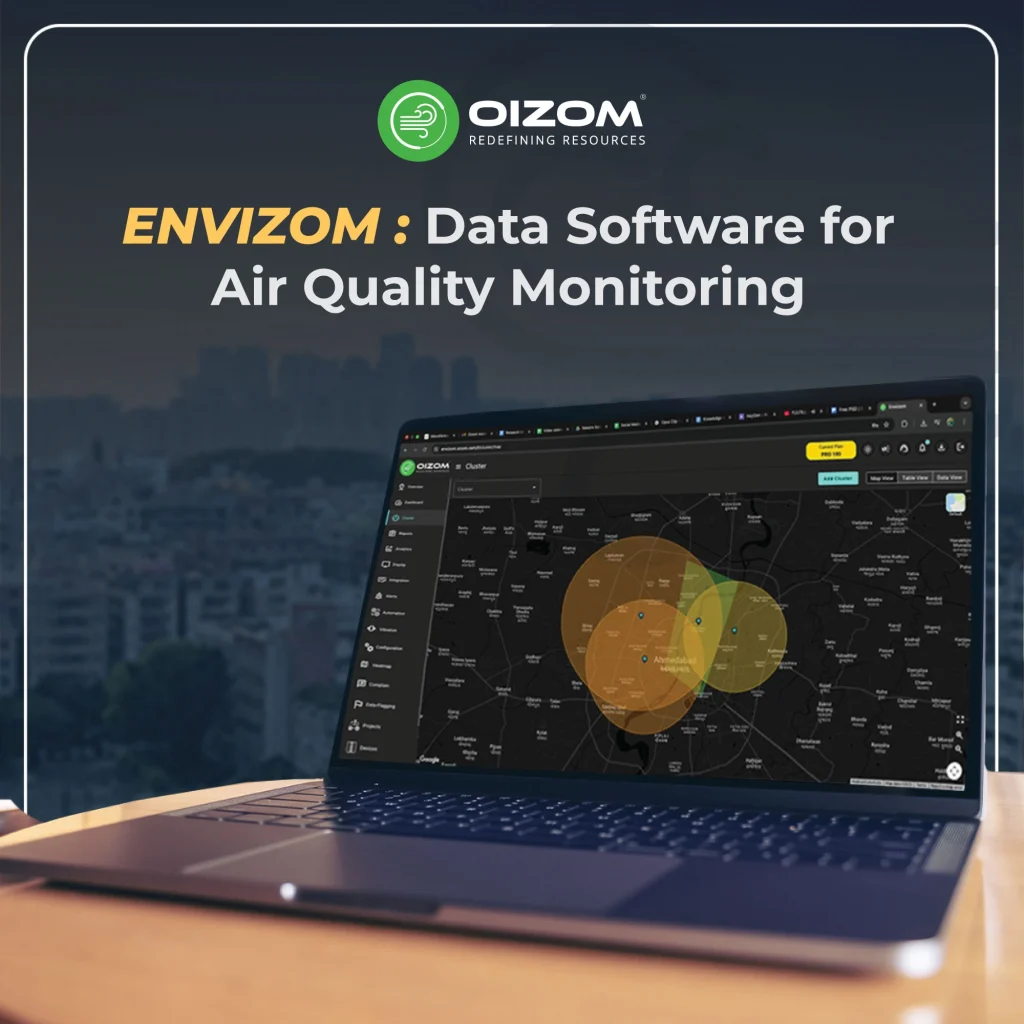
Envizom is a secure cloud-based air quality tracking platform designed to support modern air quality monitoring systems. With Envizom, users don’t need to view raw data from individual sensors; they can access all their “live” and “historic” air quality data in one easy-to-use dashboard. Furthermore, Envizom allows users to monitor multiple locations, parameters, and devices without switching between tools or formats. Insights into trends, directional patterns, and correlations enable the identification of trends and directional patterns and the comparison of air quality conditions over time and across different geographical locations.
Envizom can be used for air quality monitoring from the simplest level (site) to the largest level (city-wide network). The application includes tools such as automated reporting, intelligent alerts, heat maps, and data validation that help teams consistently and accurately handle rising data volumes. Envizom also enables integration and interoperability. Through APIs, environmental data can be shared with external applications, legacy systems, or command-and-control centers, ensuring that air quality insights are accessible where decisions are made.
In modern air monitoring ecosystems, Envizom bridges monitoring hardware and meaningful environmental insights, helping organizations better understand air quality and respond more effectively.
Key Features of Envizom That Make Air Quality Data Easy to Use

- Centralized Environmental Data Management
Envizom integrates environmental data across devices and locations into a centralized platform for unified visibility. - Real-Time Monitoring and Visual Dashboards
Interactive dashboards provide real-time insights into air quality and related environmental parameters. - Advanced Analytics and Insight Generation
Built-in analytics help recognize pollution trends, directional influence, and long-term environmental patterns. - Smart Alerts for Faster Response
Custom alerts notify users when pollutant limits are exceeded. - Spatial Visualization and Heatmaps
Spatial mapping tools visualize pollution hotspots and dispersion patterns. - Automated Reporting and Easy Data Export
Scheduled reports and export options simplify compliance and documentation. - Flexible Integration and Scalability
APIs enable integration with third-party sensors and legacy systems. - Multi-Level User and Device Management
Role-based access ensures structured and secure user management.
How Envizom Solves Real-World Air Monitoring Pain Points
Air quality monitors often struggle due to limited clarity, speed, and user-friendliness, rather than a lack of data. Envizom aims to resolve these real-world problems by connecting practical software solutions with key challenges in the air quality monitoring industry.
Without timely access to real-time air quality data, it becomes difficult for teams to take proactive action. Through real-time data visualization and smart alerts, Envizom enables teams to identify and act on exceedances as they occur, enabling quick, effective responses. Also, monitoring teams often face operational inefficiencies from manual data reporting and analysis. Envizom helps ease this burden by enabling automated reporting and analytics, data validation, and structured data analysis, saving users time while preserving data consistency and accuracy.
Pollution sources and trends are also major challenges for air quality monitoring teams. Envizom provides teams with analytics, heat maps, and trend analysis tools that allow them to assess pollution sources and directional influence and to determine site-specific and area-wide trends, enabling more accurate decisions. It also supports multi-site deployments, integrates with third-party and legacy systems, and offers role-based user management, making it easier to scale air quality monitoring without increasing complexity.
Data Security and Accuracy: Why It Is Significant in Air Quality Monitoring
A data security breach will ultimately result in a loss of credibility and an inability to achieve desired outcomes. Hence, the data used for air quality monitoring must be accurate, as many factors that influence environmental conditions can be external to the monitoring system. Reliable software platforms apply validation logic and quality checks to ensure data consistency, flag anomalies, and support meaningful interpretation of air quality measurements. In addition to data accuracy, data security and privacy are also very important in an air quality monitoring system.
When users have confidence that their data is secure and technically accurate, they can use dashboards, analytics, alerts, and reports to draw on and trust the conclusions derived from it. This is particularly important for organizations with large monitoring networks or that share environmental data across team and system boundaries.
Modern environmental data software addresses these concerns by combining secure infrastructure. This ensures that air quality data remains both dependable and defensible, supporting long-term monitoring programs and informed environmental actions.
The Future of Air Quality Monitoring Is Software-Driven
Air quality monitoring is no longer about having a single sensor or a dashboard with static data. In the future, we must do more than simply measure a pollutant’s level; we must understand its temporal pattern and predict risks before they exceed the threshold. Organizations must respond with thoughtful action rather than reaction. This change signifies the importance of monitoring towards operations and decision-making.
Today, software platforms have become the central nervous system of the air quality program. They collect, store, and analyze data over time, apply analytics, and provide actionable, timely, and location-based insights.
Companies such as Oizom are developing solutions to support this direction and provide clarity for organizations using data from their environmental testing programs. Instead of using air quality as another compliance benchmark, software-driven systems allow organizations to actively manage and reduce exposure, evaluate trends, and make informed decisions that support their health, sustainability, and regulatory objectives.
Looking ahead, organizations should expect air quality monitoring to become more predictive, integrated with broader operational systems, and outcome-oriented. The winners won’t be those with the most sensors deployed, but those with the intelligence to act on what those sensors tell them consistently in real time.
Conclusion
As environmental monitoring is being conducted at a larger scale than ever before and expectations continue to rise, software-driven platforms are key to converting raw sensor output into easily understood, reliable, and actionable intelligence. By facilitating an intelligent, centralized link between monitoring hardware and decision-makers, Envizom empowers organizations to manage complexity, identify air quality trends, and respond effectively, ultimately advancing the use of air quality monitoring to create smarter, faster, better-informed environmental solutions.
FAQs
Monitoring generates large, complex datasets that require software to organize, visualize, analyze, and turn into actionable insights.
Envizom centralizes live data from multiple monitoring devices into interactive dashboards with real-time visualization, analytics, and alerts.
Yes, Envizom automatically creates scheduled reports and downloadable datasets to simplify analysis, documentation, and compliance.
Industries such as manufacturing, construction, mining, smart cities, infrastructure, and environmental consulting benefit the most from centralized environmental data platforms.
Yes, Envizom supports compliance and audits by ensuring consistent data records, traceability, automated reporting, and secure data management.