
Summary
The smog towers in Surat are being put up against a potential alternative: effective, scalable air quality sensors that can provide information to help manage air pollution. But as the city grows denser and industrial activity expands, the pressure to keep its air clean has become harder to ignore. The blog examines key factors such as network coverage, feasibility, energy requirements, and long-term outcomes to compare how smog towers operate versus how air quality sensors function. This analysis highlights what modern air quality sensors offer and why Surat’s clean-air strategy is increasingly shifting toward a data-driven model.
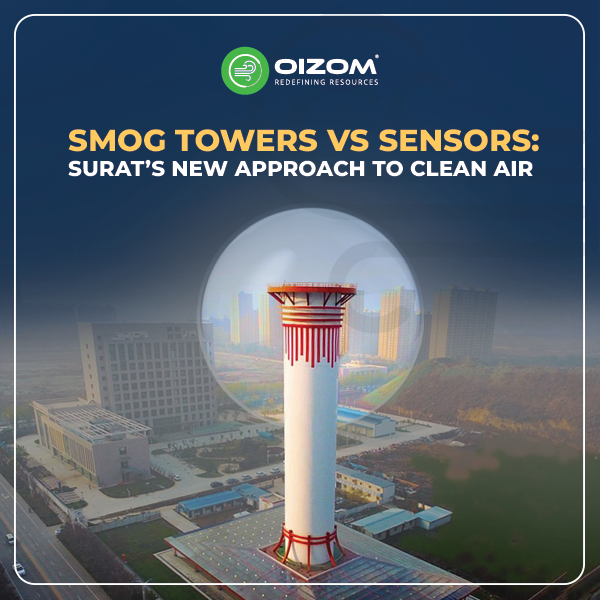
Smog Towers vs Sensors: Surat’s New Approach to Clean Air
Surat has been one of India’s most visionary cities, with rapid development, well-organised urban environments, and pioneering work in public health. But now, this fast-growing business hub is finding it increasingly challenging to keep the air clean enough to meet standards. Surat is now working to understand how smog towers work and the role modern air quality sensors play. Therefore, Surat is shifting towards developing a new clean-air strategy, aiming to utilise data from air quality sensors and analyses to determine appropriate solutions. The focus of this new strategy will not be to discredit one technology over the other, but rather to help Surat use the tools available to make sound, effective choices for cleaner air.
What Triggered Surat to Explore New Air Quality Solutions?
Surat’s history of crisis management was not established until recently. More citizens and regulators are interested in what is causing these short-term spikes in the AQI near higher-populated areas and areas with higher activity levels, including those associated with transport and industry. Historically, Surat relied on limited station-based monitoring systems that left gaps in areas with high pollution levels, which is another significant reason for seeking better methodologies for monitoring and controlling the AQI. Many of Surat’s current urban developments were established primarily by the presence of large-scale industrial operations, specifically textile, dyeing, diamond, and transportation industries, which are driving rapid growth and increased urban density.
As noted earlier, Surat’s recent economic development, emerging citizen advocacy, emerging industrial demographics, and the increased variability of AQI are continuing to drive the development of the Distributed Smart Sensor Network, creating a complete, real-time map of Surat’s air quality.
What are Smog Towers and How They Work
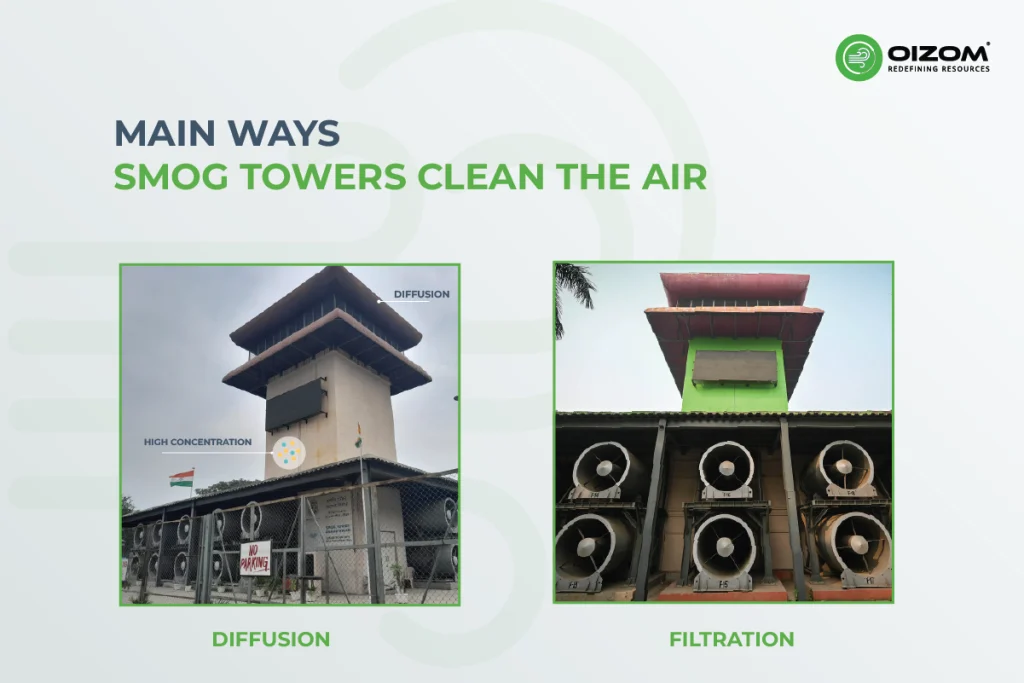
Think of a smog tower as a large air-cleaning device placed in the middle of the street, equipped with several large fans, filters, and, in some cases, water sprays that draw polluted air into it, clean it, and return cleaner air to the atmosphere.
There are two main approaches to how smog towers typically clean the air. The first is through filtration, where the air drawn through the tower passes through a filter that becomes clogged with particulate matter, including PM2.5 and PM10, and sometimes removes pollutants such as NOx and VOCs. Some of the more advanced smog towers use either HEPA-style filters or electrostatic precipitation technology like those found in many industrial-grade air cleaners.
The second method of operation is through air circulation and diffusion. This occurs when a tower uses large fans to push cleaned air back into the surrounding air, creating a localized airflow that somewhat dilutes pollutant levels in the area. An easy way to visualize how a smog tower works is to think of it as a vacuum cleaner for a city’s air. It “sucks up” dirty air, removes contaminated particles, and “blows out” cleaned air, but only in a tiny area. Unlike natural occurrences like wind or rain, the effect of a smog tower is highly localized.
Essentially, smog towers use mechanical methods to clean the air by targeting particulate matter concentrated in specific areas. However, smog towers are not meant to serve as replacements for more comprehensive measures designed to control pollution, including reducing emissions, managing traffic, and regulating industries.
Air Quality Sensors: A Smarter & Scalable Alternative
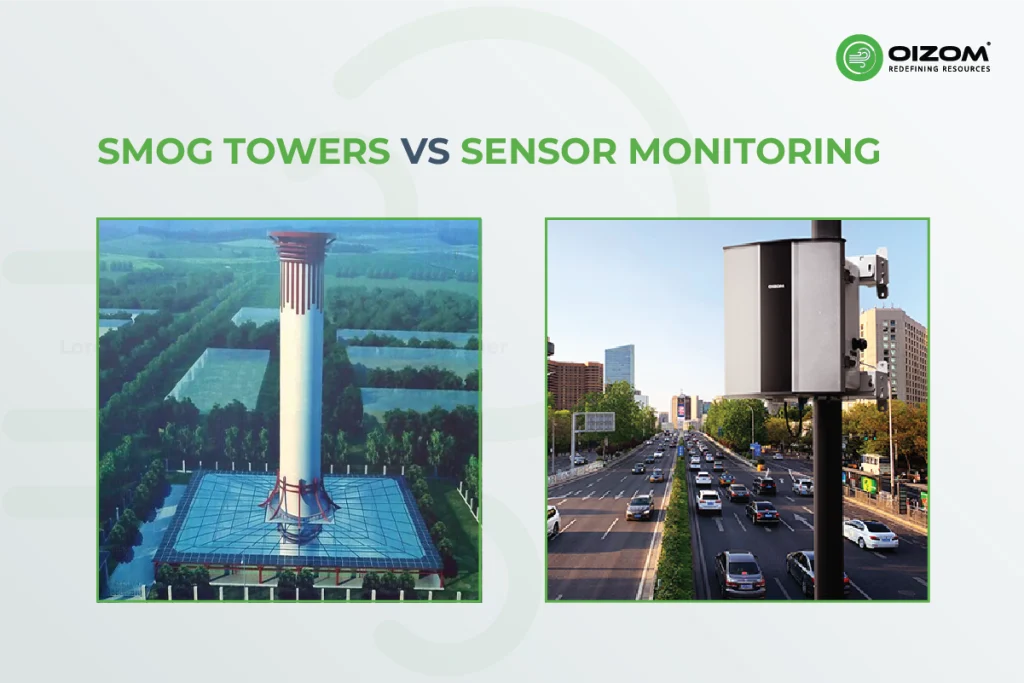
Air quality sensors provide real-time data on PM2.5, PM10, NO2, and O3 levels, enabling analysis of how air quality is changing. The primary benefit of sensors over smog towers is their scalability. A single smog tower has a minimal influence, while a network of sensors can cover an entire city, identifying pollution hotspots, tracking emission patterns, and pinpointing the exact times and locations of pollution increases.
Most modern sensors use both optical and electrochemical technology combined with Internet of Things (IoT) connectivity to transmit data as soon as it is captured to local information dashboards, apps, and public platforms. The result of this technology is a shift from a reactive to a proactive approach to air quality management in urban environments, enabling the city to respond more quickly, industry to make adjustments, and residents to make informed daily decisions about the impact of pollution on their health.
Using data and analytics to determine and manage air quality, as well as to enforce pollution controls, will allow cities to develop comprehensive clean air strategies over time without the capital costs, unnecessary infrastructure, and limited reach of smog towers.
Smog Towers vs Sensors
1. Coverage Area & Impact
Smog towers are filtering machines intended for use in small areas (10 to 200 meters), and are mostly limited to hyperlocal use.
Key points:
- Effective only in close range
- Cannot address pollution sources spread across multiple hotspots
- Impact varies with weather and airflow
Air quality sensors work differently from smog towers; instead of filtering polluted air, they monitor the air and provide information about where and when pollution is occurring, helping cities understand and remediate pollution sources.
Key points:
- Wide coverage with multiple deployment points
- Enables hotspot identification
- Supports targeted interventions
2. Cost, Maintenance & Long-Term Feasibility
Smog towers require substantial investment, energy-intensive operation, and timely maintenance of filters and electrostatic parts. Their long-term practicality is uncertain due to the high costs and low measurable impact.
Key points:
- High installation and operational costs
- Regular filter replacement
- High energy and labor-heavy
Sensors are cheaper to place and maintain, making them ideal for wide deployment with limited budgets. They require only occasional calibration and basic servicing, reducing the overall cost.
Key points:
- Low installation and maintenance costs
- Minimal energy use
3. Scalability & Real-World Outcomes
Installing smog towers citywide is impractical given their cost, size, and limited range. Even if installed extensively, those towers would not lead to measurable AQI changes.
Key points:
- Cannot be scaled at the city scale
- Space and power limitations
- Low return on scaling
Sensors, on the other hand, are designed for scalability. A city like Surat can deploy multiple units across industrial clusters, traffic corridors, and residential zones to translate data into workable steps.
Key points:
- Easy to scale across multiple locations
- Works well with community and industry participation
- Generates data that improves outcomes over time
4. Data Availability & Decision Making
Smog towers provide limited information on real-time data, since their role is mechanical cleaning, not monitoring. They cannot pinpoint the pollution hotspots or give insights into how it moves across the city.
Key points:
- Lacks real-time monitoring capability
- Limited use for planners or enforcement teams
Sensors provide continuous, real-time data that enables data-backed decisions. This helps cities pinpoint sources, track trends, evaluate interventions, and comply with NCAP and pollution reporting requirements.
Key points:
- Real-time air quality data
- Supports hotspot management
- Helps in policy evaluation and decision-making
5. Environmental & Energy Impact
Smog towers are energy-intensive and can indirectly contribute to emissions, depending on the energy mix. Their maintenance creates waste from spent filters.
Key points:
- High energy consumption
- Filter waste and resource demand
- Indirect carbon footprint
Sensors have a far smaller environmental footprint. They consume minimal energy, produce minimal waste, and run continuously without affecting local carbon emissions.
Key points:
- Very low energy usage
- No consumable waste
- Efficient for long-term use
Why Surat’s New Approach Needs a Sensor-First Strategy
The pollution in Surat does not come from a single source. Different parts of the city contain different mixes of pollution, including textile manufacturing, construction, traffic, and dense housing development. To effectively manage pollution, Surat needs an accurate understanding of pollution sources, pollutants to focus on, and pollutant behavior over time. This data can be obtained from sensors located in key areas throughout the city. With the implementation of the NCAP program, cities that fail to meet air quality standards will have to rely on timely, accurate air quality measurement and analysis to inform future planning. This is why there will be a strong emphasis on accurately measuring and tracking changes in pollutant trends, and on using that information to develop well-informed interventions.
As an industrial city, Surat will greatly benefit from using sensors to monitor air quality and emissions from various industries. Textiles, diamonds, and chemical industries produce different contaminants depending on their operations and location, and their pollutants will vary over time. Providing a distributed network of sensors throughout Surat will help Surat better identify and delineate high-pollution areas, enabling targeted enforcement actions.
Overall, a sensor-driven approach might provide Surat with scalability, precision, and decision-making power, required for long-term clean air planning. It doesn’t replace action but enables the city to take the right action, in the right place, at the right time.
Conclusion: Smog Towers vs Sensors for Surat’s Future
Surat’s pursuit of clean air is about what works functionally. Smog towers offer limited local benefits, a limited range, high cost, and significant resource use, making them marginal compared to other measures. In contrast to smog towers, real-time sensors enable Surat to understand and measure pollution levels in real time. Sensors help Surat’s government make much greater use of all methods of pollution control that affect air quality. Thus, while smog towers may serve a specific purpose, the development of a robust, scalable sensor network as a foundational component of the city’s air quality management ultimately provides a much more reliable way for Surat to achieve large-scale, sustainable improvements in air quality.
FAQs
- Smog towers provide only hyperlocal relief, so they don’t create measurable improvements at the city scale.
Sensors offer real-time, city-wide data that helps identify pollution sources and guide effective interventions.
- Surat aims to deploy a wider sensor network to map hotspots, track trends, and support data-driven actions under NCAP.
Yes, live AQI updates help citizens adjust outdoor activities, protect sensitive groups, and stay informed.
It has strengthened monitoring, improved compliance in key sectors, and enabled more targeted pollution-control measures.