
Summary
Cement manufacturing is among the most carbon-intensive industries; it accounts for 7-8% of global carbon emissions annually. However, in contrast to most other industries, there is a considerable element of unavoidable emissions in the cement sector, linked to the chemical reaction of limestone in the manufacturing of ‘clinker’. Other emissions like NOx, ‘black carbon,’ or methane remain overlooked in most ‘climate change’ studies.
This blog explains why the cement sector is hard to abate and why demand is growing in developing countries. It also describes measures that could be taken in the cement industry, including technologies such as clinker substitution, low-carbon fuels, energy efficiency, carbon capture, and low-carbon materials. Importantly, the increased use of emissions tracking and data-driven decision-making in cement is also highlighted as indicative of a shift in the cement industry’s focus from pollution control to climate responsibility.
How Does Cement Production Contribute to Global Warming
Cement is often associated with dust and visible air pollution, but its far greater environmental impact lies in global warming. Cement production emits large volumes of carbon dioxide, which directly influences the global climate. What makes cement unique is that much of this CO₂ is chemically unavoidable. Understanding cement’s true climate footprint, just like PM emissions, becomes essential. Cement is no longer evaluated solely on compliance but on its ability to transition to low-carbon production in a carbon-constrained future.
How Cement Is Made: The Emissions Start Here
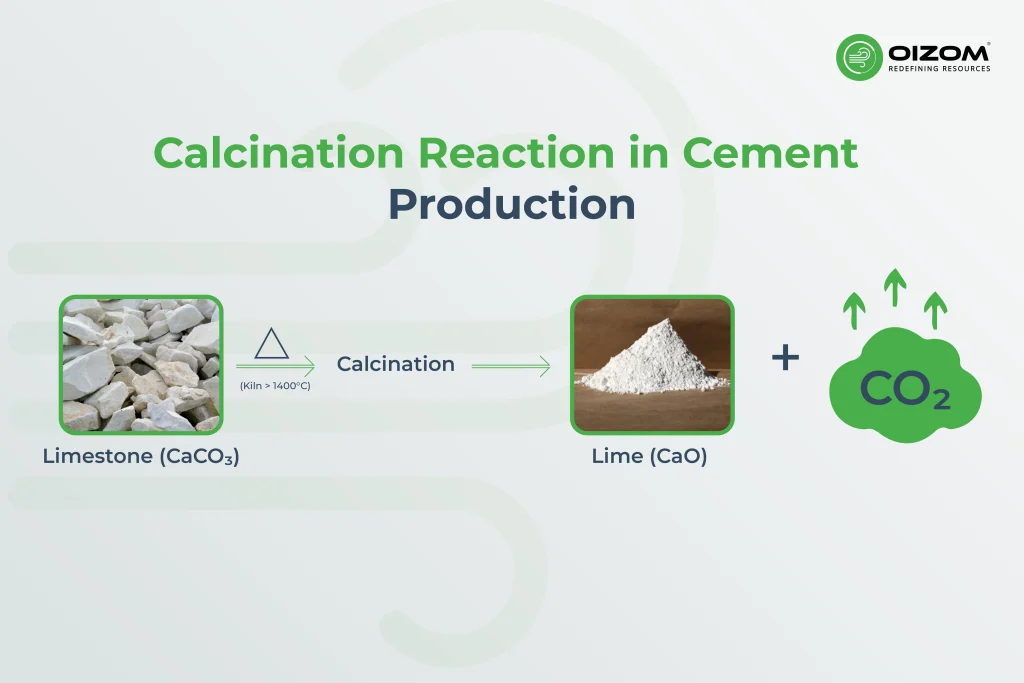
The climate impact of cement stems from its chemical structure. A significant portion of the greenhouse gases emitted during cement production comes from calcination, which occurs when limestone or calcium carbonate is heated in a kiln to produce lime (calcium oxide) and release carbon dioxide.
CaCO₃ → CaO + CO₂
The production of clinker requires a kiln temperature above 1,400 °C.
Cement manufacturing produces two separate streams of carbon emissions: process-related emissions from calcination (the unavoidable emissions associated with producing lime) and combustion-related emissions. The majority of emissions from cement manufacturing are due to the chemical composition of the ingredients used and the production processes.
The Real Reasons Cement Production Causes Global Warming
62% of cement production CO₂ emissions originate from process emissions (CO₂ generated from calcining limestone). Since this is a chemical reaction, CO₂ release from limestone can be avoided by capturing CO₂ post-production.
The remaining approximately 38% of cement CO₂ emissions are due to thermal energy requirements; i.e., cement kilns operate at over 1,400°C. Thermal energy demand is primarily met by CO₂-intensive fuels (e.g., coal, petroleum coke). While alternative fuels can reduce CO₂ emissions relative to fossil fuels, they cannot eliminate them.
An additional significant driver of CO₂ emissions in cement production is the clinker content of cement. Clinker is the largest contributor of CO₂ per ton of cement, and therefore, regions with higher clinker content in cement will generate more CO₂.
Cement has a typical CO₂ emission rate of 0.6-0.9 tonnes per tonne of cement produced, depending on the specific fuel type used to produce the cement (the amount of clinker used), the way the heat is used in the kiln (i.e., its efficiency).
Cement production is classified as an extremely “hard to decarbonize” industrial sector because CO₂ emissions are almost entirely driven by raw material chemistry, making it distinct from most other industries. The majority of CO₂ generated by energy use in other industries can be eliminated by using electric power.
There is a growing global demand for cement, driven by rapid urbanization and infrastructure spending in many emerging economies, resulting in an alarming increase in overall CO₂ emissions associated with cement. Therefore, without implementing a new or vastly improved cement production process, the increased demand will result in a proportional increase in overall cement CO₂ emissions.
Cement will continue to have one of the largest climate change impacts; therefore, to reduce its global warming impact, solutions to cement production must go beyond incremental improvements to existing processes.
Beyond CO₂: Other Pollutants That Add to Warming
It also produces other atmospheric pollutants that contribute to global warming.
Nitrogen oxides (NOx) are produced when fuel is burned at high temperatures. NOx produces ground-level ozone, another greenhouse gas.
Black carbon results from the incomplete combustion of fuels and is an immediate heat driver because it absorbs solar radiation directly within the atmosphere. Therefore, black carbon immediately warms.
Sulfur dioxide (SO₂) plays a complex role in climate forcing. It produces aerosols that reflect sunlight, cooling the atmosphere. Other environmental effects associated with SO₂ are much more significant than the short-term cooling effect.
Methane may be released into the atmosphere when alternative or waste-based fuel sources are not managed properly. Methane is a potent greenhouse gas.
All of these substances are categorized as “short-lived climate pollutants” (SLCPs). While CO₂ remains in the atmosphere for longer, SLCPs do not; their relative strength allows them to have a considerable short-term effect on the climate.
How Much Does Cement Really Contribute to Global Warming?
Cement is responsible for 7-8% of global CO₂ emissions.
Globally, cement produces more CO₂ than aviation and shipping combined, which together account for about 3% of total CO₂ emissions. Cement’s emissions are also similar to those of the global steel industry and account for a considerable share of industrial CO₂ emissions from the processing and refining of oil and natural gas.
The amount of cement produced in India will continue to grow steadily as demand for infrastructure, urban housing, and industrial operations increases. While the amount of cement used per person in India is still significantly lower than in many other developed countries, it is an important part of India’s overall climate strategy.
According to the IEA, if deep decarbonisation does not take place, cement CO₂ emissions worldwide could increase by 10-20% between now and 2050, mainly due to rising construction and urbanisation demands in emerging economies.
Climate models cited by the IPCC highlight that continued high emissions from cement and other heavy industries substantially affect long-term warming. These figures make one point clear: cement is not a marginal climate issue.
What Cement Plants Can Do to Reduce Climate Impact
The most significant short-term lever for decarbonizing cement is clinker substitution. Blended cements (such as LC3 – limestone calcined clay cement) and the use of fly ash and slag reduce the clinker-to-cement ratio and thus lower the CO₂ intensity of cement.
Switching fuels also significantly reduces CO₂ emissions. When coal or petroleum coke is replaced with biomass or refuse-derived fuel. Hydrogen and ammonia are also being examined as alternatives to traditional fuels for deep decarbonizing high-temperature heat.
In addition to fuels used in cement kilns and preheaters, carbon capture, use, and storage (CCUS) will help mitigate the unavoidable CO₂ emissions generated by the cement-making process. By capturing CO₂ from cement kilns and preheaters, cement manufacturers can begin to address process emissions.
Auxiliary technologies will further enhance these solutions’ ability to reduce the climate impact of cement. Waste heat recovery (WHR), energy-efficient kiln design, and renewable energy-operated mills or grinding systems. Geopolymer cements, low-carbon concrete, and circular use of industrial byproducts will provide significant reductions in CO₂ emissions across the entire cement value chain. Once these solutions are deployed at scale, developing methods to accurately measure CO₂ emissions will be vital to the commercialization of these technologies.
The Role of Air Quality and Emissions Monitoring
Cement plants are evolving from a focus on pollution control to decarbonization, in which emissions monitoring has become the main function of Climate and ESG Departments. As cement plants continue to track trends in CO₂, NOx, SO₂, and CO, they will gain visibility into how their operational decisions affect the climate.
The foundation for decarbonisation planning is established through baseline emissions mapping and continuous emissions monitoring at the kiln and calcination stages. By distinguishing between CO₂ produced during fuel combustion and that produced during cement production, cement manufacturers have a reliable source for setting targets.
The ability to assess the impact of fuel switching on emissions trends also supports data-driven decision-making. This insight into the true emissions associated with their operations will lead to more meaningful engagement with stakeholders regarding Climate and ESG issues.
From an ESG perspective, knowledge gained from continuous emissions inspection and monitoring can help provide an accurate account of a cement plant’s Scope 1 emissions and Net Zero strategies. Linking a plant’s operating activities to its daily Climate and ESG Performance through long-term dashboards and KPIs. It provides transparency into how a plant is operating.
With ambient air quality and emissions monitoring solutions such as Oizom’s, monitor trends and quantify impact, and adopt a new model, where monitoring transitions from regulatory compliance to real-time performance tracking.
Conclusion
The cement industry’s contribution to climate change through both the industrial use of alternative materials (called “clinker substitution”) and the continued use of less harmful fossil fuel types, improved manufacturing efficiencies, and the use of either mechanical or chemical means to capture carbon dioxide. These solutions are achievable through integrating technology and using various accountability measures, such as measuring emissions against carbon capture. As countries develop their economies toward Net Zero, cement will continue to fulfill the need for physical structures.
FAQs
Because limestone breaks down into lime and CO₂ during calcination, and additional CO₂ is released from burning fuels to heat the kiln.
Yes, cement is one of the top three industrial emitters globally, producing more CO₂ than aviation and nearly as much as steel.
Not entirely, but emissions can be drastically reduced through LC3, clinker substitution, green fuels, and carbon capture technologies.
Local emissions like NOx contribute to ozone formation, which indirectly adds to warming even beyond CO₂.