
Summary
Dust in industrial settings presents unique challenges that conventional measurement methods cannot fully address or help understand its environmental effects. This blog explains why a comprehensive representation of dust from PM₁ to PM₁₀₀ is essential for accurately assessing ambient dust levels and supporting mitigation planning. The blog also details Dustroid’s ability to provide real-time, size-specific measurements to turn raw data into insights. As well as case studies showing how to properly analyse and apply dust data to improve dust management, support trend analysis, and build compliance confidence.
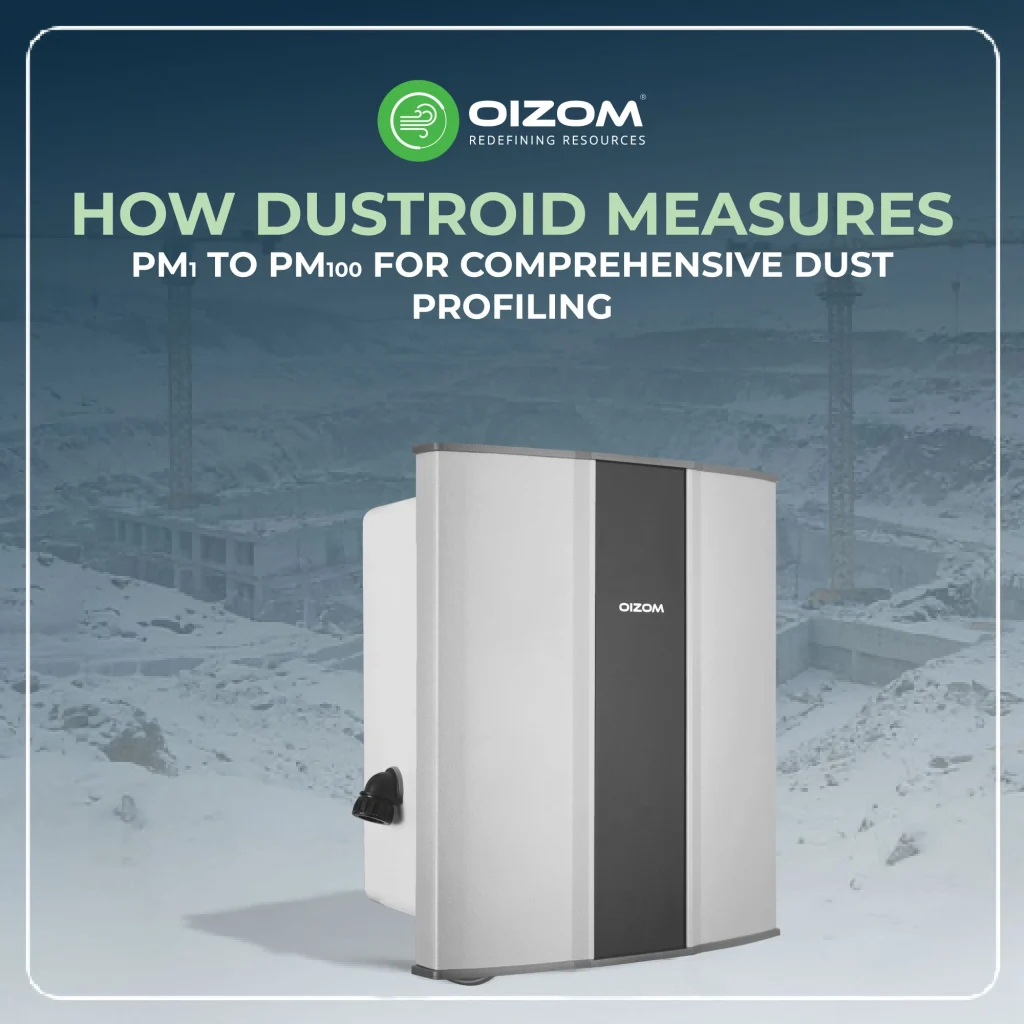
How Dustroid Measures PM₁ to PM₁₀₀ for Comprehensive Dust Profiling
Dust pollution is unpredictable and non-uniform. Construction sites, mines, and industrial sites have variations in their dust characteristics. Thus, determining the actual exposure levels, emission source, and dust mitigation impact on reducing exposure is essential. To overcome these limitations, dust monitoring should adopt continuous, size-specific ambient monitoring rather than periodic or time-averaged measurements. Dustroid provides a solution for continuously measuring PM across all sizes and delivers the data needed to understand, manage, and control dust emissions.
The Limits of Conventional Dust Measurement Techniques
The primary purpose of traditional dust monitoring methods is to comply with regulations, which are not suited for real-time dust control. Gravimetric sampling, filter-based techniques, and manual dust accumulation tend to measure only limited variables since these metrics do not track the full range of ambient dust particle sizes. Another limitation of traditional dust measurement methods is their reliance on time-based sampling frequencies. As a result, rapid fluctuations in dust levels from vehicular movement, materials handling, and blasting can often go unnoticed by traditional sampling techniques.
Environmental factors further reduce measurement accuracy. High-humidity air can alter measurements due to moisture absorption on the filters used to collect dust accumulations, while differences in airflow patterns and variable handling of collection materials introduce variability and operator error. Furthermore, due to laboratory analysis timeframes and the maintenance of traditional measurement systems, continuous monitoring is not possible.
Perhaps most significantly, dust monitoring using traditional methods yields limited actionable information, primarily due to a lack of ambient size-specific data. Without this type of information, we cannot identify where dust is coming from, assess how effective we are at mitigating it, or take steps to prevent exceedances. As expectations and compliance requirements for dust continue to increase, it is clear that we need modern ambient dust monitoring systems, such as Dustroid, that provide continuous, comprehensive, and decision-ready dust data.
Dustroid: Built for Complete Dust Profiling
Today’s needs for dust or airborne particulates require more than limited particle-size information; to properly manage this type of pollutant across diverse, complex environments, companies need a more robust monitoring system than traditional dust measurement techniques provide. Dustroid addresses the gap between what is required for effective management of ambient dust and what conventional dust measurement methods offer.
Dustroid is a real-time monitoring system dedicated to continuous measurement of particulate matter (PM) in sizes ranging from 1 to 100 micrometers (TSP). Instead of relying on passive collection or time-averaged sampling methods to measure particulate emissions, Dustroid continuously draws ambient air into its active sensing chamber to obtain consistent, representative samples.
The capability to simultaneously determine ultrafine, respirable, and coarse ambient particulate emissions provides users of Dustroid with complete knowledge of how each of the 3 types of ambient PM particles behaves. Users of Dustroid can therefore easily identify which PM emissions are combustion-related, aerosolized dust produced by mechanical generation, or generated during material handling. identifying sources of PM emissions, evaluating exposure risks, and determining the most appropriate mitigation strategies.
Dustroid was designed to withstand extreme environmental conditions. It includes a weather-resistant housing, a heated inlet option, and various network connectivity options, enabling Dustroid to provide continuous, real-time dust monitoring without requiring manual operator intervention. In this way, Dustroid changes how organizations monitor dust, moving from a compliance-driven approach to a data-driven one that enables proactive management of environmental impacts.
How Dustroid Detects Particles Across PM₁ to PM₁₀₀
Dustroid does this by combining a laser-based optical particle counting method with an active airflow management system. Dustroid continually draws ambient air through an active vacuum source into a controlled chamber. Within each controlled-atmosphere chamber, photosensitive detectors that collect light scattered by particles passing through the focused laser beam help determine the number and size of those particles.
Photodetectors will measure the intensity and patterns of light scattered by particles. The larger the particle, the more intense and scattered the light emitted; whereas, the smaller the particle, the lesser the intensity and the degree of scattering. Dustroid uses the raw counts of collected particles and classifies them into four standard particle fractions (PM₁, PM₂.₅, PM₁₀, and PM₁₀₀).
Dustroid’s detection of particulate matter size enables quicker identification of dust hazards in high-dust environments dominated by coarse particles. During the Dustroid operation, the sensors record data from every size simultaneously. Dustroid provides immediate, thorough knowledge of how and when total dust is measured.
How Raw Particle Data Becomes Clear PM Information
It must be converted into a form that can be readily interpreted, analysed, and acted upon. Dustroid was developed to perform this conversion in real time as its laser beam detects dust particles. Each time a dust particle passes through the laser beam in the Dustroid sensing chamber, the interaction between the particle and the laser beam produces a scattering of light. Each signal corresponds to a unique particle-detection event, and its strength varies with the dust particle’s size. Dustroid’s internal processor records these signals as raw counts for each particle size.
To convert raw particle counts to micrograms per cubic metre of air (µg/m3), Dustroid uses calibrated algorithms that account for particle-size distributions and density assumptions. The data that has been processed is then grouped according to recognised particulate categories, PM₁, PM₂.₅, PM₁₀, and PM₁₀₀, making it possible to directly compare the data with both environmental and regulatory limit values. Data averaging is performed over variable time intervals, from minutes to hours, depending on the monitoring objectives.
After processing, the particulate matter data is sent to a central storage location on a cloud-based platform. It will be converted into visual formats via dashboards and reporting tools. Dustroid converts complex optical inputs into standardized PM values in near-real time.
How Dustroid Handles High Dust Loads Without Losing Accuracy
Ambient air monitoring systems face unique challenges in high-dust environments due to the sudden nature of dust bursts, heavy material handling, and vehicle movement. Particulate concentrations can increase rapidly over time, and many conventional monitors are unable to operate effectively during these periods. Dustroid has been specifically designed to be reliable in high-particle-concentration environments.
Active sampling design maintains a controlled, consistent airflow throughout the sensing chamber, preventing the sensor from being overloaded during sudden dust spikes and allowing it to detect stable particulate levels despite dramatic increases in concentration. Dustroid’s optical particle counter is designed to measure across a wide range, allowing it to monitor particulate concentrations from relatively low to extremely high without interruptions in measurement data.
Other environmental factors, such as humidity, can also create additional accuracy issues for electronic air quality monitors used in high-dust environments. Humidity can form particle aggregates, thereby increasing the apparent dust levels reported by the monitor. To compensate for humidity, Dustroid Pro features a heated inlet that dries the air entering the system. By minimizing the effects of water droplets on particulate measurements, the Dustroid Pro system delivers highly consistent results. It eliminates false high readings that may occur in humid or foggy environments.
Dustroid’s internal processing algorithms are designed to handle high particle complexity with minimal signal distortion. Data is validated and averaged over user-defined intervals, ensuring consistent reliability while capturing the rapid rise and fall in dust content. Through a combination of controlled sampling, conditioned environments, and robust signal processing systems, Dustroid provides accurate, continuous data even in extreme or highly variable dust environments.
The Role of the Heated Inlet in Accurate Dust Measurement

Humidity poses a major challenge for dust monitoring, especially in industrial environments where fog, mist, rain, or high moisture levels are common. Water droplets scatter light in a similar way to dust particles, which can artificially inflate particulate readings and hide dust behaviour.
To prevent this, Dustroid Pro and Max variants use a heated inlet to condition incoming air before it reaches the sensing chamber. The inlet gently evaporates moisture while leaving solid dust particles unaffected, ensuring that only real particulate matter is measured.
By eliminating humidity-related interference at the sampling point, the heated inlet improves measurement stability and prevents false-high readings in wet or humid conditions. Working along with Dustroid’s active airflow control and signal-processing algorithms, it enables accurate, size-resolved PM₁-PM₁₀₀ monitoring even in challenging weather and high-dust environments.
How to Interpret Dust Data from PM₁ to PM₁₀₀
It is necessary to understand that not all particulates behave or have the same effect in the environment. For instance:
PM₁ represents ultrafine particulate matter that is produced primarily from combustion and high-temperature industrial processes. PM₁ can remain suspended indefinitely in the atmosphere and penetrate deep into the human lung.
PM₂.₅ represents fine respirable particulate matter that is associated with adverse health effects, and for which regulatory limits have been established. Both combustion and mechanical processes can increase PM₂.₅ levels.
PM₁₀ refers to coarser particulate matter generated by material handling, vehicle movement, and surface disruption. Although PM₁₀ generally settles rapidly from the air, it can still impact air quality and visibility.
PM₁₀₀ or TSP represents the full range of dust particles suspended in the atmosphere, including large mechanically generated particulates produced during various types of mining, quarrying, and other earth-moving activities.
Identifying trends in each size fraction is useful for differentiating dust sources. A rise in PM₁₀ without a corresponding increase in PM₂.₅ suggests resuspension of soil or material handling. In contrast, synchronous increases across all size fractions could indicate extensive site activity or high wind events. Analysis of size-resolved data, both collectively and individually, provides users with a better understanding of dust behavior, enabling them to implement more targeted mitigation methods and evaluate control measures more effectively.
Where Comprehensive Dust Profiling Makes a Real Difference
Dust profiling becomes much more beneficial when dust-creation processes are complex, erratic, and cannot be effectively managed with traditional techniques. With the Dustroid platform, we can provide “Actionable Insights” through detailed analysis of particulate matter (PM1-100).
Dust generated by construction sites can vary significantly depending on activities such as excavation, demolition, and vehicle movement. The largest mass concentration of dust particles consists of coarse particulate material; yet the finest particles remain airborne longer, spreading farther from the construction zone. Therefore, measuring only PM₂.₅ and/or PM₁₀ may not provide a detailed, dynamic picture of dust generation. construction managers to immediately identify which activities are producing the most dust and take action to eliminate or reduce dust emissions.
Dust sources from mining, such as blasting, crushing, haul road traffic, and wind, can produce huge amounts of dust. Dustroid PM₁₀₀ data provides the volume of mechanically generated dust; yet, measurements of PM₁ and/or PM₂.₅ still offer insight into fine dust emissions that negatively impact workers and others living close to mining operations and assess the performance of dust suppression efforts.
Dust generated during the loading and unloading of materials, as well as during the transport of materials (i.e., transfer) in warehouses and ports, produces a wide range (size distribution) of dust particles. Using continuous profiling, operators can distinguish between normal operational (routine) dust and abnormal emissions generated during operation, resulting in quicker response times for corrective actions.
Using Noise and Vibration Data to Contextualise Dust Events
Dust levels alone do not always explain why particulate concentrations rise. By incorporating noise and vibration data alongside dust measurements, site operators gain valuable context about the activities driving emissions.
In construction, mining, and industrial environments, high noise and vibration levels often coincide with high-dust activities such as blasting, crushing, heavy vehicle movement, or material transfer. Correlating these signals with PM₁-PM₁₀₀ data allows operators to distinguish operational dust events from environmental influences, such as wind.
This multi-parameter insight supports faster root-cause analysis, improves confidence in dust source identification, and helps the team verify whether mitigation measures are responding to the correct triggers. When combined with continuous dust profiling, noise and vibration data enhance situational awareness and strengthen proactive environmental management.
For all use cases, comprehensive dust profile development improves decision-making. In addition, it helps organizations shift their decision-making from reactive compliance to proactive environmental management, as dust-related data can now be directly linked to site activities and mitigation results.
How Dustroid Fits into a Long-Term Dust Monitoring Strategy
Continuous dust management cannot be achieved by taking one-time measurements. Rather, a long-term approach to dust management requires developing a dataset that consistently reflects dust levels over an extended period, accounting for seasonal differences and fluctuations driven by site behaviours.
Dustroid supports a long-term approach to monitoring ambient dust levels through its real-time, online monitoring system. Dustroid allows organisations to establish a continuous record of dust data. With data collected through this continuous monitoring method, organisations will have a historical dataset, helping them identify dust-level trends.
Dustroid’s cloud-based data platform enables organisations to store, visualise, and generate reports on dust data collected. Historical datasets can be used to produce compliance reports, prepare for audits, and confirm ongoing adherence to site-specific environmental commitments. Additionally, historical data can help determine whether site-specific mitigation actions, including water spray, enclosures, and/or traffic management systems, are sustainably reducing dust levels or only temporarily.
Moreover, the inclusion of configurable thresholds and real-time alerts enables Dustroid to integrate seamlessly into a site’s day-to-day operations. By automatically activating corrective action when dust exceeds established limits, Dustroid minimizes the risk of sustained excessive dust exposure. With continual measurement and historical data analysis, Dustroid will serve as the basis for proactive, data-informed management of dust rather than a reactive compliance activity.
Conclusion
Dust management includes understanding the type and amount of dust, its sources, and how it will evolve. Dust monitoring programs may miss key information in bustling operating areas. Dustroid’s continuous, throughout PM₁-PM₁₀₀ dust measurement capability provides users with a more comprehensive and realistic method for ambient dust monitoring. By using size-resolved data to assess the efficacy of mitigations and develop long-term dust profiles, companies can shift from a reactive to a proactive, data-driven approach.
FAQs
Dustroid uses active sampling and laser-based particle counting to measure coarse particles up to PM₁₀₀.
Yes, it's built for high-dust sites and can measure up to 30,000 µg/m³.
It delivers more consistent, real-time, size-resolved insight than time-averaged manual methods.
It gives a complete dust profile for better source identification and control planning.
Yes, it's data logs and MCERTS-certified PM₂.₅/PM₁₀ support compliance reporting.