
Summary
Low-cost, sensor-based indicative monitoring provides a wide range of near-real-time air quality information, enabling large-scale, decentralized monitoring networks. Indicative monitoring complements traditional reference-grade systems by enhancing spatial coverage and allowing for local analysis of pollution behavior. Indicative monitoring is being adopted in urban, industrial, and smart cities, supported by the IoT and data analytics. While the performance of the technologies used in indicative monitoring may be affected by various conditions, indicative monitoring remains a critical source of data for trend analysis, hotspot identification, and improving overall strategies for assessing air quality.
Introduction
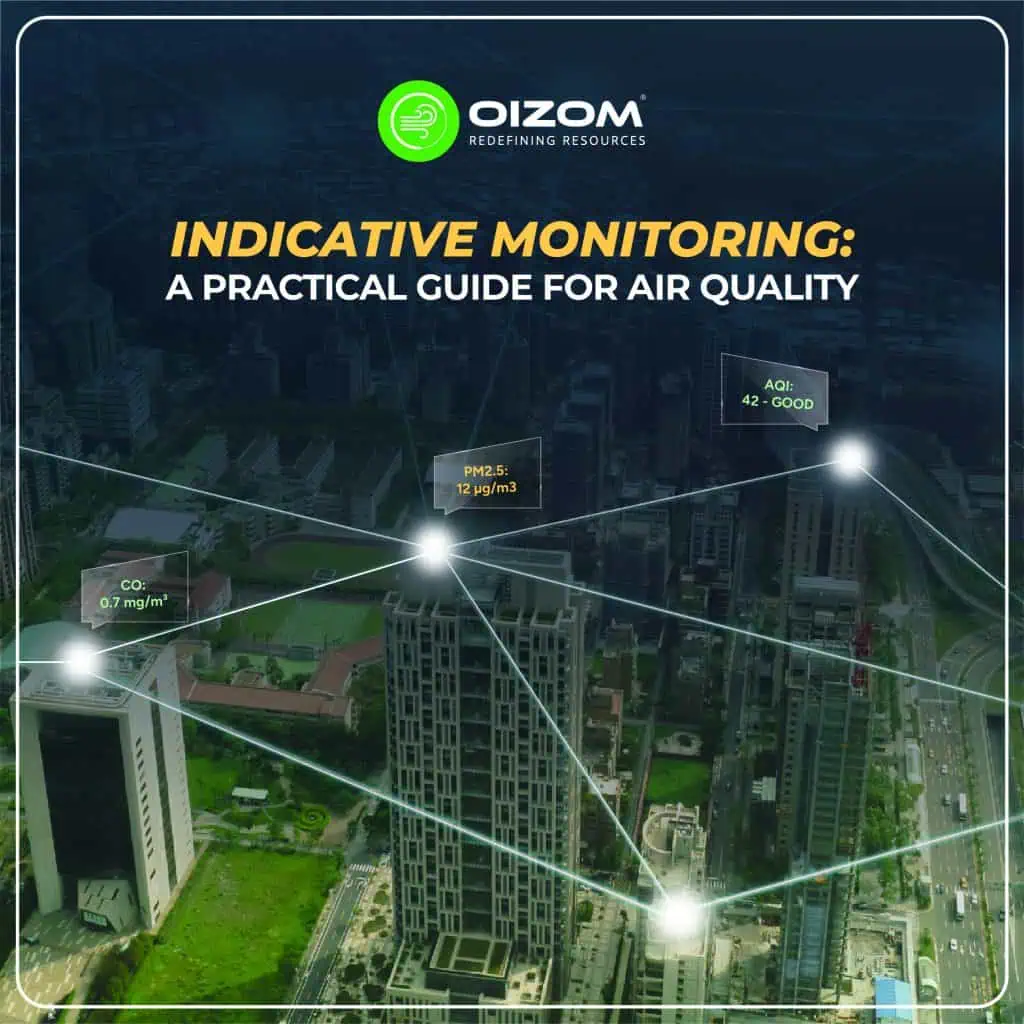
With pollution levels adversely affecting human health, the environment, and regulatory compliance, the significance of air quality monitoring has grown tremendously. While traditional monitoring systems provide accurate data on air pollution, they have limited reach, offering only an incomplete view of localized pollution patterns. Indicative monitoring is a viable solution to this problem, as it utilizes sensor-based systems to provide near-real-time air-quality information across multiple locations, enabling broader coverage and faster decision-making.
What Is Indicative Monitoring?
Indicative monitoring is a method for assessing air quality using sensor-based systems. These systems provide near-real-time air quality data with moderate accuracy compared to traditionally operated reference-grade instruments. The majority of systems are designed with inexpensive sensors so that they can be deployed extensively in many different locations.
In contrast to traditional monitoring stations that focus on providing the most precise measurements, indicative monitoring is intended to be more informative and useful for identifying pollution trends, understanding pollution-level variations by location, and providing real-time air-quality information. Indicative monitoring is an important component for identifying pollution hotspots and evaluating localized environmental conditions.
As sensor technologies continue to evolve, indicative monitoring is a viable, large-scale alternative to conventional methods, especially in applications where coverage density and the timeliness of insights are more important than the absolute precision of measurements.
Why Indicative Monitoring Is Used in Environmental Monitoring
Traditional reference-grade stations are precise but costly and limited in number, making it nearly impossible to monitor localized pollution variations.
Indicative monitoring helps to solve these problems by providing:
- Affordable deployment: Lower-cost sensors allow for simultaneous monitoring of numerous sites
- Significant coverage: Dense network of sites allows for the identification of micro-level pollution trends
- Quick access to data for responsive decision-making: Continuous data allows for a more rapid response to changing conditions
Indicative systems provide additional data that may aid in creating an overall picture of air quality. This is particularly useful in cities, industrial areas, and areas with elements of Smart City applications.
Indicative Monitoring vs Continuous Monitoring
The two forms of tracking air quality are continuous monitoring and indicative monitoring. Here are the key components of each:
Continuous Monitoring (Reference-Grade Systems):
- High accuracy and regulatory compliance
- Expensive installation and maintenance
- Limited number of stations due to cost
- Used for official reporting and long-term assessments
Indicative Monitoring (Sensor-Based Systems):
- Moderate accuracy with greater variability
- Lower cost and easier scalability
- Enables dense, distributed monitoring networks
- Suitable for trend analysis, hotspot detection, and real-time insights
Continual and indicative forms of monitoring will work together to increase the overall amount of data available to stakeholders, enabling them to make better decisions about the environment.
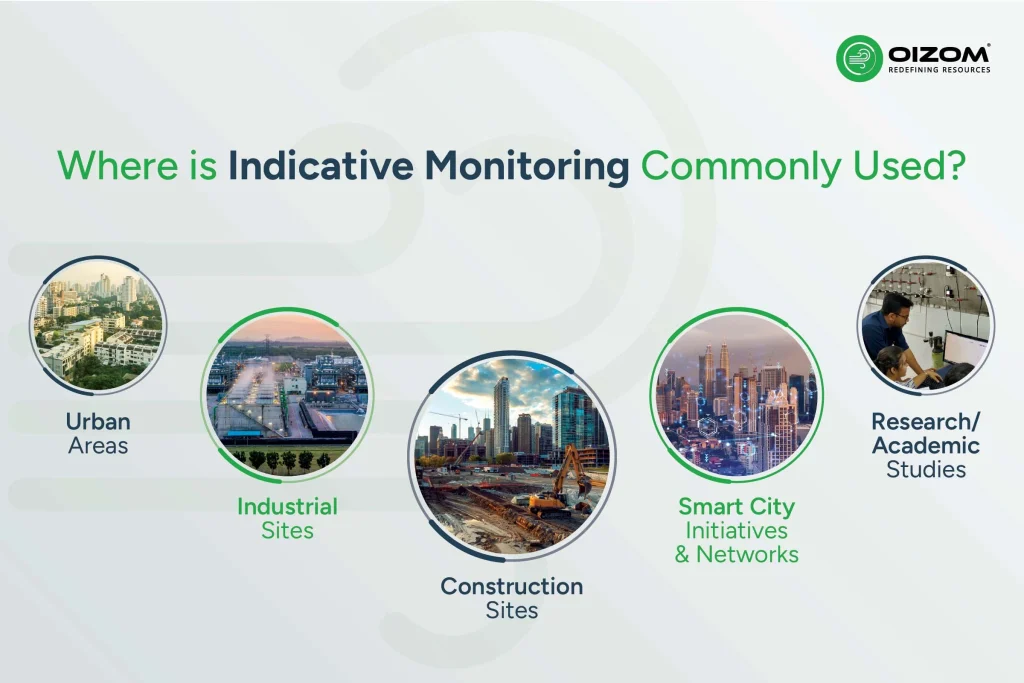
Where Is Indicative Monitoring Commonly Used?
The ability of indicative monitoring to provide critical information about localized air quality has led to its broad adoption for permanent or temporary applications. The most common types of applications include:
- Urban Areas: Monitoring pollution at a neighborhood scale; tracking traffic emissions; and identifying “hotspots” in cities.
- Industrial Sites: Perimeter monitoring, tracking emissions, and assessing community exposure.
- Construction Sites: Monitoring construction-related dust levels; verifying compliance with environmental regulations.
- Smart City Initiatives and Networks: They are integral parts of real-time environmental monitoring systems.
- Research/Academic Studies: For local air quality studies or pilot studies.
The use of indicative monitoring typically involves case scenarios in which indicative monitors are mounted along major roadways to collect traffic-related emissions, in perimeter areas of industrial facilities to assess the company’s impact on the surrounding area, and in communities to assess community exposure.
Technologies Used in Indicative Monitoring Systems
An indicative monitoring system uses various sensor technologies and digital infrastructure to provide real-time air quality data. At the center of this are various types of gas sensors, such as:
- Electrochemical Sensors: to detect gases such as carbon monoxide (CO), nitrogen dioxide (NO₂), and sulfur dioxide (SO₂), and are highly sensitive for ambient monitoring.
- Optical/Laser-Based Sensors: to measure particulate matter (PM₁, PM₂.₅, PM₁₀) using light scattering techniques.
- NDIR Sensors: to detect gases such as carbon dioxide (CO₂) with good levels of stability and selectivity.
- In addition to sensing mechanisms, these systems require:
- IoT Connectivity: To send real-time data back from many locations, this technology connects all the sensors in a system.
- Cloud Platforms: To store and visualize data and to allow for remote access to data.
- Data Analytics: To identify trends, patterns, or anomalies in air quality.
- Calibration Mechanisms: Both for factory calibrating sensors before installation and for doing field calibrations after installation to help ensure accurate data.
All these technologies enable indicative monitoring systems to function as scalable, connected networks, providing actionable environmental insights.
What Accuracy Level Can You Expect from Indicative Monitoring?
Indicative monitoring systems provide air quality data, but their accuracy is questionable. The types of sensors, how they are deployed, and how well they are maintained can all affect their accuracy.
Sensors are evaluated for performance using statistical metrics, including:
- Root Mean Square Error (RMSE): which reflects how well sensor readings match a reference value
- Correlation Coefficient (R²): which indicates the extent to which sensor data correlates with what is expected
Indicative monitoring systems are generally very good at detecting pollution patterns and trends. Several factors affect their performance:
- Environmental Variables: include the temperature, humidity, and the cross-sensitivity of sensors to other gases
- Sensor Drift: It is a gradual change in the sensor’s response characteristics over time
- Quality of Calibration: Proper calibration will have a dramatic effect on data reliability.
- Installation/Poor Placement: How well a sensor is placed can affect measurement accuracy.
With proper calibration, validation, and maintenance of sensors, indicative monitoring systems can provide consistent, valuable insights rather than exact measurements of a given air quality parameter.
Best Practices for Implementing Indicative Monitoring
To ensure that an indicative monitoring system provides reliable, accurate information that accounts for both technical and operational aspects.
- Calibration and Validation: Regular calibration, both in controlled settings (e.g., test labs) and in the field, will improve the accuracy and consistency of the collected data.
- Strategic Placement of Sensors: Sensors should be placed in areas that represent true exposure levels, with no nearby obstructions or sources of interference.
- Environmental Conditions: When possible, take into account environmental conditions (temperature, humidity, airflow) that can contribute to variability in the data you collect.
- Frequent Maintenance: Periodically checking and servicing your sensors will help reduce sensor drift and maintain performance over time.
- Data Quality Checkers: Having procedures for validating the data you collect and detecting anomalies will lead to more reliable information.
A good way to improve the effectiveness of the indicative monitoring system is to couple good deployment strategies with continuing maintenance and validation.
How Sensor-Based Monitoring Is Improving Indicative Monitoring
Sensors and digital infrastructure use indicators. Sensor-based systems have:
- Better Stability and Accuracy: With new-generation sensors, we have greater overall reliability and less drift over time.
- Access to Real-time Data: Through continuous data streams, we can analyze air-quality changes and respond quickly.
- The ability to connect to the Internet of Things (IoT) and Cloud platforms: By connecting sensors at installation, we now have central monitoring across multiple distributed networks.
- Advanced Analytics: Machine learning and data modeling can correct sensor deviations, improving the overall reliability of the data collected.
- The ability to deploy quickly and inexpensively: Our ability to quickly install and deploy dense monitoring networks has increased.
When Should You Choose Indicative Monitoring?
Flexible monitoring, spatial coverage, and fast access to information are more important factors than strictly following regulations.
Some examples of when indicative monitoring is effective include:
- Large-Scale & Multi-Location Monitoring Needs: You need a monitoring solution that covers a large area, with multiple monitors operating across various cities, industrial parks, or project locations.
- Cost Constraints Driving Scalable Deployment: The cost restrictions of using traditional monitoring methods – the costs of using these lower-cost systems have made it possible to use large numbers of monitors.
- Need for Real-Time or Rapid Decision-Making: When you require immediate or near-immediate information from the monitor to make decisions quickly and take necessary action.
- Trend Analysis & Pollution Hotspot Identification: You need to identify trends and locations of frequent pollution; you are not trying to quantify the amount of pollution, but rather to gain insight into the political and economic conditions of your community and to help your community manage the environment.
- Multi-System Validation & Data Representativeness: You are using more than one monitoring system to identify which parts of the environment are being monitored and to assess how representative that information is of the environment being measured.
The Future of Indicative Air Quality Monitoring
The development of indicative air quality monitoring due to advancements in sensor technology and in how we manage Air Quality data.
Some major upcoming trends include the following:
- Standardizing Efforts: Regulatory agencies are developing guidelines for evaluating and using low-cost air quality sensors.
- Integration with Smart City Ecosystems: Air quality data aligns with traffic, Weather, and urban planning data systems.
- More Accurate Data Due to Artificial Intelligence: Machine Learning algorithms will improve the Calibration, Error ban or correction process as well as the Predictive Capabilities of low-cost sensors.
- Miniaturization and Portability: The increased miniaturization and portability mean that many additional scenarios could utilize portable air quality monitoring systems.
- Increased Ease of Use for the General Public: Use of open data platforms, which allow Convenience Store or Community Members access to local air quality information.
Indicative outdoor air quality monitoring will serve much more as an Environmental Decision-Making Tool.
Conclusion
Increased accessibility, flexibility, and data-driven decision-making in conducting pollution-based measurements through indicative monitoring in Air Quality Management. Though not intended to replace the accuracy and precision achieved by reference-grade methods, indicative monitoring will provide. If conducted in conjunction with proper calibration, validation, and ongoing maintenance, the information derived from indicative monitoring can assist in making informed environmental management decisions. Indicative monitoring will become a component of complete air quality monitoring programs.
FAQs
Indicative monitoring provides moderate accuracy and is less precise than reference-grade systems, but it is reliable for trend and pattern analysis.
Indicative monitoring is generally not used for regulatory compliance but can support and complement compliance strategies.
Indicative monitoring uses sensor-based instruments such as electrochemical, optical (PM), and NDIR sensors.
Yes, sensor-based air quality monitors are the primary tools used for indicative monitoring.
Indicative monitoring can measure pollutants like PM₂.₅, PM₁₀, CO, NO₂, SO₂, O₃, and CO₂.