
Summary
This blog discusses the various types of pollution produced by modern mining practices, including explosive blasting, material handling, diesel-powered equipment, and transport. It shows how mining practices affect the health of workers, neighbouring communities, and the environment in both the short and long term. When traditional pollution monitoring was limited, air quality sensors that provide continuous, actionable data weren’t available. Constant monitoring enables mines to make operational changes, implement engineering controls, and develop a strategic air-quality monitoring program that helps them reduce emissions, comply with regulations, and protect employee and environmental health.
Mining Pollution: Causes, Impacts & Real-Time Solutions
Mining sites often resemble vast landscapes of rock and machinery, but hidden within these operations is a dynamic, invisible challenge: air pollution. From blasting and drilling to hauling and processing, mining activities emit fine dust and harmful gases that fluctuate constantly, affecting workers, nearby communities, and surrounding ecosystems. Understanding what mining pollution represents today is the beginning of managing it effectively and obtaining a clearer view of the air we all share.
What Mining Pollution Really Means Today
The pollution by mining today is less a result of what can be seen and more of what is released into the atmosphere during the mining process. The majority of modern mines rely on mining operations. These operations create a constant source of particulate matter (PM₂.₅ and PM₁₀), nitrogen oxides (NOx), sulfur dioxide (SO₂), carbon monoxide (CO), and fugitive dust into the air. Modern mining operations are larger and operate with greater intensity than historically small-scale mines, thus posing a continuous challenge to air pollution. In contrast, traditionally smaller-scale mines produced air pollution only during occasional operations. Emission levels are not constant throughout the day but change during the operational phases, including spikes during blasting and hauling, and are also detected in surrounding communities. Therefore, it is important to account for the visibility of these variations, as the most significant exposure to PM₂.₅, PM₁₀, NOx, SO₂, and CO often goes unnoticed.
What’s Causing Pollution in Mining Areas?
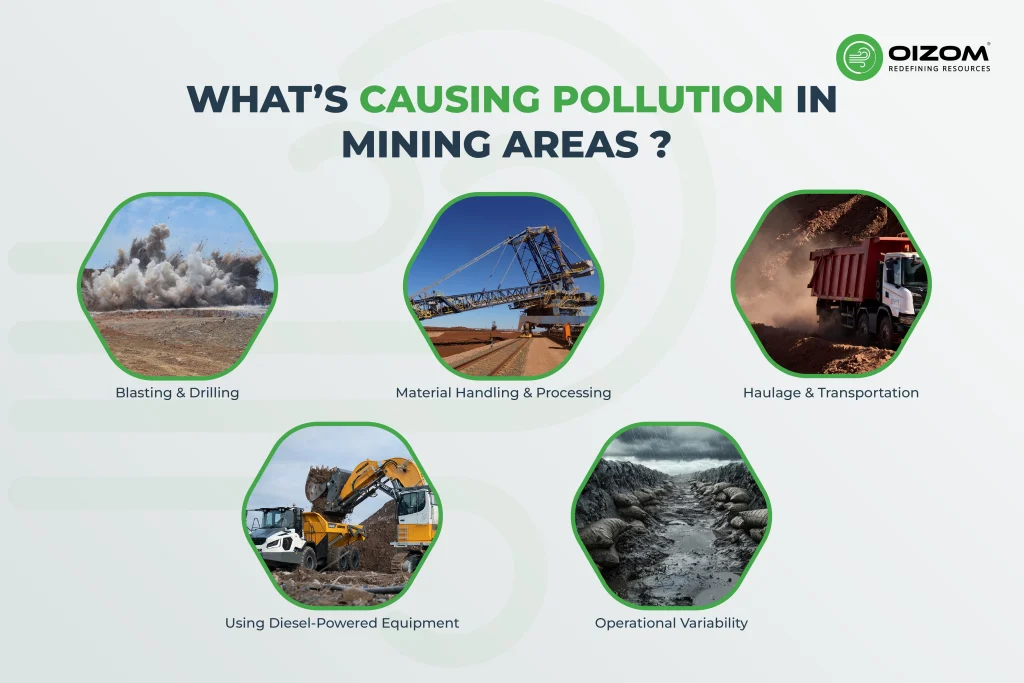
Mining workflow-related processes contribute to air pollution in and around mining operations, with most emissions produced throughout the operation and at every stage.
- Blasting and Drilling: The friction/pulverisation from rock fragmentation creates dust and fine particles (PM₁₀ and PM₂.₅) that remain airborne for a long time and can be transported over some distance from the blast area.
- Material Handling and Processing: During operations such as loading, unloading, crushing, and screening, fine dust is continuously being created when large amounts of dry material are being handled (at high volume).
- Haulage and Transportation: During the transportation of heavy vehicles, dust is produced over unpaved Roads. There is also fugitive dust from resuspension by heavy vehicles’ acceleration and braking.
- Using Diesel-powered Equipment: During operation, haul trucks, excavators, loaders, and generators emit NOₓ, SO₂, CO, and DPM.
- Operational Variability: Emissions fluctuate during operational hours, with peak emissions occurring during high-activity periods. Emissions vary based on weather patterns and topographic conditions.
With the combined activities (which interact with one another), air pollution becomes an inherent problem at mining locations rather than an isolated issue.
How Mining Pollution Impacts Workers, Communities & Ecosystems
There are three distinct but related ways that mining pollution affects different populations, with air quality as the central factor. The direct exposure to workers is the most severe. Dust from blasting, drilling, and material handling enters their breathing zones. Exhaust from diesel-powered equipment contains gases, including nitrogen oxides and carbon monoxide. Short-term exposure can cause headaches and fatigue; long-term exposure increases the risk of chronic respiratory disease. These exposures are at their highest during active times or in poorly ventilated locations and therefore vary across work shifts.
When airborne pollutants migrate beyond the operational boundaries of mining sites, they also affect the communities surrounding these areas. During periods of high dust and gas emissions (often occurring during dry seasons or windy conditions), these pollutants affect the quality of air in and around the community, resulting in chronic respiratory discomfort, less outdoor time, and increased concerns regarding environmental quality and safety, as a result of both periodic exposure and cumulative exposure.
The impact of mining pollution on ecosystems has a slower, more gradual, but long-term cumulative effect. Airborne emissions from mining operations can contaminate adjacent bodies of water through deposition. This accumulation of dust and gas emissions disrupts the local biodiversity and ecological balance.
Together, these impacts highlight how mining air pollution creates layered risks that vary by location, timing, and intensity, often beyond what snapshot measurements can reveal.
Why Traditional Pollution Checks Fail in Mining Sites
Traditional methods of assessing the environmental impact of mining operations rely on periodic readings to confirm compliance with regulations. While this has proven effective for industries with slight variation, such as manufacturing, in an atmosphere where both mining operations and blasting continue to create airborne particles and noise from overburden, it fails to adequately reflect how quickly and drastically pollution levels fluctuate due to factors like blasting or movements of heavy equipment through the facility.
Additionally, a common problem with pollutant monitoring in mining operations is the data gap caused by the current manual sampling method. Taking average samples yields a product that averages short-term emission spikes, which typically coincide with the highest exposure risk for workers and individuals living near air quality monitoring sites. Practically, those compliance reports do not accurately reflect the high degree of fluctuation across shifts, locations, and operating conditions, as evidenced by unrecorded high-emissions events over time.
The Role of Real-Time Air Quality Monitoring in Tackling Mining Pollution
Real-time air quality monitoring fills gaps in traditional methods by providing information about pollution as it occurs. The constant nature of monitoring can account for fluctuations caused by blasting and heavy haulage activities or changes in the weather, and provides a more accurate view of air quality on site. This data allows operators to determine not only if their limits have been exceeded, but also the time, location, and reasons for the exceedances.
Not only does real-time monitoring strengthen insight, but it also allows operators to take proactive action before exposure levels escalate. Real-time data supports trend analysis, alerts, and continuous recording, enabling regulatory compliance rather than relying on periodic verifications. Thus, enabling better pollution control but also more credible environmental accountability, eliminating the downsides of treating monitoring as a purely reactive, passive, or paperwork-based exercise.
How Real-Time Monitoring Helps Mines Stay Compliant
By continuously measuring mining air emissions in real time, the system provides mines with a comprehensive picture of their emission variations throughout the year. Unlike traditional periodic assessments of mining emissions, real-time data enables regulatory bodies and internal auditing departments to maintain an accurate record of fluctuations in air quality. Constant tracking of pollutants allows real-time detection of potential exceedances and internal compliance standards. Therefore, real-time monitoring has transitioned compliance from a paperwork-driven exercise to a data-driven process better suited to modern mining operations.
Practical Strategies Mines Can Use to Reduce Pollution
Mines can reduce their air quality impacts by combining operational adjustments and engineering control strategies.
Operational Adjustments
Operational decisions made to reduce air quality impacts, including scheduling blasting during periods of low wind, restricting haulage speeds on unpaved roads, and rotating work zones to reduce the likelihood of prolonged dust exposure.
Engineering Controls
Engineering controls include using water sprays, dust suppressants, enclosed conveyors, and upgraded diesel equipment to contain emissions at the source.
Monitoring-Informed Strategies
They are developed using real-time information to define a targeted set for mine operations. An example of a monitoring-informed strategy is to apply dust control during the peak activity period or to increase ventilation in areas with high pollutant levels.
Short-term vs Long-term Impacts
Short-term measures are designed to minimize immediate exposure to pollutants, while long-term measures, such as equipment upgrades and roadways, will continue to reduce a mine’s overall emissions.
Choosing the Right Monitoring System for Mining Sites
When selecting the proper monitoring system, it is important to strike a balance between functionality and its fit with current operations. Managers should evaluate the following:
Sensor Types and Placement
The monitoring system should include sensors covering the most dangerous areas of the mine to obtain representative air-quality data from these locations.
Features and Capabilities
Monitoring systems that can collect continuous data, alert mines through real-time alarms, interface with operational dashboards, and conduct trend analysis to provide insight into air quality allow for better management of air quality issues through proactive decisions based on informed data, rather than relying solely on raw data.
Decision-focused Perspective
Select monitoring systems that provide actionable data. It helps teams to prioritize corrective actions, demonstrate regulatory compliance, and remain accountable for environmental obligations.
By enhancing the mine’s monitoring capabilities, the system provides site-specific solutions that meet regulatory obligations, improve operational efficiency, and eliminate unnecessary complications in the monitoring process.
Conclusion
Mining pollution is complex and continually evolving. Mining pollution is a function of the size, level, and timing of mining operations. Mining Pollution impacts workers at the mining site, surrounding communities, and ecosystems, underscoring the need for proper management of this pollution. Real-time monitoring provides mining sites with tools to be proactive in meeting environmental compliance requirements and creating healthier environments. Understanding the issues related to mining pollution and the reasons behind it enables mining sites to implement actions to achieve cleaner, safer mining operations.
FAQs
Blasting, drilling, material handling, and diesel-powered equipment are the primary sources of mining air pollution.
It can cause respiratory issues, chronic health problems, and long-term environmental harm.
Fine particulate matter (PM₂.₅, PM₁₀), nitrogen oxides (NOₓ), sulfur dioxide (SO₂), carbon monoxide (CO), and diesel particulates.
Visible dust clouds, unusual odors, reduced air clarity, and increased respiratory complaints among workers or residents.