
Summary
Dust monitoring requires real-time monitoring to enable prompt action. This blog describes how Dustroid Smart can continuously monitor multiple PM in real time; it provides details on the technology, field-ready features for long-term outdoor operation, and instructions for using Dustroid Smart to monitor dust in real time from your job site and take action via alerts and automation. The blog also includes examples of how Dustroid Smart can be applied in practice, a comparison of Dustroid Smart vs. conventional monitoring methods, and what it takes to implement and manage Dustroid Smart over time. By bringing these insights together, this blog can help site managers and EHS teams determine whether real-time PM monitoring aligns with their company’s operational and compliance objectives.
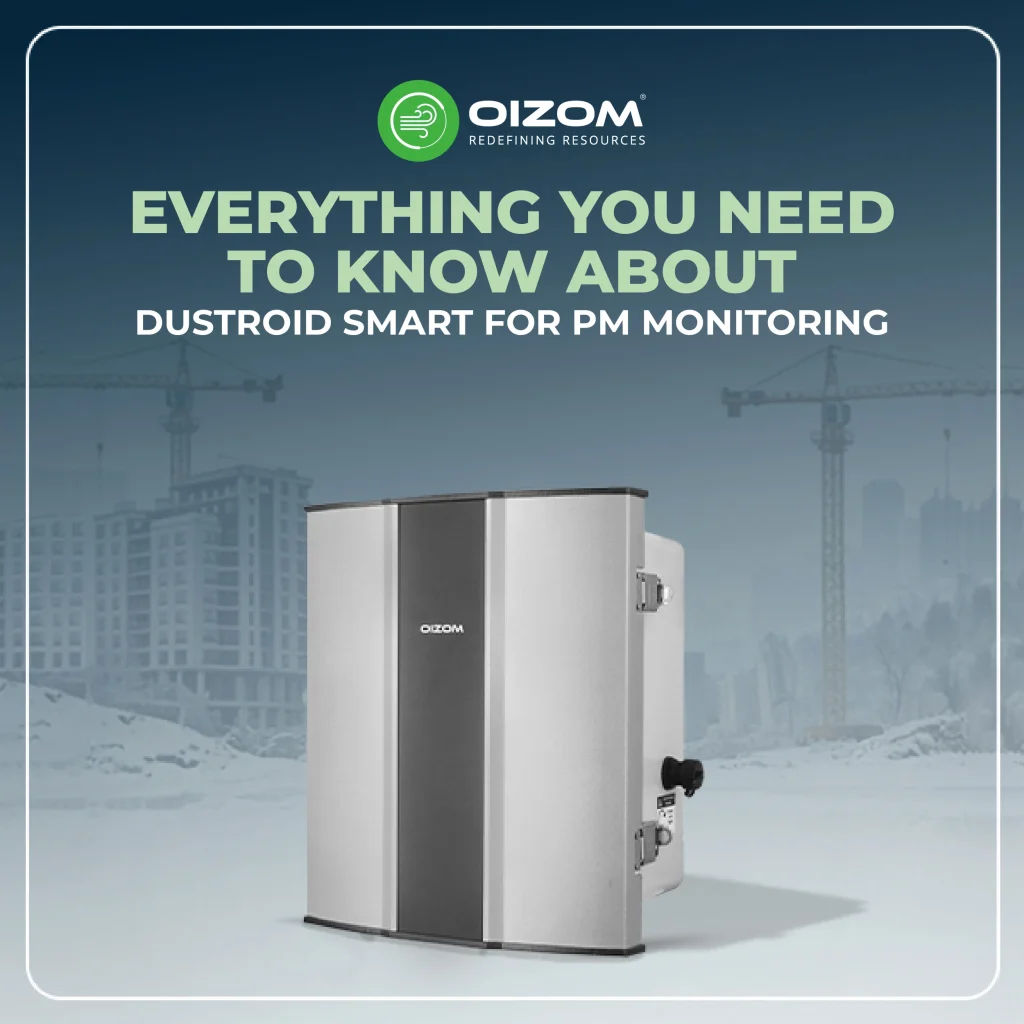
Everything You Need to Know About Dustroid Smart for PM Monitoring
Live insight into particulate matter levels is essential for managing dust in high-risk industrial environments. Dustroid Smart has been developed specifically to help site supervisors and managers stay informed about PM levels in high-dust areas, enabling them to monitor real-time changes and take action before serious problems occur. This blog evaluates Dustroid Smart’s position in the overall PM monitoring system, how Dustroid Smart measures PM, and insights into its design and development to improve the effectiveness of using dust management strategies on-site.
What is Dustroid Smart, and Where Does It Fit in PM Monitoring
Today, particulate matter monitoring encompasses both regulatory compliance and on-site dust control. The contradiction between the regulatory nature of PM measurement and the need for operational teams to grasp “its role and function” in real time when PM levels rise, fall, or change direction poses a continuous challenge for industries like construction and mining.
To address this disconnect between compliance-focused monitoring and real-world dust control, industries require continuous visibility into on-site PM behaviour. This is where Dustroid Smart comes in, an accurate, continuous, real-time dust monitor designed to deliver optimal performance for facilities that experience varying, intense dust levels in direct relation to their activities and weather conditions. Dustroid Smart is MCERTS-certified, backing its use in regulatory and compliance-driven monitoring programs where proven performance and data reliability are essential.
Within the spectrum of PM monitoring, there are three forms: manual gravimetric sampling (for regulatory compliance), fixed ambient stations (for urban air quality), and real-time indicative monitors (for operational use). Dustroid Smart has been created specifically for use in high-dust industries, whereas the previously mentioned types of PM monitoring are designed more to monitor general ambient air quality.
Dustroid Smart’s ability to monitor dust and other particulate matter enables organizations to monitor and manage multiple PM sources and comply with multiple regulations. Dustroid Smart shows that PM can be both very fine particulate matter (PM₁), which poses potential health effects beyond the construction site and can migrate to other locations, and larger particulate matter (PM₁₀₀), obstructing visibility or causing nuisance within and outside a construction site. The ability to monitor both fine and coarse PM allows construction and mining stakeholders to move beyond a single PM metric used for compliance to a broader understanding of dust impacts.
How Dustroid Smart Measures Particulate Matter in Real Time
The reliability of real-time particulate matter monitoring depends heavily on air sampling, handling, and measurement. In dusty environments, such as construction sites and mines, changes in humidity, fluctuations in airflow, and dust bursts can lead to inconsistent air quality data.
To collect air samples, Dustroid Smart uses a controlled suction system to continuously draw air into the sampling unit. This enables the consistent collection of an ambient air representative sample in the field environment. Once the air sample is pulled into the sample unit, it is analyzed for particulate matter using laser-scattering technology. The intensity and pattern of scattered light are used to calculate the concentrations and sizes of the different types of particulate matter (PM₁, PM₂.₅, PM₁₀, and PM₁₀₀) present in the air sample.
In addition to PM₁-PM₁₀₀, Dustroid Smart continuously monitors ambient temperature and relative humidity. These readings help correct particulate measurements for environmental variations, ensuring accurate and consistent data even in dusty, humid, or rapidly changing conditions.
Dustroid Smart’s designs aim to minimize environmental interference and ensure reliable samples in these environments. The Dustroid Pro and Max models feature a heated inlet to reduce the effects of moisture on collected data, preventing PM readings from water droplets from being inflated relative to actual dust. This measurement approach, along with Dustroid Smart MCERTS certification for PM₂.₅ and PM₁₀, ensures data quality and performance align with recognised regulatory standards for particulate monitoring.
Critical PM Parameters Measured by Dustroid Smart
In an industrial environment, dust exhibits diverse characteristics depending on its size. By measuring multiple fractions of particulate matter (PM), Dustroid Smart provides users with a comprehensive assessment of dust behaviour on their site.

PM₁
The ultra-fine particles making up PM₁ have a long airborne residence time and are small enough to reach deep into the lungs and airways when inhaled. Most of the time, PM₁ is from sources that combust like heavy equipment using diesel fuel, and fine material handling.
PM₂.₅
PM₂.₅ is often referenced in air quality regulations and guidelines due to its health-related significance. On active job sites, PM₂.₅ levels will increase due to drilling, crushing, machinery movement, and material transfer.
PM₁₀
It is used to describe coarse particles created from mechanical processes (e.g., excavation, loading, and hauling). PM₁₀ monitoring enables site personnel to assess the effectiveness of dust suppression practices and make timely adjustments when the threshold is exceeded.
PM₁₀₀ or TSP
Larger dust particles settle on the ground relatively quickly, like PM₁₀, PM₁₀₀ provides an overall indication of dust in the environment. Elevated PM₁₀₀ concentrations in mining and construction environments are typically attributed to poor material handling or resuspension of surface dust.
A Closer Look at Dustroid Smart’s Design for Long-Term Field Use
Dust-monitoring systems for construction and mining environments are designed to withstand the rigorous demands of long-term field conditions, including exposure to severe weather, high dust levels, and variable power sources. Each Dustroid Smart model is equipped with a rugged IP66-rated enclosure, protecting the device from heavy dust and excess moisture when installed outdoors.
Dustroid Smart models have been developed to perform reliably in environments with very high dust levels up to 30,000 μg/m³ (PM100 / TSP). In addition, the onboard memory capture can help prevent data loss in the event of a network failure. Dustroid Smart’s onboard temperature and humidity sensors provide additional environmental context, allowing site managers to interpret PM fluctuations accurately, adjust dust suppression strategies, and maintain reliable monitoring under diverse weather conditions.
Dustroid products can be operated with minimal operator intervention for the duration required by a typical short-term program and long-term monitoring program.
How Dustroid Smart Handles Data: From Measurement to Meaning
To handle data, Dustroid Smart has been developed around the complete dust monitoring workflow. Particulate Matter levels are measured, with collected PM data processed in real-time and sent to Envizom at user-defined time intervals. When the PM data reaches Envizom, the platform allows users to view raw PM data values, trends, and alerts.
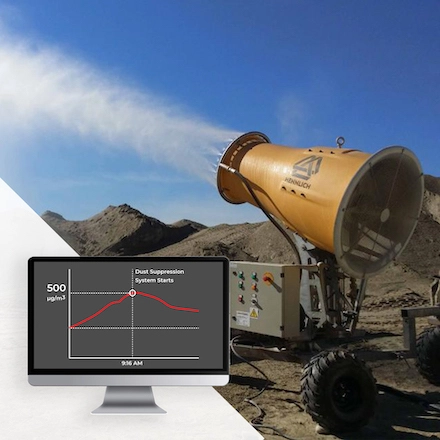
Users of Dustroid Smart can create multiple threshold limits to set different levels of on-site PM and meet their company’s internal guidelines. The system will automatically notify the user when dust levels exceed the user-defined threshold and initiate an action to mitigate elevated PM levels before they reach unacceptably high levels. This Dustroid Smart approach reduces the number of manual actions required.
Over time, historical dust data stored in Dustroid Smart will be used to generate reports and evaluate dust mitigation actions, creating an informed plan to help meet any on-site dust monitoring requirements.
Dustroid Smart vs Traditional Dust Monitoring Methods
While traditional dust monitoring methods, such as periodic and manual sampling, have been in use for a long time, many are used only to determine the overall amount of dust in the atmosphere over a time interval, to report on this information for future reference, and to assess baseline conditions.
Dustroid Smart is an innovative approach to real-time dust monitoring and particulate measurement. By measuring particulate concentration in real time, Dustroid Smart can track dust events as they occur. This is especially important in construction and mining environments, where dust levels can change rapidly with activity levels or the movement of materials/vehicles.
Dustroid products do not replace traditional dust monitoring methods; however, as an MCERTS-certified system, it complements established compliance techniques while providing continuous operational visibility. Unlike traditional dust monitoring methods that rely on manual setup and periodic site visits, Dustroid Smart is designed for continuous operation with flexible installation, multiple communication options, and remote system management.
Who Should Consider Using Dustroid Smart?
Some examples include construction and mining companies, as well as industrial facilities that handle bulk materials, where continuous data and information are key to safer workplace operations. The ability of site managers and teams responsible for Environmental Health & Safety to manage employee exposure to hazards while maximizing productivity may benefit from increased real-time visibility into dust levels and from monitoring that provides continuous insight and timely notification, such as Dustroid Smart’s automated notifications. In addition, Dustroid Smart’s ability to provide centralized dust location data and automated dust response functions allows operations teams to have more control over multiple sites located at a distance from one another.
Conclusion
Particulate matter monitoring is evolving from a compliance-focused activity into a practical tool for day-to-day operational control, especially in environments where dust levels can change rapidly. Dustroid Smart reflects this shift by combining continuous PM measurement with automated data handling and actionable feedback designed for construction, mining, and material-handling industries. For site managers and EHS teams, the focus is no longer just on measuring PM or reviewing isolated values, but on whether a monitoring system enables timely action, sustained dust control, and long-term operational stability. From that perspective, real-time solutions like Dustroid Smart are well-suited to support both operational performance and environmental goals.
FAQs:
Dustroid products measure PM1, PM2.5, PM10, and PM100 (TSP), covering particles from fine to coarse.
Unlike manual sampling, Dustroid Smart provides continuous, real-time PM measurements for immediate insight and action.
Yes, Dustroid Smart’s measurements and MCERTS-certified design align with regulatory and compliance monitoring needs.
Yes, its rugged IP66 enclosure and field-ready design handle harsh outdoor and industrial conditions.